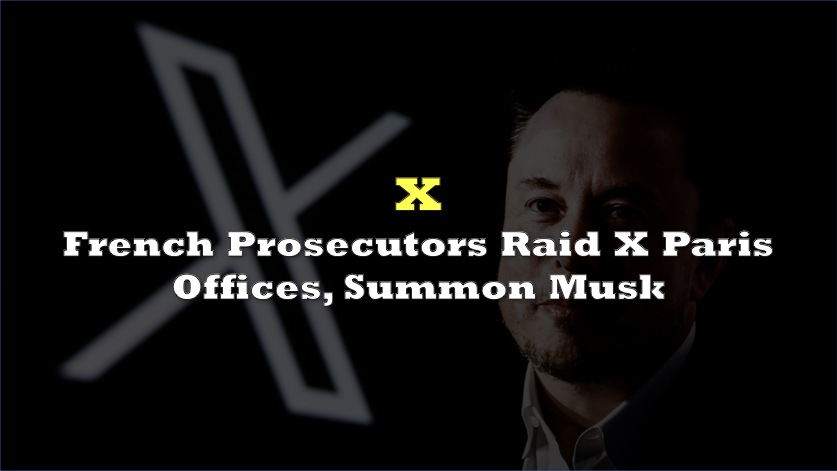

French prosecutors raided the Paris offices of Elon Musk’s X on Tuesday, escalating a preliminary cybercrime investigation that now spans alleged child sexual abuse imagery, sexually explicit deepfakes, Holocaust denial, and suspected manipulation of automated data processing systems tied to organized activity.
The Paris prosecutor’s office said its cybercrime unit opened the investigation in January last year and is examining alleged “complicity” in possessing and distributing pornographic images of minors, alongside additional alleged offenses including denial of crimes against humanity and manipulation of an automated data processing system as part of an organized group.
JUST IN: 🇫🇷🇪🇺 France & Europol raid Elon Musk's X office in Paris. pic.twitter.com/nkqRWdS5pT
— BRICS News (@BRICSinfo) February 3, 2026
Prosecutors asked Musk and former CEO Linda Yaccarino to attend “voluntary interviews” on April 20, and also summoned X employees during the same week to be heard as witnesses.
Yaccarino served as CEO from May 2023 until July 2025.
The prosecutor’s office publicly announced the ongoing searches at X’s offices in France and signaled a communications break from the platform itself, posting that it was leaving X while urging followers to join it on other social media.
In parallel, prosecutors described the investigation as being conducted on a “constructive approach” intended to ensure X complies with French law while operating in France.
Europol confirmed it is supporting French authorities in the matter, without detailing the scope of that support. 
The inquiry began after reports by a French lawmaker alleging biased algorithms on X were likely distorting the functioning of an automated data processing system. Prosecutors later broadened the probe after Musk’s AI chatbot Grok generated posts alleged to deny the Holocaust and spread sexually explicit deepfakes.
One widely shared post in French attributed to the chatbot asserted that gas chambers at Auschwitz-Birkenau were designed for “disinfection with Zyklon B against typhus” rather than mass murder, phrasing commonly associated with Holocaust denial. Holocaust denial is a crime in France.
In subsequent posts, the chatbot acknowledged the earlier reply was wrong, said it had been deleted, and pointed to historical evidence that Zyklon B in Auschwitz gas chambers was used to kill more than 1 million people.
The chatbot has faced prior controversy for antisemitic comments, and Musk’s company removed posts that appeared to praise Adolf Hitler following complaints.
The case also lands amid broader EU pressure. The bloc’s executive arm opened an investigation last month after the chatbot spewed nonconsensual sexualized deepfake images on the platform, and Brussels has already fined X €120 million for failures under EU digital rules, including “blue checkmarks” described as violating restrictions on “deceptive design practices” that risk exposing users to scams and manipulation.
X did not immediately respond to a request for comment.
Earlier this year, UK has announced plans to open an investigation and threatened to take control of Grok chatbot if X fails to stop users from creating sexualized images of women and children through the artificial intelligence tool.
If found in violation, X could face fines of up to £18 million or 10% of its global revenue.
Meanwhile in the US, last December 2025, the Department of Defense said it has formally entered an agreement with xAI to embed xAI’s “frontier AI systems,” based on the Grok family of models, directly into its GenAI.mil platform, with initial deployment targeted for early 2026.
Information for this story was found via Associated Press and the sources and companies mentioned. The author has no securities or affiliations related to the organizations discussed. Not a recommendation to buy or sell. Always do additional research and consult a professional before purchasing a security. The author holds no licenses.