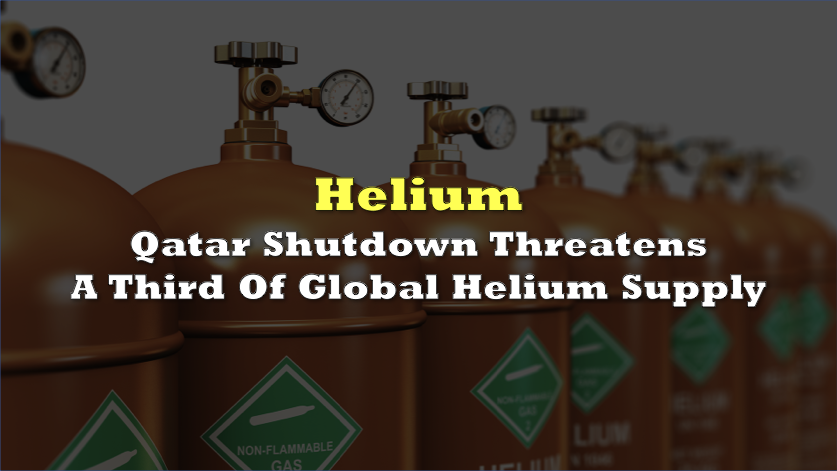

The immediate risk to semiconductors is no longer just demand concentration around AI memory but a physical helium bottleneck after Qatar’s shutdown at Ras Laffan took about one-third of global production offline and stranded pre-filled containers as the Strait of Hormuz effectively closed.
Helium is embedded in daily fab operations across multiple steps, including thermal management, wafer cooling, leak detection, and carrier-gas use during etching. Unlike neon, which caused disruptions after Russia’s 2022 invasion of Ukraine but could be replaced within months through other steelmaking-linked sources, helium has no viable substitute in chip manufacturing and no fast workaround.
In the current market, that means HBM and server DRAM for AI customers. Conventional DDR5, DDR4, and NAND for PCs and smartphones would likely absorb a disproportionate share of any cuts. In other words, the existing AI-first allocation would harden further, not because demand improved, but because a critical manufacturing input became scarce.
Good piece on Bloomberg Intelligence and for those with HELIUM exposure.
— Baron Investments (@baroninvestment) March 12, 2026
• Qatar’s shutdown of LNG production has taken about a third of global helium production offline, affecting chipmakers who rely on helium for semiconductor manufacturing.
• Helium has no… pic.twitter.com/cpIdwL4jD3
In a 2023 public comment to the USGS, the Semiconductor Industry Association said helium used by the semiconductor industry comes predominantly from Qatar and Russia. The US remains the world’s largest producer, but about two-thirds of US output is consumed domestically.
South Korea is the clearest pressure point because it produces roughly two-thirds of global memory chips and sourced 64.7% of its helium imports from Qatar last year.
Qatar’s Helium 4 project, expected in 2027 and previously the next major supply addition, is being built at Ras Laffan itself, meaning the same conflict now disrupting current flows may also delay future capacity.
Meanwhile, Russia’s Amur facility was designed to eventually cover roughly 30% of global demand, but it is still ramping and remains constrained by Western sanctions. USGS data cites Russia supplies only 9% of global helium in 2025.
No major chipmaker is yet reporting direct production losses. SK Hynix says it has diversified supply chains and holds sufficient inventory. TSMC says it does not expect a significant impact and Korean chipmakers are estimated to have as much as six months of helium stockpiles.
The downstream numbers are already weak without a helium shock. IDC forecasts worldwide PC shipments will decline 11.3% in 2026 and smartphone shipments will fall 12.9%.
Information for this story was found via the sources and companies mentioned. The author has no securities or affiliations related to the organizations discussed. Not a recommendation to buy or sell. Always do additional research and consult a professional before purchasing a security. The author holds no licenses.