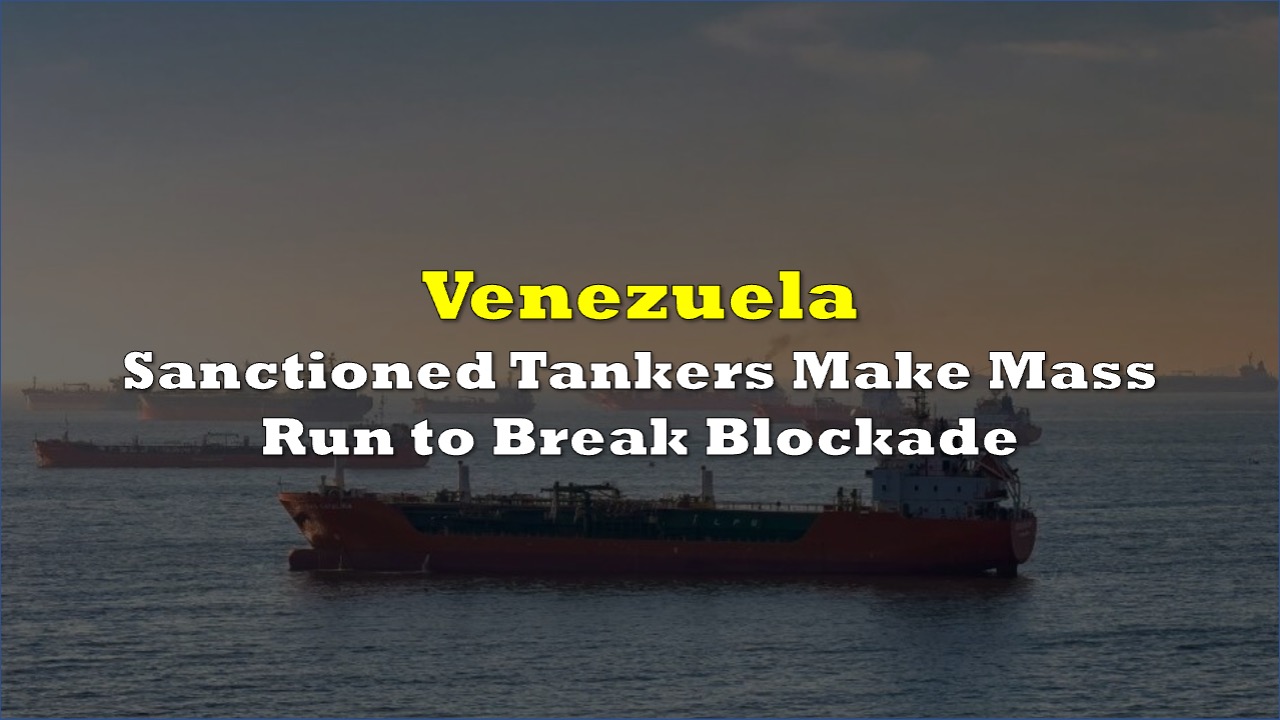

Up to 16 sanctioned tankers carrying Venezuelan crude slipped past the US blockade on Saturday and Sunday using “dark mode” tactics and coordinated departures, according to monitoring service TankerTrackers.com — hours before the storage crisis would force Venezuela to begin cutting oil production.
The tankers, loaded with an estimated 12 million barrels of oil, departed without authorization from Venezuela’s interim government, using techniques employed by the modern “ghost fleet” of sanction-skirting vessels.
BREAKING: Multiple oil tankers hit by U.S. sanctions appear to be making a coordinated attempt to break the U.S. naval blockade on Venezuela’s energy exports by departing all at once. w/ @AKurmanaev https://t.co/iOzyxz9r5b
— Christiaan Triebert (@trbrtc) January 5, 2026
At least four tankers were confirmed via satellite heading east about 30 miles offshore, carrying 4 million barrels of crude and fuel. The remaining 12 vessels turned off their tracking systems and haven’t been located since departure.
Three tankers departed Saturday — the same day as Maduro’s capture — with more following Sunday. By the time PDVSA began asking joint ventures to cut production on Sunday due to the storage crisis, the tanker fleet had already made its run.
“The only real way for oil-laden tankers to break through a naval blockade is to overwhelm it with outbound vessels,” TankerTrackers.com co-founder Samir Madani told The New York Times.
The tankers pulled a classic ghost fleet move:
Bertha painted “Ekta” on its hull and spoofed its location to Nigeria. Veronica III used the alias “DS Vector,” also claiming Nigeria. Aquila II transmitted as “Cape Balder” while pretending to be in the Baltic Sea. Vesna sailed as “Priya” and was satellite-spotted heading northeast in the Atlantic, 25 miles west of Grenada
The tankers were contracted by oil traders Alex Saab and Ramón Carretero, both under US sanctions for Maduro business ties. Saab served as Maduro’s industry minister before Saturday’s capture. The ships left without authorization from interim president Delcy Rodríguez.
About a dozen tankers loaded with Venezuelan oil departed from the country in dark mode, seemingly breaking a US blockade, https://t.co/HiarHQQtNy said. The ships are under sanctions. A separate group of vessels also under sanctions left the country empty https://t.co/LqaG1IXuqq
— Marianna Párraga (@mariannaparraga) January 5, 2026
The tanker breakout came as PDVSA faced a storage crisis. By Sunday, onshore storage had hit 45% of capacity, and more than 17 million barrels sat in floating storage offshore with nowhere to go.
On Sunday, PDVSA began cutting production and shutting down oilfields, with workers at joint venture Sinovensa preparing to disconnect up to 10 well clusters.
The tanker departures could provide temporary relief — if the vessels successfully reach their destinations, likely China.
Read: Trump Promised to Ramp Up Venezuela Oil — Instead, Production Is Being Cut
Despite the tanker exodus, the Trump administration insisted the blockade remains in force.
“We have a quarantine right now which sanctions oil shipments,” Secretary of State Marco Rubio said Sunday. “We will seize it. That remains in place.”
President Trump on Saturday said “the embargo on all Venezuelan oil remains in full effect,” though he added that China would continue receiving oil owed by Venezuela.
Related: Are Oil Giants Ghosting Trump on Venezuela?
Whether the tankers reach their destinations — likely China — or face interdiction remains unclear. The US Coast Guard has seized two Venezuelan oil shipments since December.
Information for this story was found via the sources and companies mentioned. The author has no securities or affiliations related to the organizations discussed. Not a recommendation to buy or sell. Always do additional research and consult a professional before purchasing a security. The author holds no licenses.