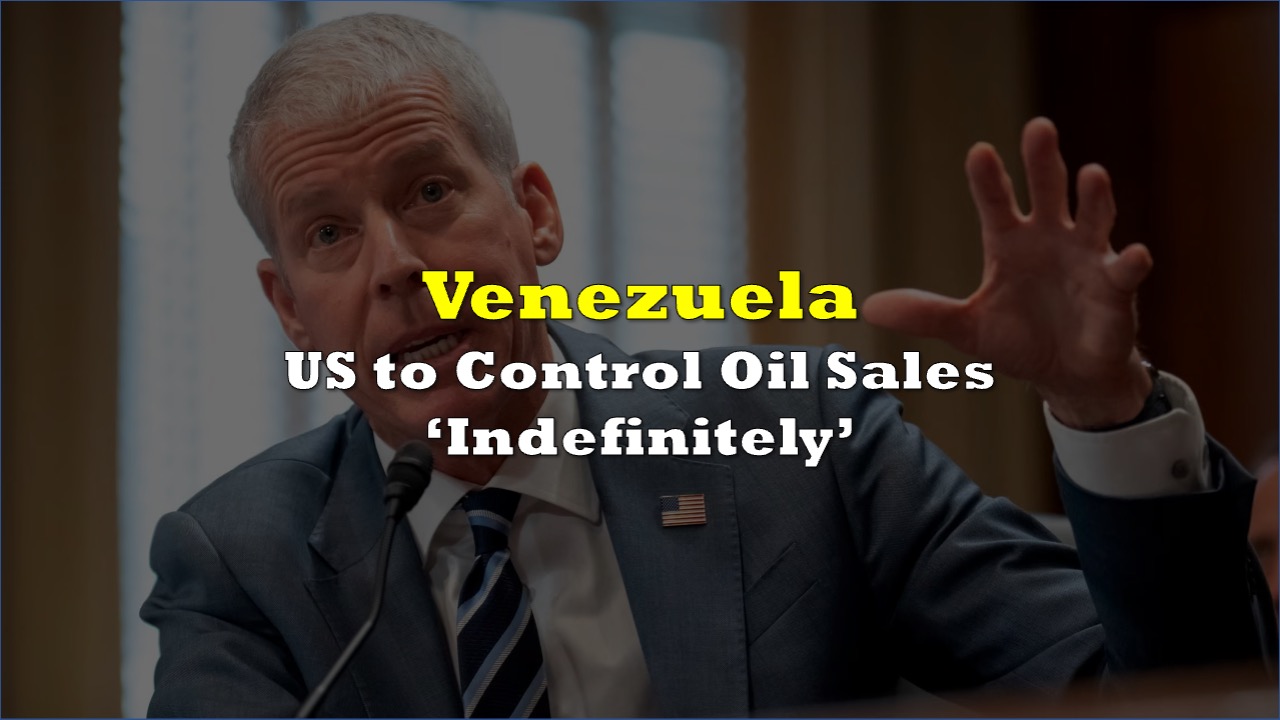

The US will control the sale of Venezuelan oil “indefinitely” rather than simply seizing stockpiled barrels, Energy Secretary Chris Wright said Wednesday, outlining a plan that would give Washington sweeping authority over the country’s petroleum industry.
“We’re going to market the crude coming out of Venezuela — first this backed up stored oil and then indefinitely, going forward, we will sell the production that comes out of Venezuela into the marketplace,” Wright told the Goldman Sachs energy conference in Miami.
The announcement expands significantly beyond President Trump’s Tuesday statement that Venezuela would turn over 30 to 50 million barrels of sanctioned oil. Wright described those barrels as merely “the first tranche” and said the US would control ongoing production indefinitely.
Revenue Through Offshore Accounts
Wright said all sales would be “done by the US government and deposited into accounts controlled by the US government.” The funds would then “flow back into Venezuela to benefit the Venezuelan people, but we need to have that leverage and that control of those oil sales to drive the changes that simply must happen in Venezuela.”
 Sponsored · Selkirk Copper Mines
He did not detail how much revenue would ultimately return to Venezuela.
Administration officials later told members of Congress the money would be placed in bank accounts outside the US Treasury — what sources described to PBS as “off-shore” accounts — according to five bipartisan congressional officials. The Energy Department said funds would go into “globally recognized banks to guarantee the legitimacy and integrity of the ultimate distribution of proceeds.”
A Republican Senator told PBS NewsHour correspondent Lisa Desjardins the rationale is that the US wants to show it does not own the proceeds from the oil while still controlling them — so the money goes to banks to hold at US direction rather than directly to the Treasury. A senior White House official later clarified that “no decisions have been made and discussions are ongoing.”
The plan also calls for the US to supply diluent — a light crude required to thin Venezuela’s extra-heavy oil for transport. “We will have the US as the supplier of diluent that has to come down there to enable that production,” Wright said.
PDVSA Says It’s Still Negotiating
Hours after Wright’s announcement, Venezuela’s state oil company PDVSA said it is in “negotiations” with the United States to sell Venezuelan oil, suggesting the arrangement is not finalized.
The company said talks are “for the sale of volumes of oil, within the framework of the commercial relations that exist between both countries” and would be conducted “under schemes similar to those in place with international companies, such as Chevron.”
Wright’s comments suggest the US views the arrangement as already decided. “I’m working directly in cooperation with the Venezuelans,” he said, adding that the Energy Department considers oil sales to have begun “immediately.”
Congressional Scrutiny and Constitutional Questions
The plan drew immediate criticism from Democrats and raised concerns about executive authority over federal spending.
“The bottom line is this — their plan is insane,” Senator Chris Murphy of Connecticut said. “Take Venezuela’s oil at gunpoint and use it run the country from DC. America is nation building again.”
Senator Chris Van Hollen of Maryland said “the president cannot grab Venezuela’s oil for his own slush fund,” noting that the Constitution vests spending power with Congress, not the executive branch.
The offshore account structure raised particular alarm among lawmakers, who questioned how the government would oversee the money and track its distribution. “I have never in my entire life in public service and as a former Office of Management and Budget employee, ever heard of anything like this,” said Representative Melanie Stansbury of New Mexico.
Infrastructure Rebuild Required
Wright described Venezuelan oil infrastructure as “not good” after “decades of under-investment, decades of corruption.” He said the US would enable imports of “parts and equipment and services to kind of prevent the industry from collapsing, stabilize the production, and then as quickly as possible, start to see it growing again.”
Several hundred thousand barrels per day could begin flowing in the “short to medium term,” Wright said.
Venezuela currently produces about 800,000 barrels per day, down from 3.5 million barrels daily in the late 1990s before the socialist government took control. The country sits atop 303 billion barrels of proven reserves — about 17% of the global total — but 86% consists of extra-heavy crude requiring specialized refineries.
Storage tanks onshore are near capacity, and approximately 22 million barrels sit in ships offshore, unable to sail for China due to the US blockade, according to data from Kpler reported by Bloomberg.
Control as Leverage
“If we control the flow of oil, the sales of oil and the flow of the cash that comes from those sales, we have large leverage,” Wright told the conference. “But without large leverage, as we’ve seen in the last 25 years, you don’t get change.”
“We want to change the game in Venezuela, fix the country so it’s a productive member of the Western Hemisphere, so it’s an ally of the United States and a major supplier of oil to the world,” he said. “But the old ways weren’t working.”
Wright insisted the US is “not taking their oil” but rather controlling its sale and the resulting revenue to force changes in how Venezuela’s oil industry operates.
WTI crude oil prices fell around 2% Wednesday following Wright’s announcement.
Information for this story was found via the sources and companies mentioned. The author has no securities or affiliations related to the organizations discussed. Not a recommendation to buy or sell. Always do additional research and consult a professional before purchasing a security. The author holds no licenses.