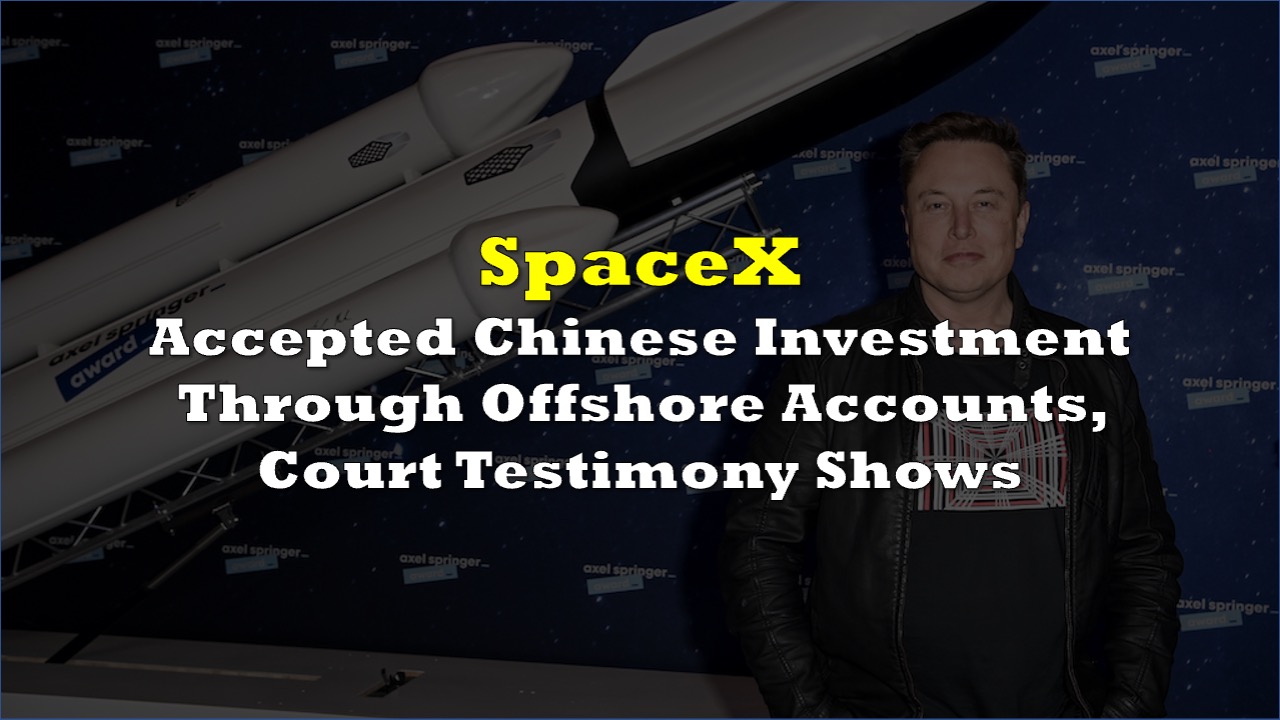

SpaceX allowed Chinese entities to invest in the aerospace company through offshore accounts, according to court testimony unsealed last October that has prompted congressional scrutiny of the defense contractor.
Iqbaljit Kahlon, a longtime SpaceX investor, testified in a Delaware lawsuit that Chinese investors hold direct stakes in the company. “They obviously have Chinese investors to be honest,” Kahlon said, confirming some are “directly on the cap table,” referring to the company’s list of shareholders.
🚨 Musk and SpaceX secretly knew China was a major investor in the company since 2015 and failed to disclose the information to Space Force and NASA
— Roger (@rdd147) February 9, 2026
Tesla $TSLAhttps://t.co/QrlIp3My8F
The testimony represents the first public disclosure of direct Chinese ownership in SpaceX, though investigators had previously reported indirect stakes through intermediary funds. Court records show SpaceX has been aware of potential Chinese investment since 2015.
SpaceX handles highly sensitive government work, launching spy satellites for the Pentagon and transporting astronauts for NASA. The company holds billions in Defense Department contracts, including a $5.9 billion launch service agreement. White House and US embassy facilities use the company’s Starlink internet service.
Senators Elizabeth Warren and Andy Kim wrote to Defense Secretary Pete Hegseth last week requesting a Pentagon review of SpaceX. “The mere proposition that an adversary nation such as China could have leverage and influence over a company such as SpaceX, one that underpins our national security apparatus, is an unacceptable risk,” the senators said.
Kahlon testified that SpaceX prefers avoiding Chinese investors but makes an exception for investments routed through offshore vehicles in locations like the Cayman Islands and British Virgin Islands. “The primary mechanism is that those investors would come through intermediate entities that they would create or others would create,” Kahlon said.
Bret Johnsen, SpaceX’s chief financial officer, testified that the company maintains no formal policy barring investments from adversarial nations, including China, Russia or North Korea. He said fund managers receive guidance to “stay away” from such ownership interests because they could “make it more challenging to win government contracts.”
Court records detail a 2021 transaction where a Shanghai-based company called Leo Group sent Kahlon $50 million to invest in SpaceX. Kahlon promised the firm quarterly business updates, facility visits, and opportunities to interview SpaceX’s CFO. SpaceX canceled the arrangement after Leo disclosed the deal in a regulatory filing that generated coverage in Chinese business media.
“This is not helpful for our company as a government contractor,” Johnsen testified about the publicity. “It, in essence, arms our competitors with something to use as a narrative against us.”
House Democrats sent a letter to Hegseth in May 2025 expressing concern about SpaceX’s “potential obfuscation” of foreign investment. “In light of the extreme sensitivity of SpaceX’s work for DoD and NASA, this lack of transparency raises serious questions,” lawmakers wrote.
Federal law requires companies to report Chinese investments only in limited circumstances, and regulations lack definitive thresholds for acceptable foreign ownership levels. The government can investigate and block transactions deemed national security threats, though this authority typically excludes passive investments representing small company stakes.
Elon Musk holds an estimated 42% stake in SpaceX, valued at approximately $168 billion.
Warren and Kim set a February 20 deadline for the Pentagon’s response to their inquiry.
Information for this story was found via the sources and companies mentioned. The author has no securities or affiliations related to the organizations discussed. Not a recommendation to buy or sell. Always do additional research and consult a professional before purchasing a security. The author holds no licenses.