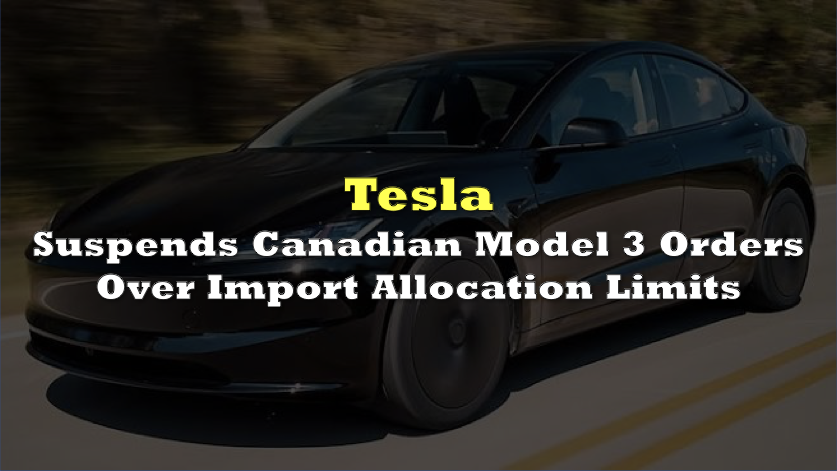

Canada’s plan to turn Chinese electric-vehicle access into an incentive for domestic investment is facing an immediate market test, with Tesla suspending orders for its lower-priced Model 3 variants even as most of Ottawa’s import allowance remains unused.
The dispute centres not on the 49,000-vehicle annual ceiling, but on who is allowed to use it. Global Affairs Canada’s tracker recorded 15,931 vehicles against that quota since March 1, leaving 33,069 available, or roughly 67.5% of the total.
The imbalance is sharper in the September-to-February window. Canada carried 8,897 unused places forward from the first six months, raising the second-period allowance to 33,397. Only 328 vehicles had entered under that allowance as of October 9.
 Sponsored · Cambria Gold Mines
Tesla stopped accepting Canadian orders on October 12 for the Shanghai-built Model 3 Premium rear-wheel-drive and all-wheel-drive variants, according to reporting by Drive Tesla and Electrek.
The automaker says its import allocation is exhausted, and orders may not resume until March 2027 unless more capacity is granted. The US-built Model 3 Performance remains orderable.
The legal framework leaves considerable room for administrative discretion. Notice to Importers 1168, issued August 29, says permits are issued on a first-come, first-served basis.
Its Section 3.4.6 also allows Global Affairs Canada to reserve capacity to provide equitable access, including for new automakers. The notice publishes no manufacturer-specific ceilings.
That distinction surfaced Tuesday when Tesla Canada public-policy executive Iain Myrans said on LinkedIn that automakers receive advance guidance from the government on maximum import volumes, as reported by Drive Tesla.
Global Affairs Canada spokesperson Rachael Dolan subsequently told Drive Tesla that Ottawa is consulting companies about the remaining quota and reviewing the program to inform a longer-term framework aimed at attracting joint ventures, Canadian supply-chain activity, and jobs.
The department declined to identify companies or anticipated shipments, citing commercial confidentiality. It neither confirmed nor denied a company-specific Tesla cap.
The import framework stems from Canada’s January arrangement with China. It replaced a 100% surtax with a 6.1% tariff for eligible vehicles within the quota. Ottawa plans to increase the annual ceiling by 6.5%, with future provisions favouring cheaper vehicles, according to government documents.
The timing has prompted suggestions of political retaliation after Prime Minister Mark Carney said in September he wanted to reduce reliance on Elon Musk’s Starlink service, and Musk advocated Quebec, Alberta, and Saskatchewan separatism on October 7.