
A recent thread on X (fka Twitter) by Dr. Sylvain Charlebois of the Agri-Food Analytics Lab at Dalhousie University, more commonly known on the platform as The Food Professor, has revealed a significant discrepancy in the Bank of Canada’s initial assessment of the impact of the carbon tax on inflation. He showed that the impact of the carbon tax on inflation is much higher than initially reported.
A month ago, the Bank of Canada released a statement, claiming that the carbon tax was responsible for a minimal 0.15% increase in inflation. This assessment led to questions and concerns about the overall impact of the carbon tax on the Canadian economy.
Dalhousie University decided to delve deeper into the matter and sought an explanation for the seemingly low percentage. The thread pointed out that the initial calculations were excessively narrow in scope, prompting further investigation.
 Sponsored · Silver47 Exploration Inc.
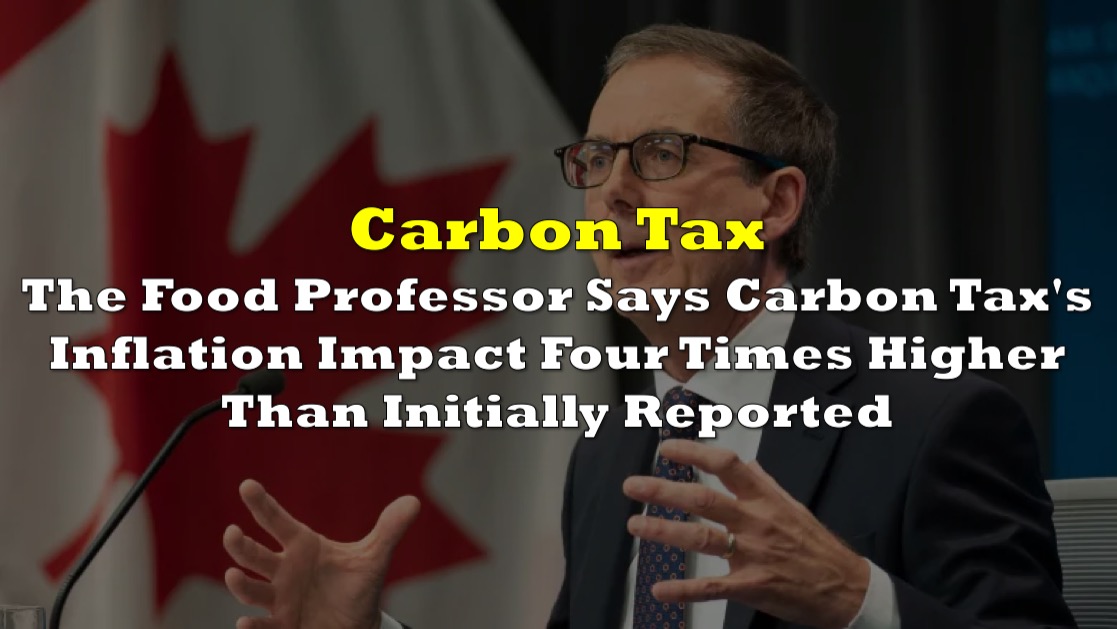
“However, just yesterday, the Governor [Tiff Macklem] revised this figure to a staggering 0.6%, which, when considering the compounding impact of the tax over a four-year period, represents a fourfold increase. With the current inflation rate standing at 3.8%, the Bank of Canada now contends that the carbon tax contributes to a substantial 16% of our current inflation rate,” Dr. Charlebois said.
This adjustment highlights the significant impact of the carbon tax on inflation and indicates that the earlier estimate by the Bank of Canada may have provided a misleading representation of its effects. The potential implications for the Canadian economy and its citizens are substantial.
In his thread, Dr. Charlebois reminded Canadians that no reporters had requested the Bank of Canada for its carbon tax coefficient calculations until Dalhousie University took the initiative to do so. This initiative demonstrates the importance of independent research and analysis to uncover the truth behind significant economic policies.
The overarching message from Dr. Charlebois is clear: “Canadians are willing to do their part to address climate challenges, but they deserve honesty” from policymakers. If addressing climate change comes at a cost, policymakers should be straightforward with the public.
 Sponsored · Selkirk Copper Mines
In his tweet, Dr. Charlebois also cited a Canadian economist who, on October 7, stated that “The impact of climate on food prices is at least an order of magnitude bigger than the impact of the carbon tax.” However, this statement was made without any empirical calculations regarding how carbon pricing is affecting food inflation.
Furthermore, on September 21, another Canadian economist highlighted that “the carbon tax is responsible for less than one percent of the increases in grocery prices.” It’s worth noting that this estimate was made without any empirical evidence within the context of the Canadian market.
The Bank of Canada responded to Dr. Charlebois’s thread, essentially disputing his characterization of the adjusted figures.
“We have not revised our calculations. The figures 0.15 and 0.6 are answers to two different questions,” the X account of the central bank replied.
The bank explained that at a meeting of the Finance Committee, Macklem reiterated that 0.15 percentage points of the current inflation rate can be attributed to the carbon tax increase that was implemented in April.
He went on to estimate the potential implications of reducing the carbon tax to zero, considering a scenario where it would go from the current rate of $65 per ton to nothing. According to Macklem’s estimations, this change would result in a substantial reduction in the inflation rate, suggesting that cutting the carbon tax to zero would decrease the inflation rate by approximately 0.6 percentage points for a year.
However, the explanation seems to be not enough for Dr. Charlesbois, who noted that the bank’s X posts didn’t have the actual clips from Macklem’s testimony.
Information for this briefing was found via the sources mentioned. The author has no securities or affiliations related to this organization. Not a recommendation to buy or sell. Always do additional research and consult a professional before purchasing a security. The author holds no licenses.