OpenAI has hit back at Elon Musk’s lawsuit by releasing a series of emails showing the Tesla CEO’s past support for the company’s shift to a for-profit model and even a proposal to merge with Tesla.
The saga between Musk and OpenAI, the AI company famed for its ChatGPT chatbot, traces back to its origins. Originally co-founded by Musk as a non-profit entity, tensions arose when Musk left OpenAI’s board in 2018, citing concerns over potential conflicts with Tesla’s AI efforts.
The crux of the matter appears to be a competition for AI talent between the two entities, coupled with disagreements over OpenAI’s direction on AI safety and its transition from a non-profit to a for-profit organization.
 Sponsored · Selkirk Copper Mines
Musk’s recent legal action against OpenAI, accusing the company of prioritizing profits over its original mission for the public good, prompted a swift response from OpenAI. The company took to its blog, outlining plans to dismiss Musk’s claims and providing evidence to support its stance.
“We’re sad that it’s come to this with someone whom we’ve deeply admired—someone who inspired us to aim higher, then told us we would fail, started a competitor, and then sued us when we started making meaningful progress towards OpenAI’s mission without him,” the firm said in its blog.
Musk’s push for for-profit
Musk famously left the firm in 2018 highlighting his uneasiness in OpenAI shifting into a for-profit entity, asserting in an interview that “it does seem weird that something can be a non-profit and somehow transform itself into a for-profit closed source.”
However, OpenAI’s rebuttal includes emails exchanged between Musk and the company, revealing a history of support for a for-profit model. Back in 2015, Musk apparently suggested announcing an initial $1 billion funding commitment to OpenAI, significantly more than the initial plan of $100 million, to “avoid sounding hopeless.”
 Sponsored · Cambria Gold Mines
However, despite Musk’s contributions totaling less than $45 million, and over $90 million from other donors, OpenAI realized by early 2017 that achieving Artificial General Intelligence (AGI) would require vast amounts of compute and capital.
“We all understood we were going to need a lot more capital to succeed at our mission—billions of dollars per year, which was far more than any of us, especially Elon, thought we’d be able to raise as the non-profit,” the firm added.

According to the released correspondence, discussions between Musk and OpenAI in late 2017 centered around creating a for-profit entity, with Musk expressing interest in majority equity, initial board control, and even the CEO position.
“We couldn’t agree to terms on a for-profit with Elon because we felt it was against the mission for any individual to have absolute control over OpenAI,” the blog explained.
However, tensions arose when Musk withheld funding, prompting intervention from Reid Hoffman to ensure the company’s operational continuity.
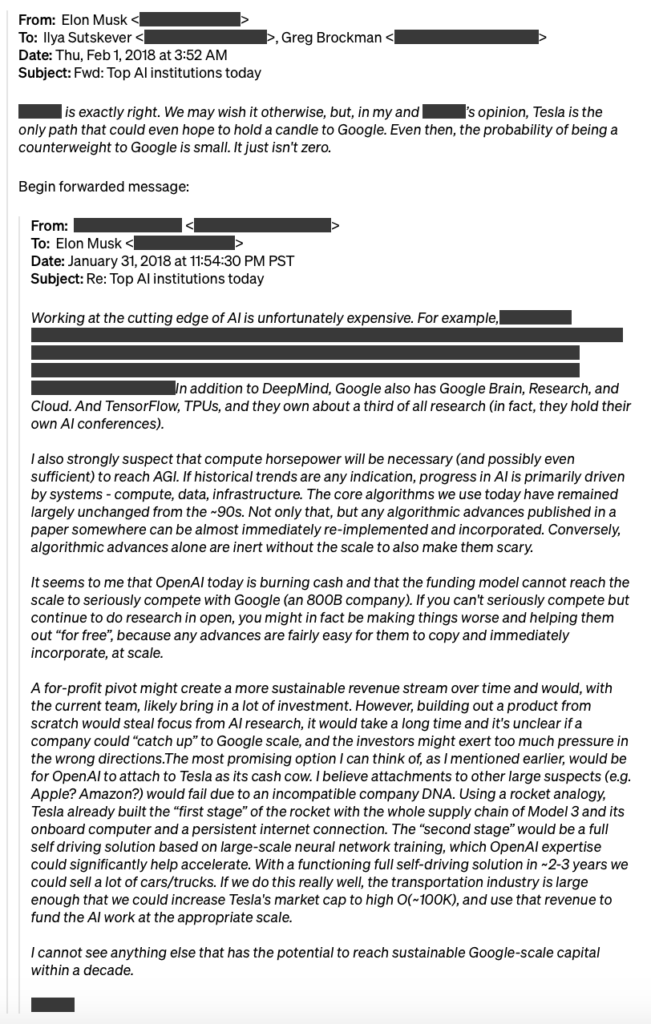
Amidst the standoff, Musk suggested an alternative approach: merging OpenAI with Tesla. In early 2018, Musk forwarded an email proposing the merger, asserting that Tesla could serve as a financial backbone for OpenAI. Musk himself endorsed the idea, describing it as “exactly right” in an email exchange with an unnamed party, whose identity remains redacted.
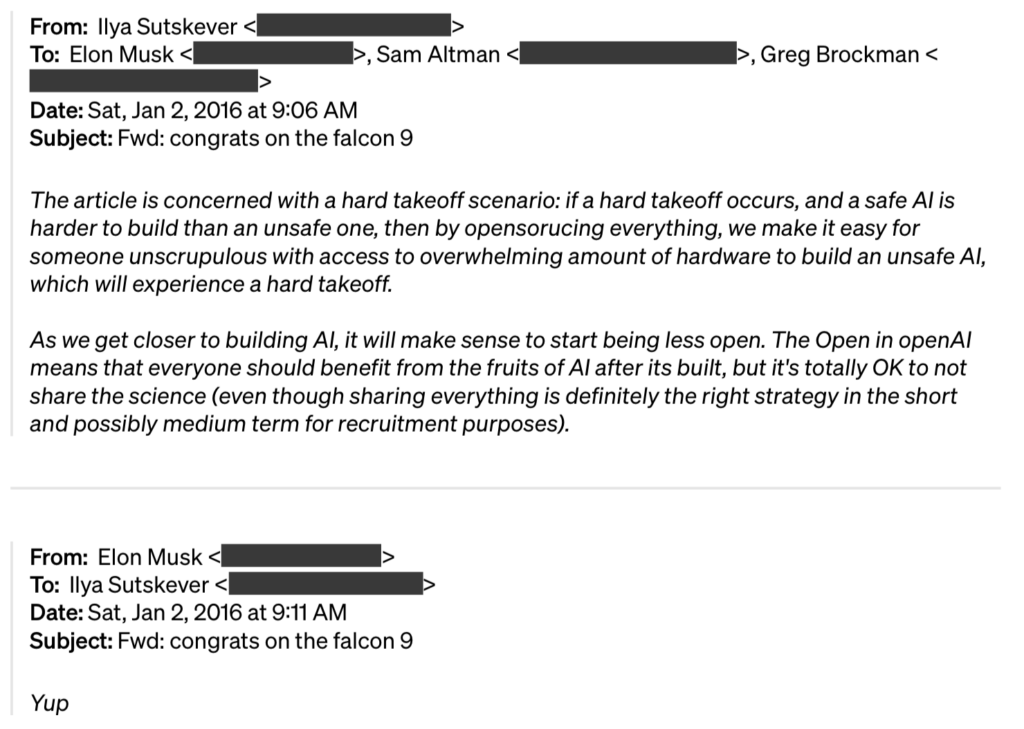
While Musk has actively criticized OpenAI for not being “open”, it was revealed that he himself agreed that the science behind the firm should “start being less open.” OpenAI said in its blog that they continue “provide broad access to today’s most powerful AI, including a free version that hundreds of millions of people use every day.”
The firm argued that Musk understood that the mission didn’t require open-sourcing Artificial General Intelligence (AGI), acknowledging that openness should benefit everyone once AI is built, but sharing scientific details may not be necessary.
“As Ilya told Elon: ‘As we get closer to building AI, it will make sense to start being less open. The Open in openAI means that everyone should benefit from the fruits of AI after its built, but it’s totally OK to not share the science…’, to which Elon replied: ‘Yup’,” the firm explained.
Even in his retort to OpenAI’s blog, Musk is still asserting that the firm chooses to be “closed” and as such, should change their name.
Even when Musk left, OpenAI said that it understood the Tesla chief is leaving because “there needed to be a relevant competitor to Google/DeepMind and that he was going to do it himself” within Tesla
“When he left in late February 2018, he told our team he was supportive of us finding our own path to raising billions of dollars. In December 2018, Elon sent us an email saying ‘Even raising several hundred million won’t be enough. This needs billions per year immediately or forget it’,” the firm said.
Years after, Musk started a new artificial intelligence start-up to compete with OpenAI, while highlighting about the safety of GPT-style models, warning that as they become more advanced, they’ll be increasingly susceptible to political bias.
Last December, Musk had X.AI–stemming from his Twitter purchase–to raise up to $1 billion in an equity offering. This comes after the firm unveiled a chatbot named Grok, inspired by “The Hitchhiker’s Guide to the Galaxy.” Grok, equipped with two months of training, boasts real-time knowledge of the internet, and the company claims it is designed to answer questions with humor and a rebellious streak, differing from most other AI systems.
X.AI aims to position itself in direct competition with industry players such as ChatGPT creator OpenAI, Google’s Bard technology, and Anthropic’s Claude chatbot.
Information for this briefing was found via Electrek and the sources mentioned. The author has no securities or affiliations related to this organization. Not a recommendation to buy or sell. Always do additional research and consult a professional before purchasing a security. The author holds no licenses.