
A closed-door meeting between senior Pentagon officials and Pope Leo XIV’s then-ambassador to the United States in January has sparked a public dispute between the Trump administration and the Holy See, with both sides offering sharply conflicting accounts of what was said.
What happened
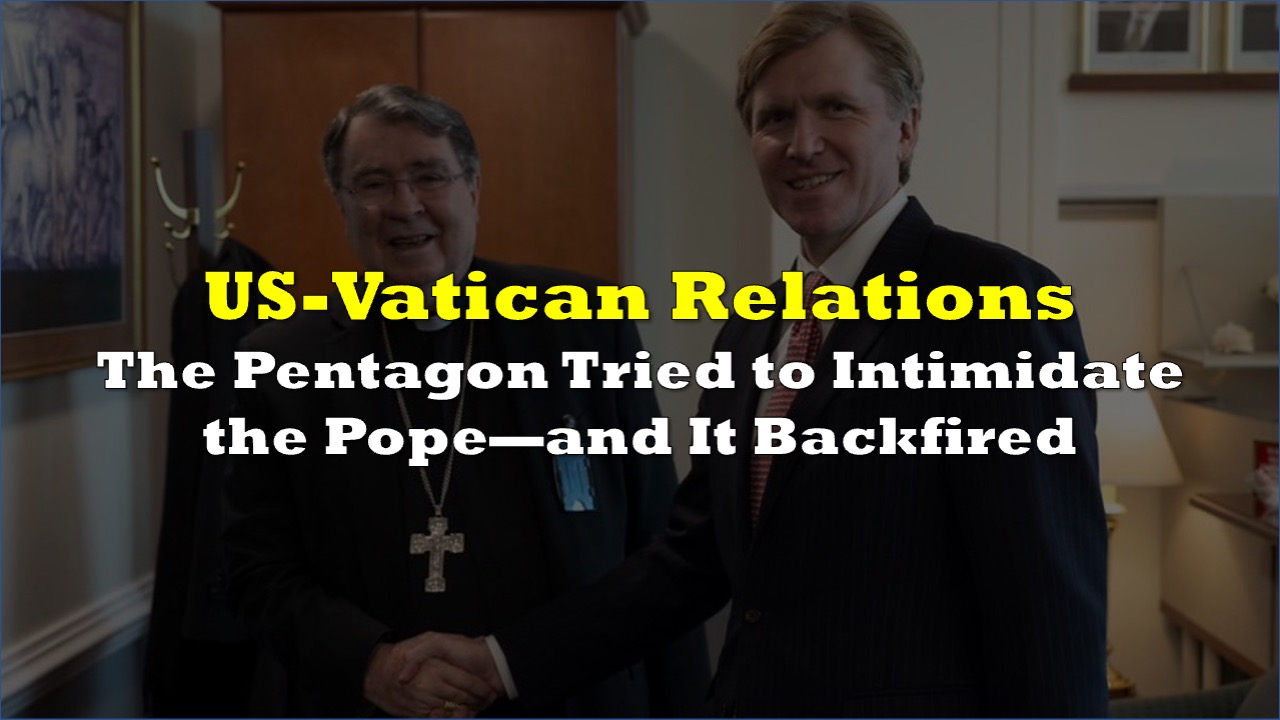
On January 22, Undersecretary of Defense for Policy Elbridge Colby summoned Cardinal Christophe Pierre — then the Vatican’s top diplomat in Washington — to a closed-door session at the Pentagon. The Free Press first reported the meeting on April 6, drawing on accounts from both Vatican and US officials briefed on the exchange.
The meeting followed a January 9 address by Pope Leo XIV to the Vatican’s diplomatic corps, in which he warned that “a diplomacy that promotes dialogue and seeks consensus among all parties is being replaced by a diplomacy based on force.” Pentagon officials read the speech as a direct challenge to the administration’s foreign policy, including its military campaign against Iran and its assertion of hemispheric dominance under what the White House calls the “Donroe Doctrine.”
According to the Free Press, Colby told Pierre, “The United States has the military power to do whatever it wants in the world. The Catholic Church had better take its side.” A separate, unidentified official then invoked the Avignon Papacy — a 14th-century period during which the French monarchy brought the papacy under its dominion, forcing it out of Rome and into Avignon — a historical analogy Vatican officials read as a veiled threat of physical subjugation of the Holy See.
The fallout
The Vatican canceled Pope Leo XIV’s planned July 4 visit to the United States for the country’s 250th anniversary celebrations. Vice President JD Vance had personally extended that invitation in May 2025, two weeks after Leo’s election. The pope instead announced he would spend July 4 in Lampedusa — a small Sicilian island known as a primary landing point for migrants crossing the Mediterranean from North Africa.
Pope Leo XIV, born Robert Francis Prevost, is the first American-born pope in history.
Disputed accounts
The Department of Defense confirmed the January 22 meeting took place but rejected the Free Press account as “highly exaggerated and distorted,” saying the session was “substantive, respectful, and professional.”
Under Secretary of War for Policy Elbridge Colby @USWPColby had a substantive, respectful, and professional meeting with Cardinal Pierre, the then-Papal Nuncio, and his team on January 22, 2026. During the cordial meeting, they discussed a range of topics, including issues of… pic.twitter.com/McI0sB2wKC
— DOW Rapid Response (@DOWResponse) April 9, 2026
Vatican officials offered a more nuanced picture. A senior official in Rome told The Pillar that the meeting grew “tense” at moments, describing the US side as “aggressive” and “bullying” at points — while still maintaining that “there was no question of anybody threatening anyone.”
That same official said no one at the Vatican Secretariat of State could confirm that the Avignon Papacy reference was made.
A source close to the pope described the session to NBC Chicago as “most unpleasant and confrontational.” US Ambassador to the Holy See Brian Burch posted on X that Pierre — now based in Rome following his retirement from the Washington post in March — personally told him the media characterizations were “fabrications” that were “just invented,” and that “there were no threats of any kind.”
Absolute bombshell. Pope Leo directly rebukes Pete Hegseth for trying to frame the Iran war as a Christian holy crusade. The Pope declares God will not listen to their prayers because their hands are full of blood. A devastating moral condemnation of the Pentagon. pic.twitter.com/KBCqog1XGM
— Furkan Gözükara (@FurkanGozukara) March 30, 2026
The Catholic Herald separately reported that sources indicated the disputed remarks — if made — did not come from Colby himself but from another Department of Defense representative present at the meeting.
Vance, speaking in Budapest, said he had not seen the reporting and would speak with both Pierre and US officials before drawing any conclusions.
Reporter: There is reporting that Pentagon officials brought in Cardinal Christophe Pierre and told him the American military can do whatever they want and the church should get on its side
— Acyn (@Acyn) April 8, 2026
Vance: I don’t know who Cardinal Christophe Pierre Is pic.twitter.com/78bHiqbrTA
Pope Leo XIV has spoken out repeatedly against the US-led war against Iran, calling the conflict unjust during a Palm Sunday address on March 29. He has also criticized the spread of “a zeal for war” among world powers and called Trump’s threats against Iran “unacceptable.”
I am glad Pope Leo speaks English so he can scold Trump for his illegal war against Iran, which is killing innocent victims and violates true Christian values. #PopeLeo @Pontifex @VaticanNews #CatholicChurch https://t.co/5h1Y9LDftd
— @RGBAtlantica (@RGBAtlantica) April 8, 2026
The Holy See has declined to characterize the meeting in detail. Holy See Press Office director Matteo Bruni acknowledged the reports in Rome on April 9 but offered no specific comment, saying only that “the pope’s words are more recent” and that he had “no specific answers to offer.” The Apostolic Nunciature confirmed only that the meeting took place and that “current affairs” were discussed.
Information for this story was found via The Free Press, The Pillar, The Catholic Herald, Newsweek, the US Department of Defense, and the sources and companies mentioned. The author has no securities or affiliations related to the organizations discussed. Not a recommendation to buy or sell. Always do additional research and consult a professional before purchasing a security. The author holds no licenses.