
Toyota, the world’s second-largest carmaker, has announced a significant technological breakthrough in battery development that could revolutionize the electric vehicle (EV) industry. The company claims to have made advancements that will enable it to reduce the weight, size, and cost of batteries by half, potentially leading to faster charging times and increased driving range.
Toyota had already been working on introducing advanced solid-state batteries in its cars by 2025. These batteries, which use a solid electrolyte instead of a liquid one, offer several advantages over traditional liquid-based batteries. Solid-state batteries have the potential to reduce charging times, increase capacity, and mitigate the fire risk associated with lithium-ion batteries.
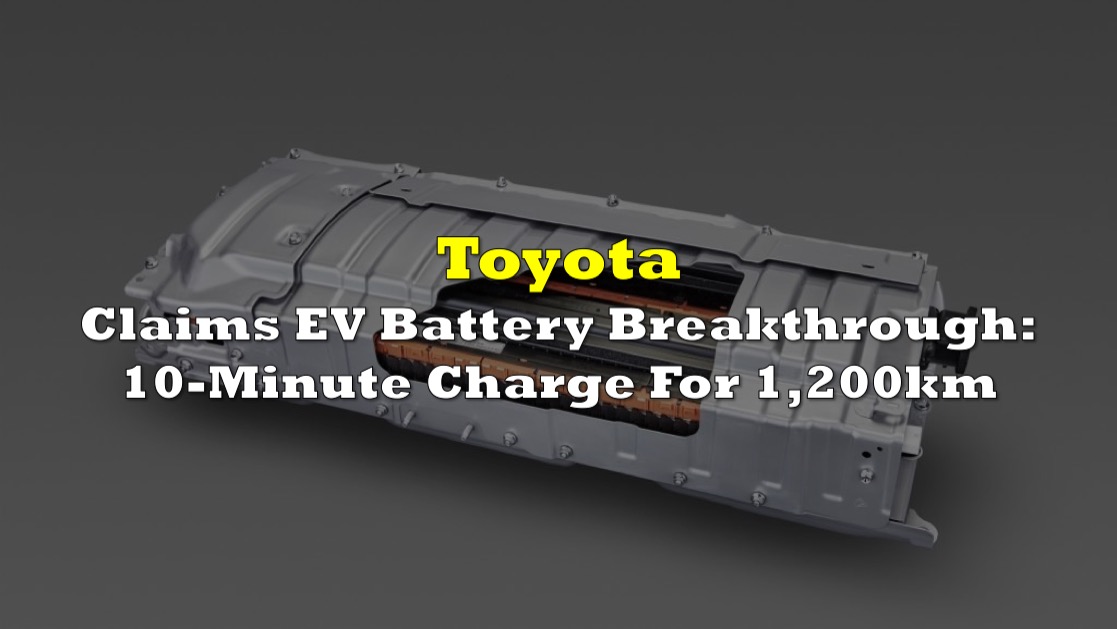
The recent breakthrough involves simplifying the production process of the material used in solid-state batteries, making them more practical and cost-effective. Toyota believes it can now manufacture solid-state batteries with a range of 1,200 kilometers (745 miles) that can charge in 10 minutes or less.
 Sponsored · Selkirk Copper Mines
“For both our liquid and our solid-state batteries, we are aiming to drastically change the situation where current batteries are too big, heavy and expensive,” said Keiji Kaita, president of Toyota’s research and development centre for carbon neutrality. “In terms of potential, we will aim to halve all of these factors.”
This advancement could be a gamechanger for the EV industry, according to David Bailey, a professor of business economics at the University of Birmingham.
“Often there are breakthroughs at the prototype stage but then scaling it up is difficult,” Bailey said. “If it is a genuine breakthrough it could be a gamechanger, very much the holy grail of battery vehicles.”
While solid-state batteries have been hailed as a gamechanger, they have been challenging and costly to produce, hindering their commercial application. However, Toyota believes it can simplify the production process, potentially making solid-state batteries easier and cheaper to manufacture than lithium-ion batteries.
 Sponsored · Cambria Gold Mines
Toyota aims to commercialize solid-state batteries and incorporate them into electric vehicles as early as 2027. This revised timeline replaces the previous target of 2025, demonstrating Toyota’s commitment to bringing this technology to market.
The development of solid-state batteries has attracted significant interest from various automakers. BMW plans to test solid-state cells this year, while Nissan aims to produce a vehicle using solid-state battery technology by 2028. Start-ups like QuantumScape and established companies like Dyson have also been investing in solid-state battery development.
Despite Toyota’s previous resistance to fully embracing electric vehicles, the company sees the potential of solid-state technology to enhance its EV lineup. However, Toyota’s executives maintain that they are not solely relying on solid-state batteries and anticipate further advancements in liquid lithium-ion battery technology.
Toyota’s recent battery breakthrough aligns with the company’s efforts to revamp its image as an EV laggard and address shareholder concerns about its position in the global electric vehicle race. The company has showcased its ambitions for next-generation batteries and new manufacturing methods to streamline EV production.
While some shareholders have questioned the lack of specific details about the breakthrough, Toyota remains committed to its target date of 2027. The company’s chief technology officer, Hiroki Nakajima, affirms that they have a solid basis for the timeline but acknowledges the challenges that lie ahead.
Information for this story was found via The Guardian, Financial Times, and the sources mentioned. The author has no securities or affiliations related to the organizations discussed. Not a recommendation to buy or sell. Always do additional research and consult a professional before purchasing a security. The author holds no licenses.