
In a significant announcement made on Thursday, Prime Minister Justin Trudeau revealed that the government is implementing a carve-out for the carbon tax concerning home heating oil. This move is part of a multifaceted strategy aimed at addressing environmental concerns while supporting Canadian households.
Under this policy adjustment, the government will exempt home heating oil from the carbon tax for a period of three years. In addition to this exemption, there will be a doubling of the rural supplement in the rebate program. Trudeau also outlined new programs designed to assist rural Canadians in transitioning to electric heat pumps.
It is worth noting that the three-year period ends almost exactly just one year after the federal elections in October 2025.
Trudeau emphasized the significance of this move, stating, “This is an important moment where we’re adjusting policies so that they have the right outcome. We are doubling down on our fight against climate change and keeping true to the principles that we’re supporting Canadians while we fight climate change,” during a press conference.
 Sponsored · Selkirk Copper Mines
While the exemption applies across the nation, Trudeau highlighted the specific benefits this policy will bring to Atlantic Canada. In this region, approximately 30% of homeowners still rely on furnace oil for heating.
“We’ve heard clearly from Atlantic Canadians through our amazing Atlantic MPs that since the federal pollution price came into force… certain features of that pollution price needed adjusting to work for everyone,” Trudeau stated, surrounded by a number of Liberal MPs from the region.
The federal carbon tax applies to provinces and territories without adequate carbon pricing systems. Households in these regions receive a rebate to offset the tax. The carbon tax took effect in the Atlantic provinces in July, following Ottawa’s determination that provincial alternatives were insufficient.
Trudeau explained that the temporary exemption is intended to provide rural Canadians with additional time to transition to alternative energy sources like electric heat pumps. To facilitate this transition, the government allocated $250 million to assist low-income households in switching from fossil fuels to cleaner energy sources.
Trudeau remarked, “We are switching to heat pumps off home heating oil as a region in Atlantic Canada and as a country.”
The government also provides a supplement to residents of rural and small communities, which increases rebates by 10% to account for heightened energy needs and reduced access to transportation options. This supplement will be further increased to 20% in April.
The current carbon tax is set at $65 per tonne of emissions and is scheduled to increase by $15 annually until 2030.
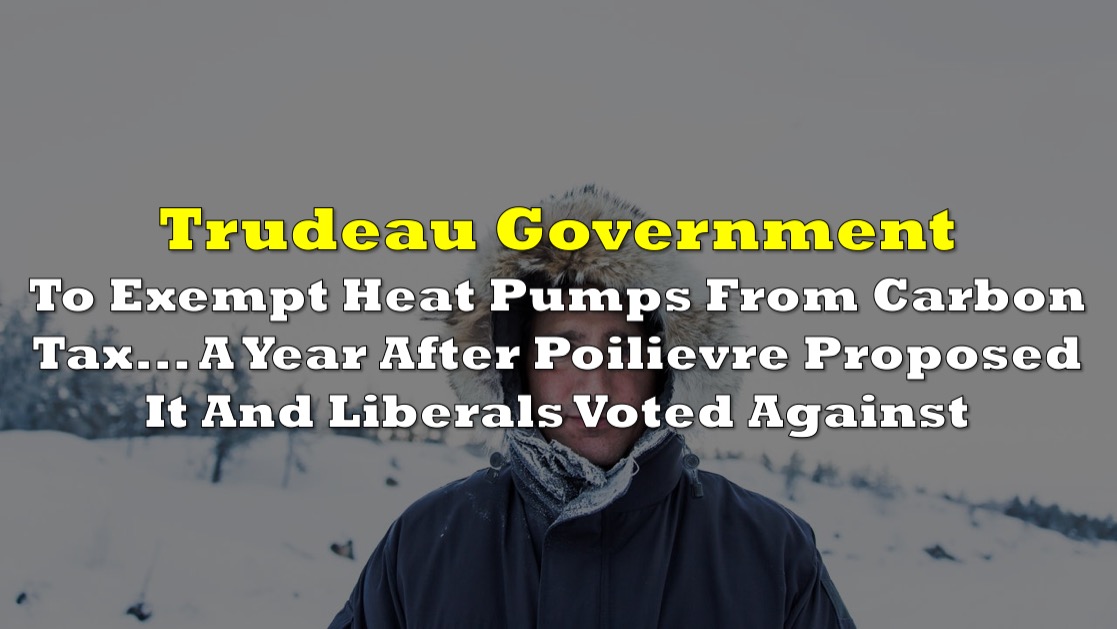
Poilievre was here first
Trudeau’s announcement comes at a time when the Liberal Party is polling behind the Conservatives, led by Pierre Poilievre. Poilievre has consistently used the carbon tax as a focal point of his criticism against the Liberals, organizing an “axe the tax” rally in Windsor, N.S.
Last year, the Conservatives proposed a non-binding motion to eliminate the carbon tax on home heating fuel, with most Liberal MPs voting against it. Responding to Trudeau’s recent announcement, Poilievre took to social media, accusing the Prime Minister of reversing his stance on the carbon tax.
“After plummeting in the polls, a flailing, desperate Trudeau is now flipping and flopping on the carbon tax,” Poilievre posted.
Additionally, NDP MPs Laurel Collins and Charlie Angus issued a joint statement, expressing concern that Trudeau’s decision was motivated primarily by political considerations in Atlantic Canada. They called on Trudeau to go further by removing the GST on home heating fuel and investing in cleaner energy sources.
Trudeau has been under pressure from provincial premiers and some of his own MPs to address the rising cost of fuel. Atlantic Liberal MPs, in particular, have expressed concerns about the carbon tax’s impact on their constituents.
When asked if the announcement was aimed at preserving Liberal seats in Atlantic Canada, the Prime Minister insisted that Canadians across the country would benefit from the suspension of the carbon tax on home heating oil and the new programs being introduced.
“People across the country are going to benefit from the suspension of the price on pollution on home heating oil and benefit from the programs we’re putting in place,” he said.
Heat pumps don’t work in cold climates, according to Trudeau’s own government
MP’s Kody Blois of Nova Scotia and Ken McDonald of Newfoundland and Labrador have been vocal advocates for a rural carbon tax carve-out. McDonald, in fact, voted twice in favor of Conservative motions calling for the tax’s repeal.
“Everywhere I go, people come up to me and say … ‘We’re losing faith in the Liberal Party,'” McDonald stated in an interview.
Blois, who chairs the Liberal Atlantic Caucus, credited his Atlantic colleagues for driving this policy change. Last year, the four Atlantic premiers had urged the federal government to delay a new clean fuel standard, which took effect in July, arguing that it would increase fuel costs.
The exemption, however, might be short-lived because as Natural Resources Canada’s Energy Star publication pointed out itself, “the vast majority of air-source heat pumps have a minimum operating temperature, below which they are unable to operate.” For newer models, this temperature point is estimated to be between -15°C to -25°C; anything below would require a supplemental system.
The heat pump’s efficiency in transferring heat from the outdoor air to the house is contingent on the external temperature. As the outdoor temperature decreases, the heat pump’s capacity to capture heat diminishes as well.
In numerous air-source heat pump setups, there exists a specific temperature, referred to as the thermal balance point, at which the heat pump’s heating ability matches the heat loss experienced by the house. When the outdoor ambient temperature falls below this point, the heat pump can only provide a portion of the heat necessary to maintain a comfortable indoor environment, necessitating the use of supplementary heating.

In colder places, like the majority of the country where temperature can go below -30°C, ground-source heat pump systems are recommended “to operate more efficiently because they take advantage of warmer and more stable ground temperatures.” Air-conditioning brand Carrier estimates a geothermal heat pump, including installation, can range from $12,000 to $45,000.
Nonetheless, according to Mitsubishi Electric, cold climate heat pumps have the capability to function in temperatures as low as -30°C and even lower. Martin Kegel, an engineer overseeing heat pump-related initiatives at Natural Resources Canada’s CanmetENERGY research center, attributes this extended operating range to advancements in technology, enabling the heat pump’s compressor to modulate its speed. This feature enhances efficiency across a broader spectrum of temperatures and has subsequently been integrated into conventional heat pumps as well.
Despite these improvements, heat pumps typically encounter challenges in maintaining efficiency and consistent operation when temperatures drop below -30°C, necessitating the use of a supplementary heating source.
Latest polling data from 338Canada predicts that the Conservatives will win 205 seats in the House in the next election, up from the last week’s polling of 194 seats and a huge jump from their current 117 seats. Meanwhile, Liberals are expected to retain only 81 seats in the latest poll, down from 90 seats in last week’s poll and a big decline from the current 158 seats they have.
Information for this briefing was found via CBC and the sources mentioned. The author has no securities or affiliations related to this organization. Not a recommendation to buy or sell. Always do additional research and consult a professional before purchasing a security. The author holds no licenses.