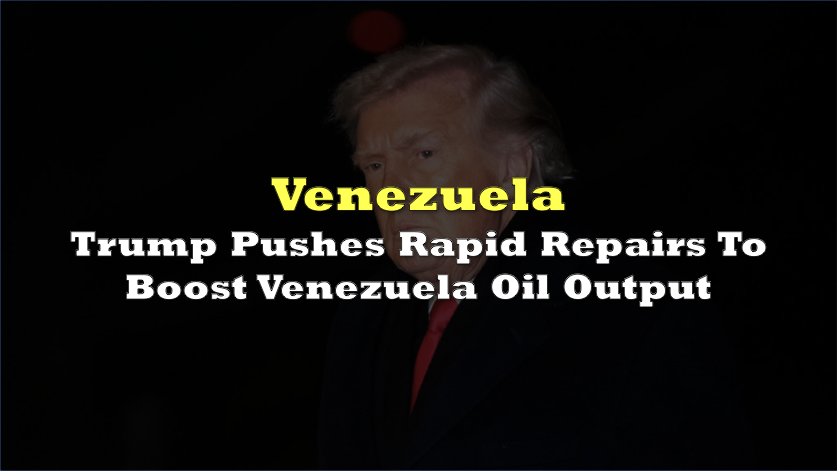

The Trump administration wants near-term Venezuelan crude gains through rapid repairs and workovers rather than a total industry rebuild, betting limited investment can lift production by several hundred thousand barrels per day.
Senior administration officials said the US is talking with Chevron, other crude producers, and major oilfield service providers about a “go-fast” plan focused on repairing or replacing broken and outdated equipment and refreshing older drilling sites. The approach is framed as a fraction of the estimated $100 billion cost of a complete rebuilding.
Contractors including SLB, Baker Hughes, and Halliburton would concentrate initial efforts on rehabilitating existing wells, repairing artificial lift pumps, and installing electric turbines at remote fields, according to the officials. SLB is described as the largest service company that has remained active in-country, while other US contractors could be cleared to join initial phases.
The short-term logic is incremental barrels with minimal upfront spend. Officials said state-of-the-art US equipment and techniques could revitalize existing wells and bring new production online within months, after years in which sanctions and underinvestment throttled operations. Analysts cited near-term “low-hanging fruit,” even as longer-term goals are positioned as far more difficult.
Longer term, Trump’s stated objective is to move Venezuela closer to its 1970 output peak of roughly 3.75 million barrels per day from current production of less than 1 million barrels per day, according to the same account. Analysts cited in the plan say that scale would take at least a decade, which is why the policy emphasis is on fast fixes first.
Trump linked Venezuelan crude flows to domestic politics and global leverage. Officials said additional Venezuelan supply could help check crude and gasoline prices and expand US leeway to move against Iran without jolting markets, with midterm elections in November described as a key political milestone.
Trump told reporters on Air Force One that Venezuelan crude sales would “bring down oil prices even further,” and argued US drilling is already at historic highs, positioning Venezuela supply as additive to market influence. The plan’s cashflow pitch is that faster exports could generate funds that support rebuilding the country.
Chevron’s near-term plan is anchored on existing joint ventures with PDVSA. Vice Chairman Mark Nelson said Jan. 9 the company would initially leverage what is already on the ground and aims to raise JV production by 50% within 18 to 24 months, from about 240,000 barrels per day currently. Chevron said it is ready to help Venezuela “build a better future while strengthening US energy and regional security.”
Service companies are already mapping the operational bottlenecks. Halliburton’s Francisco Tarazona said the objective is “quick wins” and immediate production recovery, while CEO Jeff Miller told investors the company can mobilize in weeks.
Baker Hughes CEO Lorenzo Simonelli said the company has the largest installed base of rotating and artificial lift equipment in Venezuela, critical where crude is in remote areas lacking reliable electricity. Weatherford CEO Girish Saligram called Venezuela a massive opportunity and “the most interesting development” for the industry in a long time.
Risks remain central to the commercialization path. Officials said interest is tempered by concerns about political stability and worker safety, and industry leaders have stressed the need for financial and security guarantees from the US, which Energy Secretary Chris Wright was described as appearing to foreclose in a Bloomberg TV interview.
Scale incentives are large if activity ramps. Citigroup estimated that when Venezuela produced about 3 million barrels per day it ran roughly 75 rigs, and returning to that pace would imply about $10 billion in drilling and completion spending, plus another $750 million per year for artificial lift and chemicals. Luisa Palacios said Venezuela could be heading back to 1.5 million barrels per day.
Information for this story was found via Bloomberg and the sources and companies mentioned. The author has no securities or affiliations related to the organizations discussed. Not a recommendation to buy or sell. Always do additional research and consult a professional before purchasing a security. The author holds no licenses.