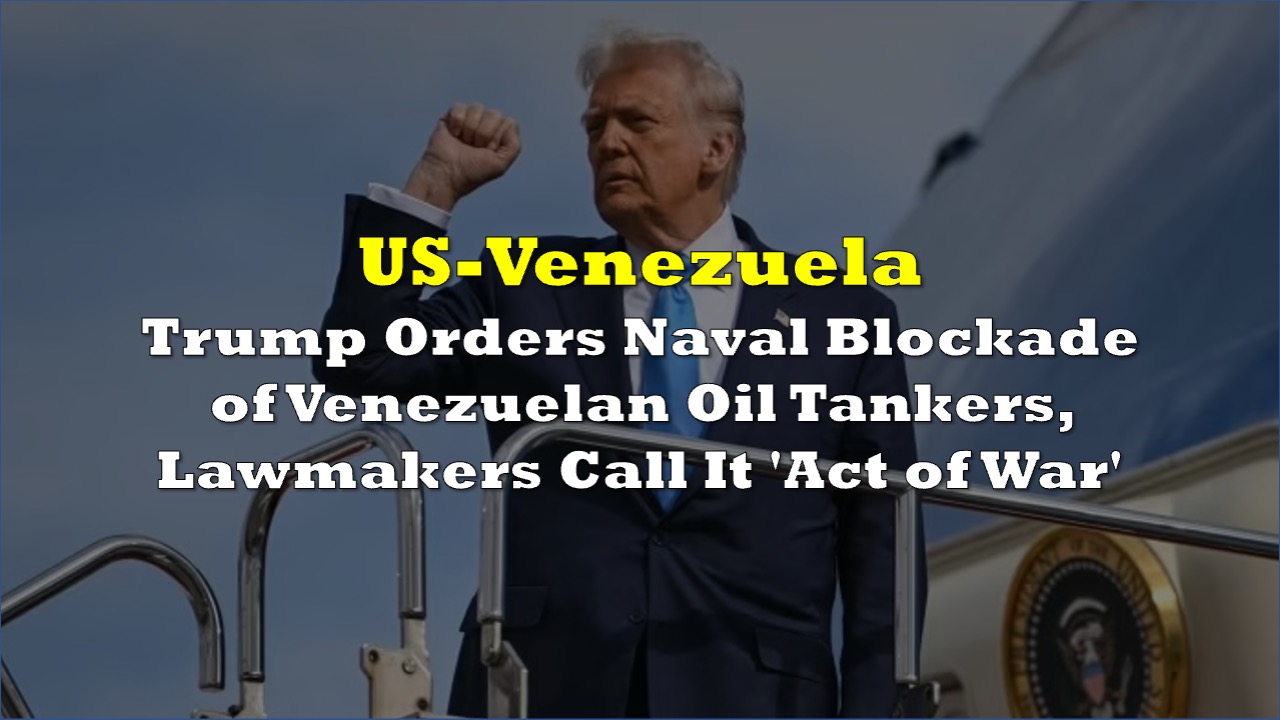

President Donald Trump ordered a blockade of all sanctioned oil tankers entering and leaving Venezuela on Tuesday, designating the Venezuelan government a foreign terrorist organization and escalating US military pressure in what lawmakers describe as an act of war.
Trump announced the move on Truth Social, declaring Venezuela is surrounded by the largest US naval force ever assembled in South American history. The order follows last week’s seizure of the Skipper oil tanker off Venezuela’s coast, with 11 US Navy ships now operating in the region, including the aircraft carrier USS Gerald R. Ford.
Rep. Joaquin Castro, D-Texas, condemned the blockade on social media Tuesday, writing that a naval blockade constitutes an unquestionable act of war that Congress never authorized. The House will vote Thursday on a bipartisan War Powers resolution introduced by Castro, Rep. Jim McGovern, D-Mass., and Rep. Thomas Massie, R-Ky., directing Trump to end hostilities with Venezuela.
A naval blockade is unquestionably an act of war.
— Joaquin Castro (@JoaquinCastrotx) December 17, 2025
A war that the Congress never authorized and the American people do not want.
On Thursday, the House will vote on @RepMcGovern, @RepThomasMassie, and my resolution directing the President to end hostilities with Venezuela.… https://t.co/9wp2iiZuYk
International law experts note that blockades are considered acts of war. A 1961 Justice Department memo stated that a blockade is a belligerent act ordinarily justified only if a state of war exists.
Venezuela’s government rejected what it called a grotesque threat and violation of international law. Venezuelan Ambassador Samuel Moncada delivered a letter to the UN Security Council formally denouncing the tanker seizure as state piracy.
Venezuela produces approximately 1 million barrels of oil daily, exporting about 850,000 barrels. China purchases roughly 80 percent of Venezuelan oil exports, while Chevron Corp. accounts for 15 to 17%, and Cuba receives the remainder.
Energy analysts project modest oil market impact. Andy Lipow of Lipow Oil Associates told CNBC that a full embargo would affect 800,000 to 900,000 barrels per day and could raise prices by $2 to $3 per barrel. However, China may continue purchasing Venezuelan oil despite US sanctions, given the discounted prices.
The US military has killed at least 95 people in 25 strikes on vessels in the Caribbean and eastern Pacific since September. White House Chief of Staff Susie Wiles confirmed in a Vanity Fair interview that the administration wants to keep blowing boats up until Maduro cries uncle, acknowledging the campaign aims for regime change.
President Trump just embargoed Venezuela oil heading to China. It's go time.
— Financelot (@FinanceLancelot) December 17, 2025
All eyes on China embargoing Taiwan $NVDA chips 👀 https://t.co/WpRe0rGHo3 pic.twitter.com/1kpGOQtYUM
Trump demanded in his Tuesday post that Venezuela return oil, land, and other assets to the United States, though he did not explain why the US has a claim to Venezuelan resources. He wrote that the naval force will only get bigger, and the shock to Venezuela will be like nothing they have ever seen before.
Information for this story was found via the sources and companies mentioned. The author has no securities or affiliations related to the organizations discussed. Not a recommendation to buy or sell. Always do additional research and consult a professional before purchasing a security. The author holds no licenses.