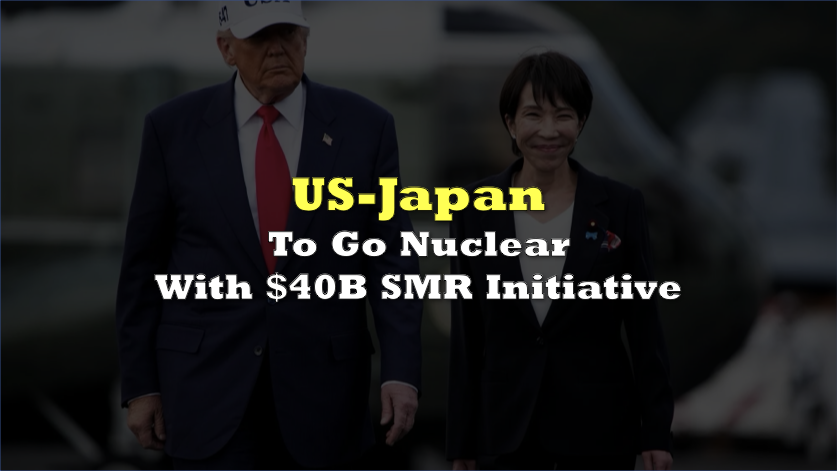

President Donald Trump and Prime Minister Sanae Takaichi are expected to unveil a nuclear power initiative in the southern US that would see GE Vernova and Hitachi build BWRX-300 small modular reactors.
The project’s stated economic case is power price stability and dispatchable generation at a time when electricity demand is rising alongside the race to build energy-intensive artificial intelligence data centers. The White House official cited the reactors as part of a broader push to reinforce US leadership in global technology competition and support industrial growth with on-demand power rather than intermittent supply alone.
The deal is notable for scale relative to prior announcements under the same framework. Last month, Washington and Tokyo announced three first-round projects totaling $36 billion, including a US oil export terminal, a gas-fired power plant, and a synthetic diamond manufacturing facility.
At up to $40 billion, the reactor package on its own would exceed the combined value of that first batch, marking the latest flagship deployment under the bilateral $550 billion investment fund tied to their trade pact.
The BWRX-300 is a small modular reactor design with lower capacity than a traditional 1 gigawatt-class reactor, but it is being promoted as faster to site, finance and build than conventional nuclear projects that often require about a decade. That speed proposition is central to the political and commercial pitch, because no SMR has yet been added to the US grid and the domestic market still lacks an operating proof point.
For Washington, Trump is likely to present the project as evidence that tariffs and trade pressure are pulling industrial capital into the US. He previously described the megafund projects as possible only because of “TARIFFS,” linking the investment pipeline directly to his tariff strategy that’s being challenged domestically.
For Tokyo, the trade framework locks in a more favorable tariff environment for auto exports and formalizes economic alignment with the US while creating a channel for direct investment into strategic sectors. It offers Japan a more structured route for large cross-border industrial commitments after the contentious path taken by a Japanese firm’s effort to acquire US Steel, which Trump eventually approved.
Information for this story was found via Bloomberg and the sources and companies mentioned. The author has no securities or affiliations related to the organizations discussed. Not a recommendation to buy or sell. Always do additional research and consult a professional before purchasing a security. The author holds no licenses.