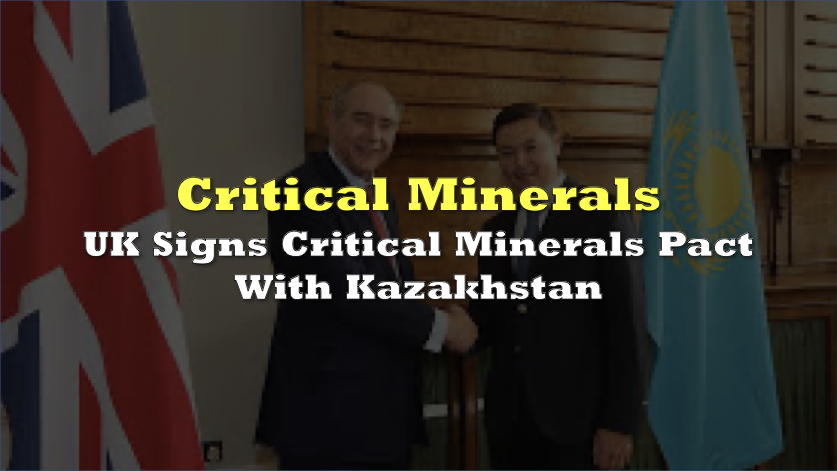

Britain has moved to harden its critical-minerals supply chain by signing a memorandum of understanding with Kazakhstan, using a London summit with five Central Asian states to advance a sourcing strategy explicitly aimed at reducing dependence on concentrated foreign supply and, by extension, China.
The agreement was unveiled as Foreign Secretary Yvette Cooper hosted foreign ministers from Kazakhstan, Kyrgyzstan, Tajikistan, Turkmenistan, and Uzbekistan at Lancaster House.
At the core of the push is Britain’s diversification target. The UK’s Vision 2035 critical minerals strategy says no more than 60% of the country’s annual demand should come from any one country by 2035.
Kazakhstan is described as producing 22 of the 36 minerals Britain classifies as vital in the cited strategy framework, giving London access to a jurisdiction that can potentially cover a broad share of its critical-mineral basket through one bilateral channel.
The country supplies more than 40% of global uranium, ranks among the leading titanium producers, and sits in the top tier of exporters for copper and zinc.
The memorandum itself was signed by Kazakhstan Deputy Industry Minister Olzhas Saparbekov and UK Trade Minister Chris Bryant during the summit. Cooper said the agreements are intended to deliver for British businesses, strengthen economic security, and demonstrate UK support for the independence of Central Asian states.
That language moves around a geopolitical context as Chinese firms have already invested heavily in Kazakh copper, aluminum, and rare-earth projects.
The pressure point is rare earths. Shortages are centered on niche but high-value elements such as yttrium and scandium, which are critical to defense technology, aerospace systems, and semiconductors, while production remains overwhelmingly concentrated in China.
Information for this story was found via Zero Hedge and the sources and companies mentioned. The author has no securities or affiliations related to the organizations discussed. Not a recommendation to buy or sell. Always do additional research and consult a professional before purchasing a security. The author holds no licenses.