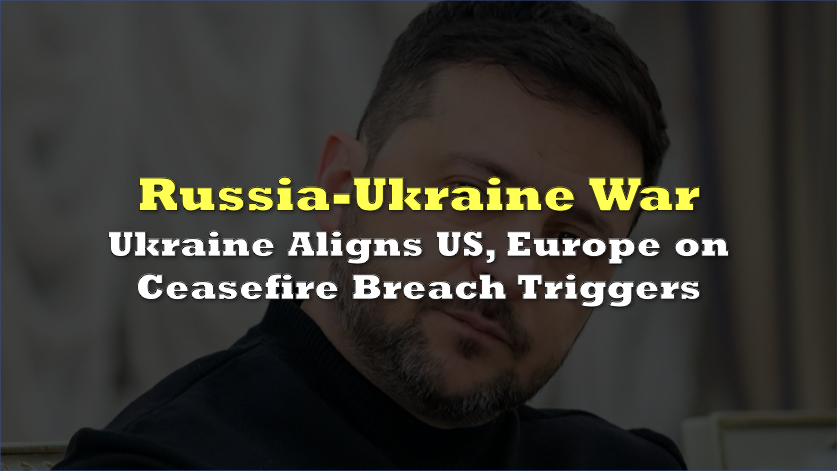

Ukraine has agreed with European and American partners to a multi-tier enforcement plan in which persistent Russian ceasefire violations would trigger escalating responses inside 24 hours and potentially a coordinated western-backed military response within 72 hours.
The enforcement ladder begins at the first breach: a response within 24 hours that starts with a diplomatic warning plus whatever action the Ukrainian army needs to halt the infraction.
If hostilities persist beyond that window, a second phase would activate forces from a “coalition of the willing” spanning many EU members plus the UK, Norway, Iceland, and Turkey.
A third phase would follow if the violation expands into a broader attack, with a coordinated response involving the US military taking effect 72 hours after the initial breach, according to people briefed on the plan.
Officials discussed the framework in Paris in December and continued talks among national security advisers in Kyiv on January 3. Envoys from Kyiv, Moscow, and Washington are scheduled to meet again Wednesday and Thursday in Abu Dhabi for talks aimed at ending the war.
The monitoring problem
The UK and France have pledged to deploy troops and weaponry to Ukraine as part of security guarantees supported by the US to underpin a 20-point peace deal. A European-led deterrence force is framed as providing “reassurance measures in the air, at sea and on land” after a ceasefire, with US intelligence and logistical support.
Monitoring is positioned as the hinge for durability. The US has offered high-tech monitoring capabilities along a roughly 1,400km front line.
Ukraine’s stated skepticism is rooted in precedent: since 2014, Russia has repeatedly breached ceasefires tied to the fighting in eastern Ukraine, including those under the Minsk agreements signed in 2014 and 2015 by Russia, Ukraine, the OSCE, and Kremlin-installed leaders in separatist-held areas.
The OSCE mission could observe violations but had no enforcement mandate and there were no western security guarantees, enabling repeated collapse and setting conditions for the 2022 full-scale invasion.
Security guarantees
In January, President Volodymyr Zelenskyy said the security guarantees negotiated with the US, with European input, were “100% ready” and that Kyiv is “waiting for our partners to confirm the date and place when we will sign it.”
“I told the American side that this is important not only for me… for people to see progress,” he added.
Zelenskyy has described President Donald Trump’s offer as “NATO-like”, akin to Article 5, with Zelenskyy saying Trump proposed a 15-year guarantee while Ukrainian officials seek 50 years.
The Ukrainian leader also said an 800,000-strong Ukrainian army backed with weapons and training is part of the package, and he wants to sign both the security document and a postwar prosperity plan with the US before February 24, the fourth anniversary of the 2022 invasion.
But key terms remain unclear and internally tensioned. The guarantees are described as contingent on a lasting ceasefire that has not materialised, while the Trump administration has indicated guarantees would depend first on a peace deal likely involving ceding the Donbas to Russia.
Zelenskyy rejected “a quid pro quo”, calling signing security guarantees an act of goodwill.
Russia has also dismissed the guarantees concept, with Security Council of Russia Deputy Chairman Dmitry Medvedev quoted saying: “these guarantees can’t be one-sided” and must work “for both sides”.
Russia has continued missile and drone strikes against critical infrastructure, including attacks that have knocked out heating and water for parts of the capital’s nearly 4 million residents amid the harshest winter of the war.
Separately, Zelenskyy has said Ukraine is adjusting its negotiating approach after major strikes on energy infrastructure as new Abu Dhabi talks approach.
Information for this story was found via Financial Times and the sources and companies mentioned. The author has no securities or affiliations related to the organizations discussed. Not a recommendation to buy or sell. Always do additional research and consult a professional before purchasing a security. The author holds no licenses.