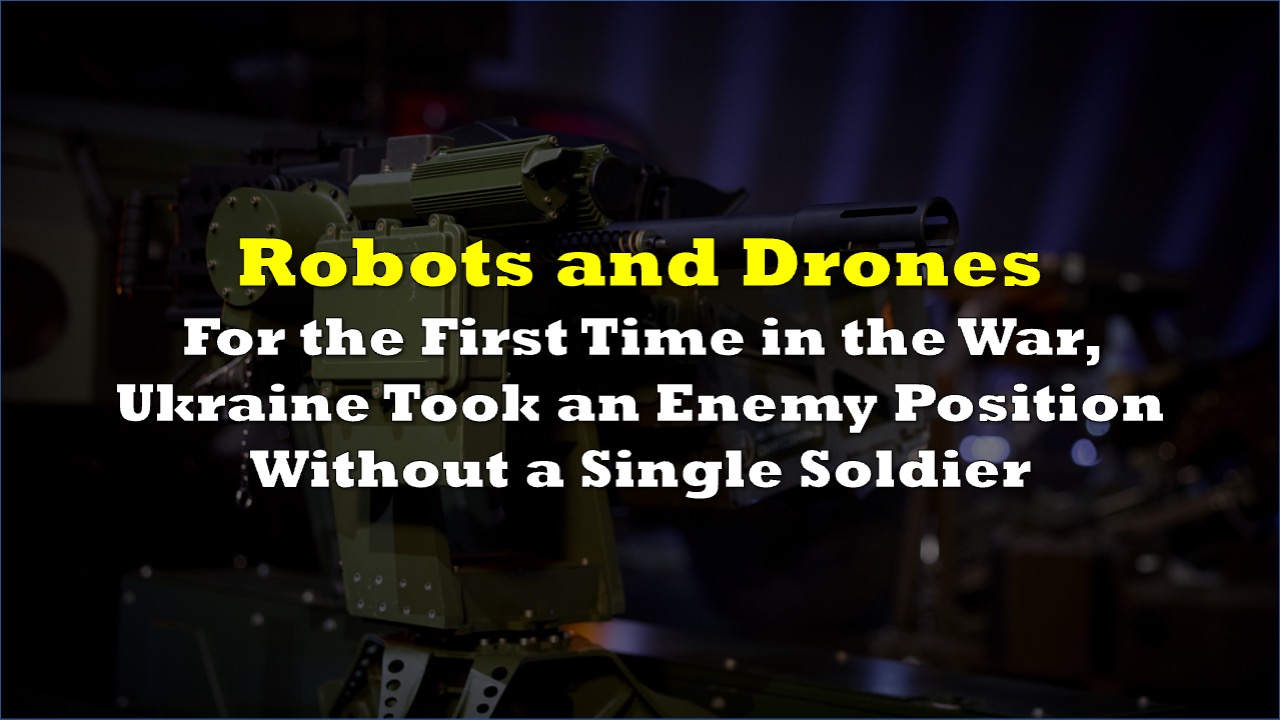

Ukraine captured a Russian position for the first time in the war using only ground robots and drones — no infantry, no casualties — the clearest signal yet that the country has become the world’s most battle-tested laboratory for autonomous warfare.
“For the first time in the history of this war, an enemy position was taken exclusively by unmanned platforms — ground systems and drones,” Zelenskyy said on April 13, marking Ukraine’s Day of the Arms Maker. “The occupiers surrendered, and the operation was carried out without infantry and without losses on our side.”
Ukraine’s ground robotic fleet — the Ratel, TerMIT, Ardal, Rys, Zmiy, Protector, and Volia systems — has carried out more than 22,000 combat missions in just three months.
 Sponsored · Selkirk Copper Mines
Commander-in-Chief Oleksandr Syrskyi reported robotic systems completed 50% more tasks in March than in February, with over 9,000 missions that month alone.
The number of military units deploying the technology grew from 67 in late 2025 to 167 by spring 2026. “Lives were saved more than 22,000 times when a robot went into the most dangerous areas instead of a warrior,” Zelenskyy said.
Four years of forced innovation
Since Russia’s full-scale invasion in February 2022, battlefield necessity drove rapid homegrown innovation — from repurposed commercial drones to a domestic industry now producing millions of aerial units per year. Ground systems followed the same arc.
Ukraine faces acute manpower shortages across a front line stretching more than 1,000 kilometers. Aerial drone proliferation pushed the kill zone to 20-25 kilometers from the front, making traditional infantry advances increasingly lethal. Ground robots became the answer: send machines where soldiers would otherwise die.
 Sponsored · Cambria Gold Mines
“Ukraine can absorb the loss of robots, but it cannot afford to lose battle-ready soldiers,” Major Oleksandr Afanasiev of Ukraine’s K2 Brigade told Foreign Policy. One manufacturer, Tencore, produced more than 2,000 UGVs in 2025 and projects demand of approximately 40,000 units in 2026.
The trajectory runs through two prior milestones: in July 2025, Ukraine’s 3rd Assault Brigade captured Russian soldiers using only robots in Kharkiv — the first time humans surrendered to a machine in modern warfare. In January 2026, a Droid TW-7.62 UGV captured three Russian soldiers in the Lyman direction.
Monday’s operation went further — not capturing individual soldiers, but seizing a full fortified position without a single Ukrainian boot on the ground.
The world is buying
Ukraine signed 10-year defense cooperation agreements with Saudi Arabia and Qatar in March, with a deal agreed in principle with the UAE. Negotiations are underway with Jordan, Kuwait, Bahrain, and Oman. Gulf states now face the same Iranian drone threat profile Ukraine has lived with since 2022 — and they are buying the expertise of the country that survived it.
Read: Ukraine Signs 10-Year Defense Deals With Gulf States, Leveraging Drone War Expertise
Ukraine has deployed more than 200 anti-drone experts to Saudi Arabia, the UAE, and Qatar, with 30 more heading to Jordan and Kuwait.
The offer covers signals intelligence, threat data sharing, interceptor deployment, short-range air defense, and training. A Saudi arms company separately signed a deal to buy Ukrainian interceptor missiles.
Information for this story was found via the sources and companies mentioned. The author has no securities or affiliations related to the organizations discussed. Not a recommendation to buy or sell. Always do additional research and consult a professional before purchasing a security. The author holds no licenses.