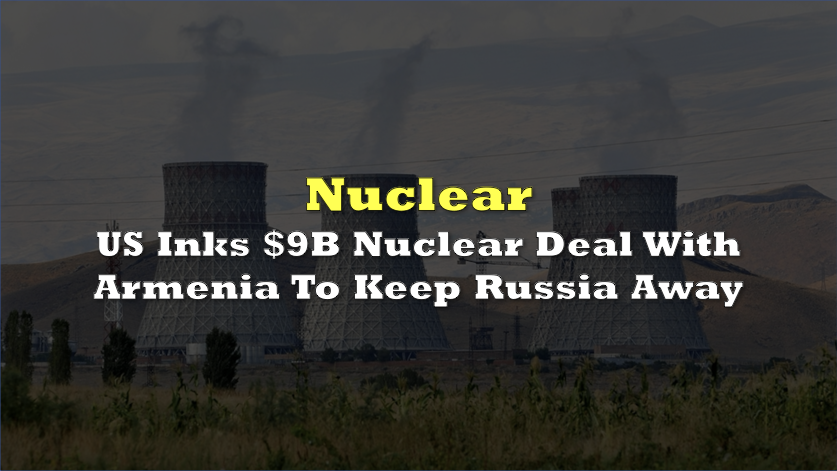

The US and Armenia signed a civil nuclear cooperation agreement that US Vice President JD Vance said could enable up to $9.0 billion in potential investment tied to exports, fuel, and long-duration operating support.
Vance signed the accord in Yerevan on Wednesday, describing it as an agreement that sets the legal framework for US companies to export nuclear technology, fuel, and services into Armenia, and to compete for replacement work tied to Armenia’s existing Soviet-era nuclear station.
“It’ll pave the way for American and Armenian companies to strike deals on civil nuclear projects. That means up to $5 billion in initial US exports, plus an additional $4 billion in long-term support through fuel and maintenance contracts,” Vance said at a briefing.
Vance also framed the agreement as “a classic win-win” that improves energy security for both countries and is also going to create new jobs, without providing a specific job count or timeline.
A $9 billion investment into nuclear power from the USA #uranium pic.twitter.com/QlT04ubEaJ
— Uranium Intern (@uraniumintern) February 11, 2026
The $9.0 billion figure is presented as a two-part commercial pathway: up to $5.0 billion of initial exports, plus $4.0 billion of longer-term support contracts tied to fuel supply and ongoing maintenance.
Armenia’s current nuclear operating baseline is tightly integrated with Russia. The nuclear facility is operated by Russia’s state-owned nuclear corporation Rosatom, and nuclear fuel for the plant is imported from Russia.
The country’s nuclear power station, known as Metsamor, has a 416-MW pressurised-water reactor unit, Armenian-2, which entered commercial operation in 1980. A second unit, Armenian-1, was permanently shut down in 1989. Both units were supplied by Russia, and the agreement explicitly “opens the door” for US firms to compete for a deal to replace the Soviet-era station.
Last year, the Armenian government established a company tasked with evaluating options for new reactor construction, including reviewing technology vendors’ proposals on possible design and cost, with the stated goal of having a development plan for new capacity by mid-2026.
Information for this briefing was found via Nucnet and the sources mentioned. The author has no securities or affiliations related to this organization. Not a recommendation to buy or sell. Always do additional research and consult a professional before purchasing a security. The author holds no licenses.