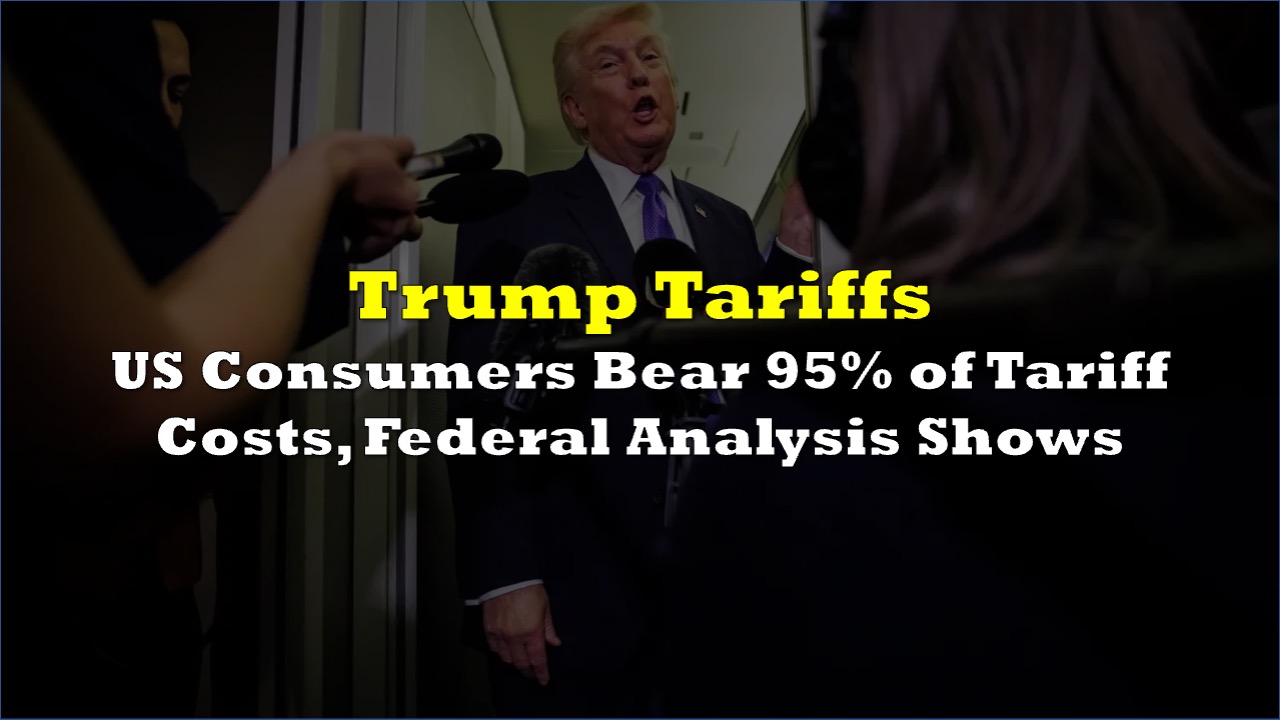

American consumers and businesses absorb approximately 95% of tariff costs, with foreign exporters bearing only 5%, according to the Congressional Budget Office’s February 2026 economic outlook.
The nonpartisan agency’s analysis of tariffs implemented through November 2025 projects that foreign exporters will reduce prices by an amount equivalent to 5% of the tariff rate increases, based on evidence from China’s 2018 and 2019 tariffs.
US businesses absorb roughly 30% of tariff costs through reduced profit margins, while consumers bear the remaining 70% through higher prices, the agency found. The effective tariff rate has climbed about 13 percentage points from roughly 2% in 2024.
Shocked – SHOCKED – that CBO would find basically the same thing re tariff incidence that the St Louis Fed, Kiel Institute, @TaxFoundation, Harvard Business School, Gopinath/Neiman, & others have found.
— Scott Lincicome (@scottlincicome) February 11, 2026
Shocked, I tell you. Shocked. https://t.co/W3oqpImcLg
The agency’s February 2026 outlook projects that tariffs will reduce deficits by $3.0 trillion through 2035, accounting for economic effects and interest costs. However, this falls far short of covering the $4.7 trillion in deficits generated by the One Big Beautiful Bill Act, the tax and spending law enacted in July 2025.
The reconciliation law permanently extended 2017 tax cuts and created new deductions while cutting spending on health care, student loans, and nutrition assistance. The CBO projects federal debt will climb from 101% of gross domestic product in 2026 to 120% by fiscal year 2036, surpassing the previous record of 106% set in 1946.
Independent research confirms CBO’s findings. The Kiel Institute for the World Economy analyzed more than 25 million shipment records representing nearly $4 trillion in US imports. The Febbruary 2026 study found foreign producers accepted just 4% of tariff costs, while US buyers shouldered 96%.
“The claim that foreign countries pay these tariffs is a myth,” said Julian Hinz, research director at the Kiel Institute. “The data show the opposite: Americans are footing the bill.”
Tariffs function as consumption taxes on imported goods, raising costs for businesses that use foreign materials and components. Companies either accept lower profit margins or pass costs to consumers through higher prices.
The fiscal picture leaves Americans bearing costs on two fronts: higher prices from tariffs that function as consumption taxes, plus mounting federal debt that will require future tax increases or spending cuts to service.
CBO projects tariffs will increase the price index for personal consumption expenditures by about 0.8 percentage points by the end of 2026, with negligible additional effects in 2027 and beyond. The temporary price increases reduce purchasing power for households and businesses.
The CBO estimates that the One Big, Beautiful Bill Act, the Trump administration's signature tax law passed last year, will widen cumulative deficits by $4.7 trillion over the next decade. https://t.co/Ryt9eBHv8M
— Axios (@axios) February 11, 2026
The Supreme Court is reviewing challenges to tariffs imposed under the International Emergency Economic Powers Act. A ruling against executive tariff authority could reduce projected revenue collections, though the administration might attempt to reimpose tariffs using different legal mechanisms.
CBO assumes current tariff policies remain in place throughout its projection period. The agency notes significant uncertainty exists because the US has not implemented tariff increases of this magnitude in decades.
Exemptions cover more than one-third of imports from policies enacted between January and November 2025, including agricultural products, consumer electronics, pharmaceuticals, and semiconductors.
Information for this story was found via the sources and companies mentioned. The author has no securities or affiliations related to the organizations discussed. Not a recommendation to buy or sell. Always do additional research and consult a professional before purchasing a security. The author holds no licenses.