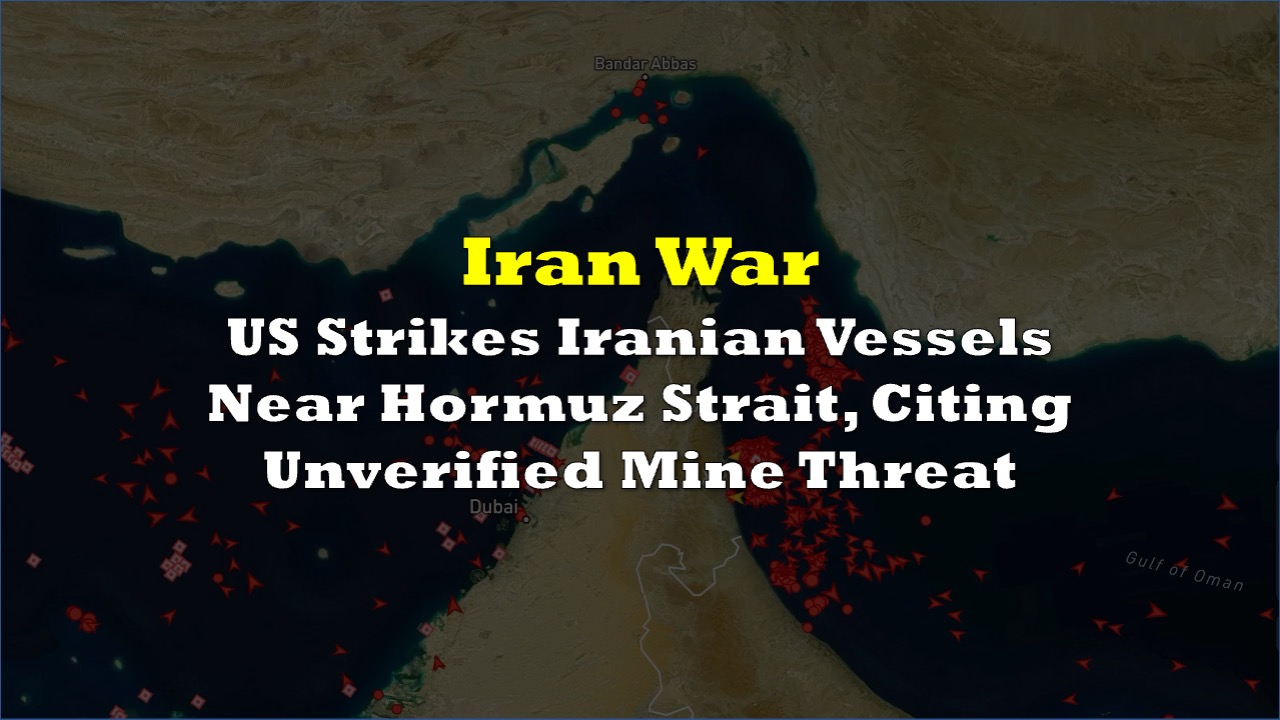

The US military struck and destroyed 16 Iranian naval vessels near the Strait of Hormuz on Tuesday, acting on what American officials described as intelligence indicating Iran was preparing to deploy mines in the waterway — though the mine-laying itself has not been independently verified, and the White House offered conflicting accounts of the situation throughout the day.
US Central Command announced on social media that it had destroyed the vessels, describing them as “inactive mine-layers.”
U.S. forces eliminated multiple Iranian naval vessels, March 10, including 16 minelayers near the Strait of Hormuz. pic.twitter.com/371unKYiJs
— U.S. Central Command (@CENTCOM) March 10, 2026
Joint Chiefs Chairman Gen. Dan Caine told reporters at the Pentagon that the military “continues to hunt and strike mine-laying vessels and mine storage facilities,” but did not specify the total number of vessels or mines destroyed.
The IRGC, which controls the strait alongside Iran’s traditional navy, has not confirmed the strikes or commented on the mine-laying allegations.
The mine threat itself rests almost entirely on anonymous US intelligence sourcing. CNN reported that two people “familiar with US intelligence reporting” said a few dozen mines had been laid in recent days, but that the operation was “not extensive.”
CBS News cited unnamed US officials who said Iran “may be getting ready” to deploy mines — a more cautious framing. Neither outlet obtained independent confirmation from Iran or third-party observers on the ground.
Washington compounded the confusion with President Donald Trump posting on Truth Social that “if Iran has put out any mines in the Hormuz Strait, and we have no reports of them doing so, we want them removed, IMMEDIATELY!” — contradicting CENTCOM’s own announcement of strikes against mine-laying vessels.
Thirteen minutes later, Trump posted that the US had already “hit and completely destroyed” 10 vessels, a figure CENTCOM later revised upward to 16.
Separately and more confusingly, Energy Secretary Chris Wright posted that “the US Navy successfully escorted an oil tanker through the Strait of Hormuz,” but deleted the post within hours.
Press Secretary Karoline Leavitt then denied the claim entirely, saying no escort had taken place. A senior IRGC naval source told Iranian outlet Iran Now that Wright’s original claim “has no basis in truth.”
The US Navy has also turned down near-daily requests from commercial shipping operators for military escorts through the strait, according to The Deep Dive. An Iranian naval commander separately warned any ship attempting to transit: “If you have any doubts, come closer and try.”
The Strait of Hormuz has been effectively closed to most commercial traffic since the war began on February 28, cutting off a waterway that carries roughly one-fifth of global crude oil supply.
Iran is estimated to hold a stockpile of between 2,000 and 6,000 naval mines, according to CBS News, though the exact figure is not publicly known. Iran deployed mines during the Iran-Iraq War in the 1980s; one struck the USS Samuel B. Roberts in 1988 and nearly sank the frigate.
The Wall Street Journal reported on Tuesday that the IEA has proposed the largest coordinated release of strategic oil reserves in its history — a drawdown that would exceed the 182 million barrels deployed following Russia’s invasion of Ukraine in 2022.
The IEA did not publicly confirm the proposal after its emergency member meeting concluded Tuesday, but a decision by the agency’s 32 member states is expected on Wednesday. Under IEA rules, a single objecting country could delay the plan.
Read: IEA Proposes Record-Breaking Oil Reserve Release to Stabilize Global Markets
With the strait blockaded, countries across Asia face acute fuel shortages, with Indonesia and Pakistan relying on reserves that analysts warn may last only weeks.
Information for this story was found via the sources and companies mentioned. The author has no securities or affiliations related to the organizations discussed. Not a recommendation to buy or sell. Always do additional research and consult a professional before purchasing a security. The author holds no licenses.