
Volkswagen is targeting a substantial expansion of its Chinese electric-vehicle business despite a reported two-year gap in new model launches, requiring its loss-making Anhui venture to increase monthly sales to nearly seven times its October delivery volume.
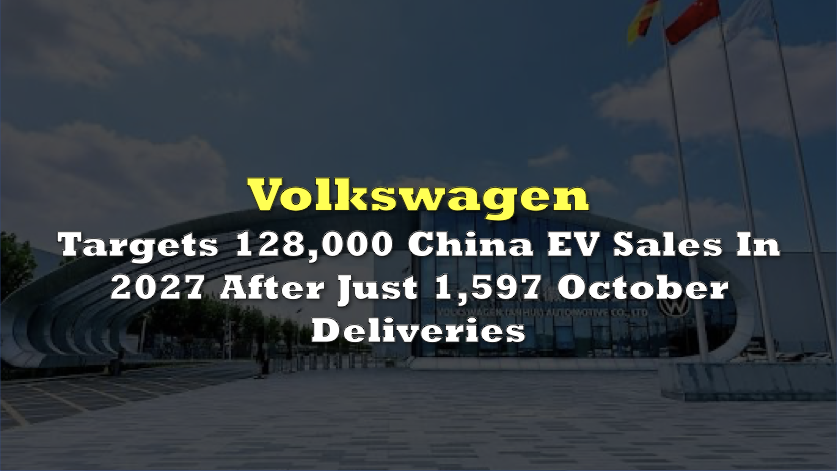
Volkswagen Anhui, the German automaker’s Chinese electric-vehicle joint venture, reported delivering 1,597 vehicles in October, according to figures released November 1. Separately, an internal planning document reviewed by Reuters sets a target of 128,000 sales for the venture’s ID. UNYX vehicle lineup in 2027, equivalent to approximately 10,667 vehicles per month.
The more direct comparison comes from consultancy ThinkerCar, whose data showed 11,360 ID. UNYX vehicles sold between January and September 2026. That translates to an annualized sales pace of approximately 15,147 vehicles.
 Sponsored · Cambria Gold Mines
Two people familiar with Volkswagen Anhui’s plans also told Reuters that the venture has no additional models scheduled for 2027 or 2028. A crossover previously considered for 2028 has reportedly been shelved.
The venture currently markets four UNYX models. Its newest, the ID. UNYX 09 sedan, developed with Xpeng, launched October 24.
Its earlier Xpeng-developed model, the UNYX 08 SUV, averaged 267 monthly sales between April and August, against an initial monthly target of 3,622, according to an October Reuters investigation.
Volkswagen China said the venture was expanding its dealership network and refreshing existing vehicles. It also maintained that its broader Chinese operations would introduce 30 new-energy models through 2029.
 Sponsored · Selkirk Copper Mines
Volkswagen Anhui’s factory has annual production capacity of up to 350,000 vehicles. The internal document reviewed by Reuters projects 2026 production of 33,000 UNYX vehicles and another 33,000 Cupra Tavascan SUVs for export.
Combined, those planned volumes represent approximately 19% of the factory’s stated annual capacity.
Volkswagen owns 75% of the venture with Chinese automaker JAC Motors. The operation remains unprofitable, with Volkswagen finance chief Arno Antlitz identifying 2030 as its expected break-even year.
Meanwhile, Volkswagen’s broader China business sold more than 1.3 million vehicles during January–September, down 30% year over year, compared with a market contraction of nearly 22%, according to data cited by Reuters.
The company separately reported record October new-energy vehicle sales of 28,000 across its Chinese operations.
That broader recovery does not establish whether Anhui can meet its own targets. With the reported launch gap leaving existing models responsible for the planned expansion, the venture’s ability to generate substantially higher sales from its current lineup will be central to its path toward profitability.