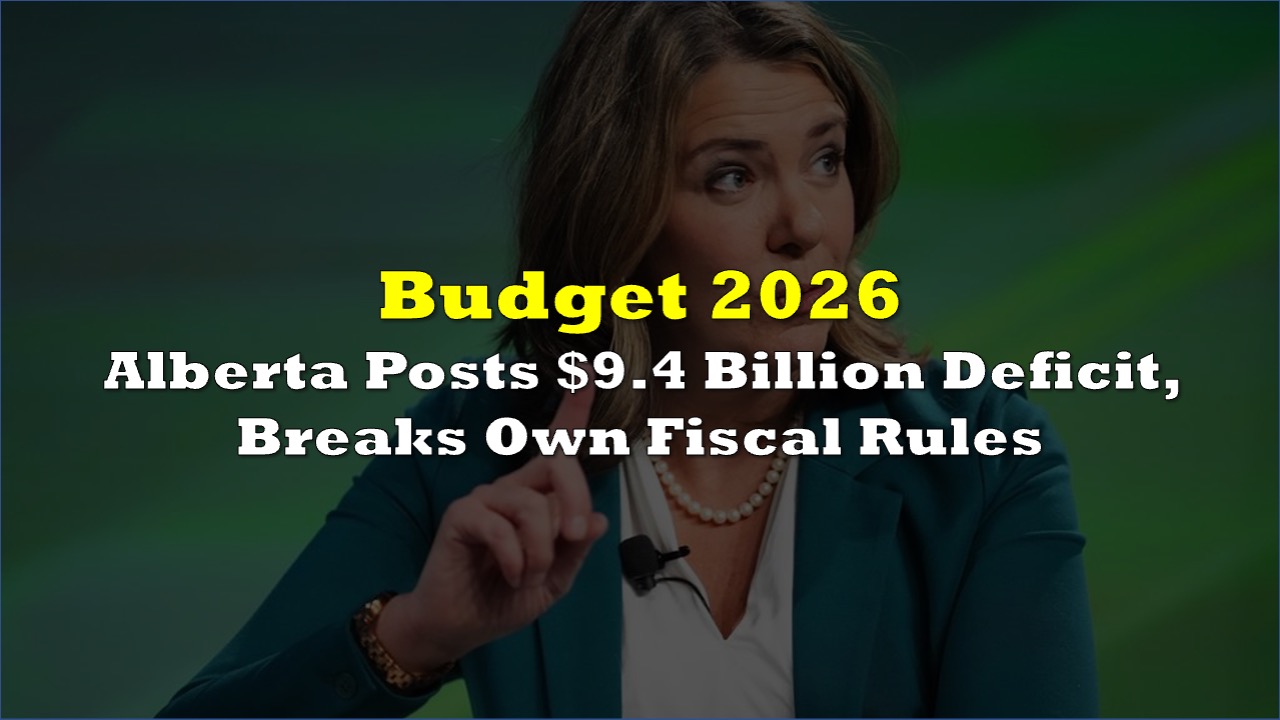

Alberta Finance Minister Nate Horner tabled a $9.37 billion deficit budget on Thursday, projecting three consecutive years of red ink as falling oil prices and rapid population growth strain the province’s finances.
The 2026-27 budget sets record spending at $83.9 billion — roughly a 5% increase over the current fiscal year — while projecting revenue of $74.6 billion. The shortfall breaks a fiscal restraint law that Premier Danielle Smith’s own United Conservative Party government enacted three years ago.
“We created these rules, and I’m breaking them. So it bothers nobody more than it does me,” Horner said at a news conference Thursday.
Alberta’s taxpayer-supported debt load now tracks toward $109 billion by March 2027 and could climb to $138 billion by 2029. Horner described the deficit as “a tough pill to swallow,” while insisting the province cannot pull back on spending for core services amid the highest infrastructure demands in a generation.
The budget lands one day after an Order in Council signed February 25 authorized the province’s Treasury Board president and finance minister to issue government securities — bonds, debentures, and treasury bills — capping outstanding amounts at $40 billion at any one time. Social media accounts portrayed the order as Smith authorizing $40 billion in new debt, but the document establishes a borrowing ceiling for managing securities already issued, not a single new debt transaction.
Smith has pointed to low oil prices as the main driver of the deficit, alongside costs from sharp population growth. The current-year deficit sits at $6.4 billion, based on a West Texas Intermediate average of US$61.50 per barrel.
The budget raises health-care spending nearly 6%, or $1.9 billion, to $34.4 billion and lifts education funding 7% to $10.8 billion. The government introduced no major new taxes, though it added a levy on car rentals and hiked vehicle registration costs. Calgary homeowners face roughly $340 more annually in education property taxes; Edmonton homeowners face a $154 increase.
The budget landed one day after Order in Council 053/2026, signed February 25, authorized the province’s Treasury Board president and finance minister to issue government securities — bonds, debentures, and treasury bills — capping outstanding amounts at $40 billion at any one time.
Oh boy…
— The Breakdown (@TheBreakdownAB) February 26, 2026
Danielle Smith has authorized the province to go $40 Billion into debt. #abpoli #ableg #cdnpoli pic.twitter.com/uveVBWXt14
NDP Opposition Leader Naheed Nenshi condemned the government’s fiscal direction. “Danielle Smith and the UCP have saddled future generations, our kids and our grandkids, with billions and billions of dollars in debt with no path to balance,” he said.
The UCP squandered Alberta’s near-record resource wealth and still produced a $9.4 -billion deficit—a failure of basic financial management.
— Naheed Nenshi (@nenshi) February 27, 2026
Somehow, under some of strongest economic conditions in a generation, life is going to cost you more. pic.twitter.com/THnLiZAnkM
The Heritage Savings Trust Fund is projected to grow to approximately $34 billion by the end of 2026-27. Horner said he remains confident the fund will reach its $250 billion target by 2050.
Population growth is expected to slow in the coming fiscal year, though Horner said the province still needs to catch up on hospital and school construction to serve its five million residents.
Information for this story was found via the sources and companies mentioned. The author has no securities or affiliations related to the organizations discussed. Not a recommendation to buy or sell. Always do additional research and consult a professional before purchasing a security. The author holds no licenses.