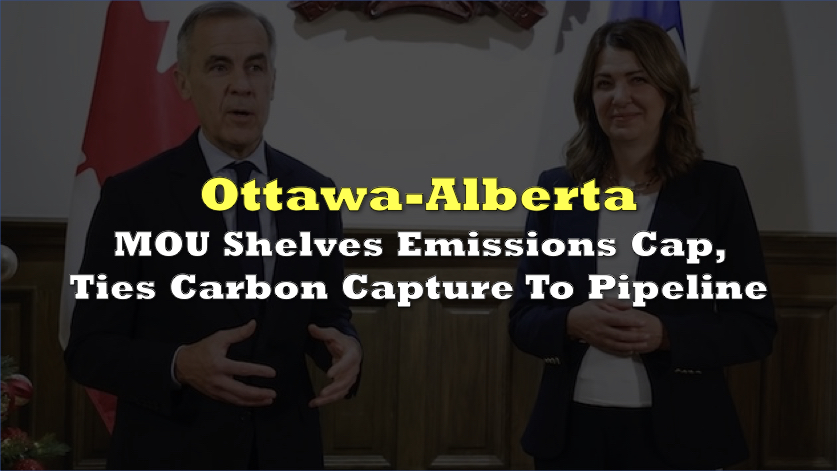

The recently announced Canada–Alberta memorandum of understanding sets a roadmap for at least 1 million barrels per day of new low-emission bitumen pipeline capacity to Asian markets, but makes the project conditional on parallel decarbonization commitments, fixed negotiating deadlines, and a targeted two-year approvals ceiling.
The MOU’s pipeline section calls for one or more privately financed and constructed pipelines with Indigenous co-ownership and benefits, and says the pipeline application will be ready for submission to the Major Projects Office on or before July 2026.
The text also states the new pipeline would be in addition to an expansion of the Trans Mountain pipeline of 300,000 to 400,000 bpd destined for Asian markets, implying 1.3 million to 1.4 million bpd of incremental westbound capacity if both elements proceed.
 Sponsored · Selkirk Copper Mines
Canada’s commitments include a pledge to not implement the federal Oil and Gas Emissions Cap that “has not yet been put into effect,” and to suspend immediately the Clean Electricity Regulations in Alberta pending a new carbon pricing agreement that must be concluded on or before April 2026.
The MOU says that after the new agreement is completed to both parties’ satisfaction, Canada will place CER in Alberta “in abeyance.”
On carbon markets, the governments commit to design “globally competitive” industrial pricing through Alberta’s Technology Innovation and Emissions Reduction system that “will ramp up to a minimum effective credit price of $130/tonne,” with the industrial carbon pricing agreement due by April 2026.
The document also sets a methane equivalency agreement deadline of April 2026, with a 2035 target date and a 75% reduction target relative to 2014 emissions.
 Sponsored · Cambria Gold Mines
The agreement explicitly links the pipeline to carbon capture scale-up. The parties commit to work with Pathways partner companies toward a tri-lateral MOU by April 2026 for “Phase 1 Pathways Projects,” with infrastructure “built and commence operations” in staged fashion between 2027 and 2040 at “date-certain intervals.” The MOU states the “approval and commencement” of initial Phase 1 projects is a precondition to commencement of the approved pipeline, while also stating pipeline approval and construction are prerequisites to Pathways, describing the two projects as “mutually dependent.”
If the pipeline is approved under the Building Canada Act and provides Indigenous co-ownership and shared economic benefits, Canada says it will enable bitumen exports from a “strategic deep-water port” to Asian markets, including, if necessary, via an “appropriate adjustment” to the Oil Tanker Moratorium Act.
Canada also commits to use the Canada Indigenous Loan Guarantee Corporation to help backstop Indigenous co-ownership of the pipeline and, “if appropriate,” Pathways, while Alberta commits to use the Alberta Indigenous Opportunities Corporation for similar backstopping.
READ: Carney Douses Ottawa-Alberta Energy MOU With BC, First Nations Approval
Beyond oil export infrastructure, the MOU includes commitments to “thousands of megawatts” of AI computing power with a large portion dedicated to sovereign cloud for Canada and allies, and large transmission interties with British Columbia and Saskatchewan.
Alberta sets internal deadlines to implement a data centre incentive framework by July 2026, and to collaborate with Canada on a nuclear generation strategy by January 2027 aimed at competitive nuclear power that can serve connected markets by 2050.
Politically, Premier Danielle Smith called the deal a “historic agreement,” citing “tens of thousands of jobs,” “billions in new investment,” and “almost tripling” exports to Asian markets, while Conservative leader Pierre Poilievre argued the memorandum “does not promise a pipeline will be built,” pointing to the July 2026 proposal timing and an approvals process he framed as protracted.
The MOU itself includes a communications protocol requiring both parties to agree to public communications before information is released.
BC Premier David Eby argues the Alberta pipeline proposal could “take our eye off the prize” by distracting Ottawa from BC’s priorities. The MOU nonetheless pulls BC into immediate trilateral talks, formalizes BC involvement in engagement with BC First Nations, and contemplates enabling exports via a “strategic deep-water port,” including possible adjustment to the Oil Tanker Moratorium Act.
Polling embedded in the discussion shows regional splits that complicate the BC narrative. In the province, 53% support the idea of an Alberta-to-BC-coast pipeline through northern BC versus 37% opposed, with 10% unsure. Nationally, support totals 60% and opposition 25%, with 15% unsure, while Alberta stands at 74% support and 16% opposed, and Quebec posts 50% support and 33% opposed.
Information for this story was found via the sources and companies mentioned. The author has no securities or affiliations related to the organizations discussed. Not a recommendation to buy or sell. Always do additional research and consult a professional before purchasing a security. The author holds no licenses.