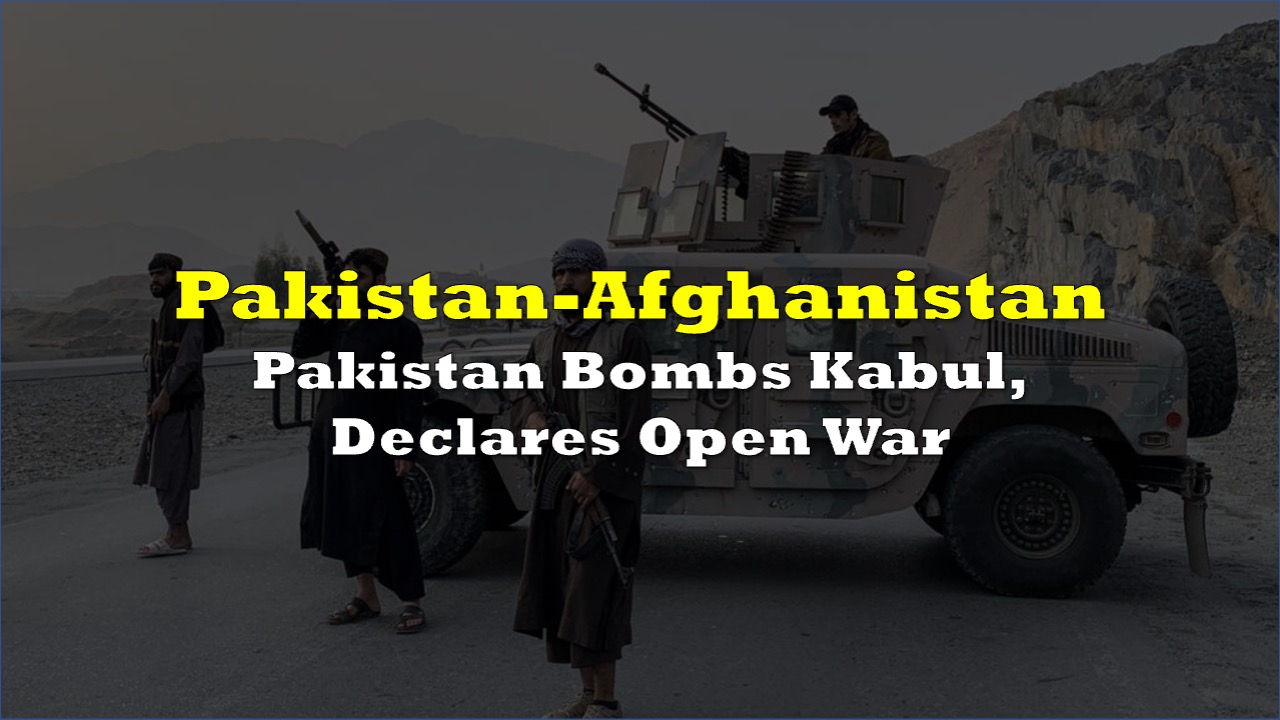

Pakistani warplanes struck Afghanistan’s capital Kabul and two other provinces early Friday, as Defence Minister Khawaja Asif declared the two countries at war following a retaliatory cross-border assault by Afghan Taliban forces the night before.
The strikes hit targets in Kabul, the southeastern province of Paktia, and Kandahar in the south, according to Afghan government spokesperson Zabihullah Mujahid, who said there were no Afghan casualties.
Pakistan’s Information Minister Attaullah Tarar confirmed the targets on social media, describing them as Afghan Taliban defence facilities. Residents in Kabul reported hearing jets overhead and multiple explosions over a period of more than two hours, followed by gunfire.
Pakistan’s Prime Minister spokesperson Mosharraf Zaidi said the strikes killed 133 Afghan Taliban fighters and wounded more than 200, with nine Taliban positions captured and 27 destroyed. Afghanistan has not confirmed the Pakistani casualty figures, and the claims could not be independently verified.
 Sponsored · Cambria Gold Mines
Asif framed the operation as a direct response to Afghan aggression. “Our patience has now run out,” he wrote on X. “Now it is open war between us.” Pakistan’s Information Ministry said strikes were also ongoing in several districts of the northwestern Khyber Pakhtunkhwa province, including Chitral, Khyber, Mohmand, Kurram, and Bajaur.
What Triggered Friday’s Escalation
Afghan forces launched what their Defence Ministry described as large-scale offensive operations against Pakistani military positions along the Durand Line late Thursday, citing Pakistan’s earlier airstrikes as justification.
Afghanistan’s Ministry of Defence said the overnight operation killed 55 Pakistani soldiers, destroyed 19 army posts and two bases, and resulted in the capture of additional personnel. Pakistan has not confirmed those figures. Eight Afghan soldiers were killed and 11 were wounded in the fighting, according to Kabul.
The Thursday attack followed Pakistani airstrikes on Afghanistan’s Nangarhar, Paktika, and Khost provinces on February 21–22, which Pakistan said targeted seven militant camps linked to the Tehreek-e-Taliban Pakistan (TTP) and the Islamic State-Khorasan Province. The UN Assistance Mission in Afghanistan confirmed at least 13 civilian deaths from those strikes. Afghanistan said 18 civilians died, including 11 children from a single family.
A Pattern of Escalating Conflict
The latest flare-up follows one of the most violent periods in the two countries’ shared history. A Qatar-mediated ceasefire reached in October 2025 after 10 days of border fighting that killed more than 70 people on both sides had grown increasingly fragile, with land border crossings largely shut since.
Saudi Arabia brokered the release of three Pakistani soldiers captured during those October clashes earlier this month.
Pakistan’s strikes this week came after a series of deadly attacks inside its borders, including a February 6 suicide bombing at a Shia mosque in Islamabad that killed at least 36 worshippers — claimed by the Islamic State-Khorasan Province — and a vehicle bombing in Bajaur that killed 11 soldiers and a child.
Islamabad attributes the attacks to militants operating from Afghan soil, an accusation Kabul has repeatedly rejected.
Analysts warn the situation may deteriorate further. Pearl Pandya, senior South Asia analyst at the Armed Conflict Location & Event Data Project, told Al Jazeera that the Afghan Taliban’s reluctance to move against the TTP — partly due to historical ties between the two groups — makes additional escalation increasingly likely.
Information for this story was found via Al Jazeera, and the sources and companies mentioned. The author has no securities or affiliations related to the organizations discussed. Not a recommendation to buy or sell. Always do additional research and consult a professional before purchasing a security. The author holds no licenses.