

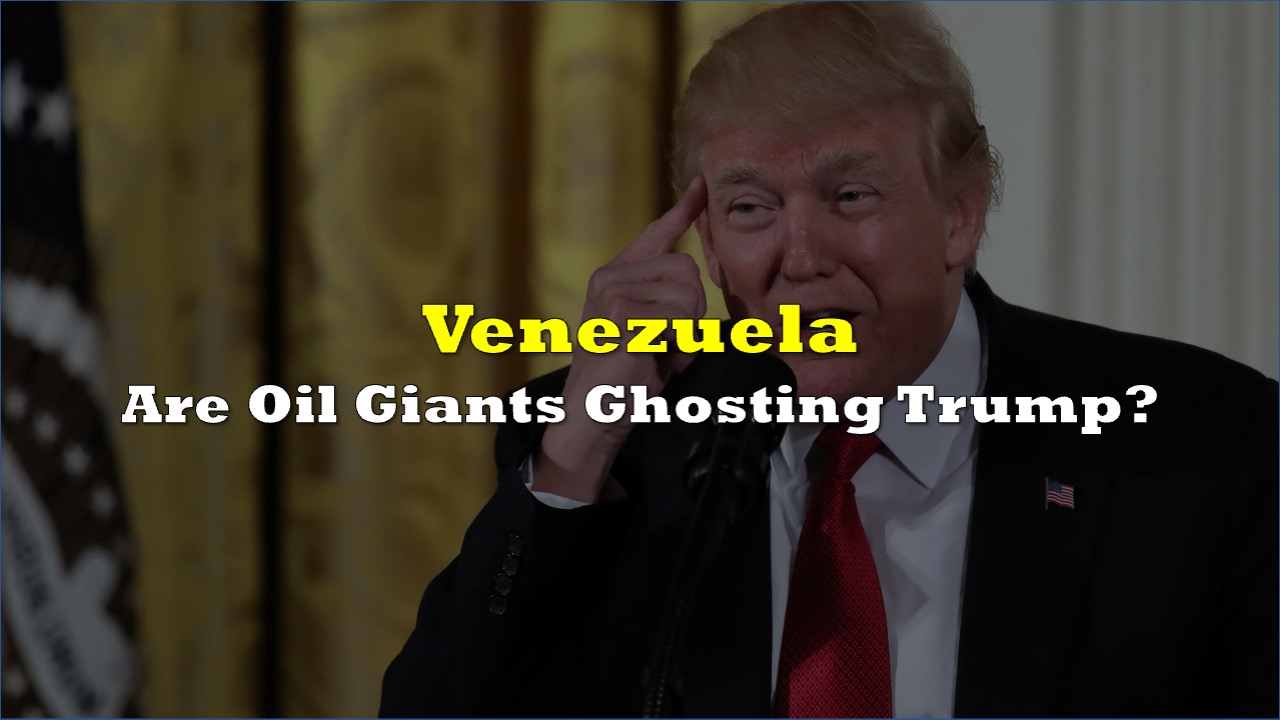

President Donald Trump on Saturday promised that “very large” US oil companies would pour billions into rebuilding Venezuela’s oil infrastructure after capturing President Nicolás Maduro. The industry’s response: deafening silence.
Hours after Trump’s Mar-a-Lago announcement, the three major American oil companies with Venezuelan ties offered cautious statements that avoided any commitment to new investments.
It’s unclear how willing oil giants like Exxon Mobil Corp., Chevron Corp., ConocoPhillips and others are to pour substantial sums of money into a country run by a temporary US-backed government without established legal and fiscal rules. Exxon and ConocoPhillips didn’t respond to…
— Giovanni Staunovo🛢 (@staunovo) January 3, 2026
Chevron, the only US major currently operating in Venezuela, told Fox Business it “remains focused on the safety and wellbeing of our employees” with no mention of new investment plans.
ConocoPhillips, which Venezuela owes more than $10 billion from an arbitration judgment, said “it would be premature to speculate on any future business activities or investments.”
ExxonMobil, the largest US oil company, has not responded to requests for comment as of this writing.
Put together, these paint a sobering picture that contradicts Trump’s optimistic timeline.
Francisco J. Monaldi, director of the Latin America energy program at Rice University, told CBS News that rebuilding Venezuela’s oil infrastructure would require “at least a decade — and investments of more than $100 billion.”
Venezuela currently produces approximately 1 million barrels per day, less than 1% of global output, down from more than 3 million barrels daily in the early 2000s. Columbia University estimates even modest production increases would need “more than $10 billion in investment over two to three years.”
The Iraq precedent also offers little comfort. It took nearly two decades to revitalize Iraq’s oil industry after the 2003 US invasion, experts note, and corruption remains pervasive.
And there’s the most immediate obstacle: legal certainty.
“No one’s going to start investing on the ground in a place where there’s no legal contract and viable permission to operate,” Gerald Kepes, president of Competitive Energy Strategies, told NPR.
Trump said the United States would “run” Venezuela temporarily but provided few specifics about governance or legal frameworks. Vice President Delcy Rodríguez was ordered by Venezuela’s Supreme Court to serve as acting president, but she has alternately offered to work with Washington while insisting Maduro remains legitimate.
There are also some historical grudges to consider. After Venezuela nationalized its oil industry and forced unfavorable contract renegotiations, ExxonMobil and ConocoPhillips exited in 2007 and won arbitration cases. Venezuela was ordered to pay more than $11 billion combined. It has paid only a fraction.
And of course, current market conditions don’t help. Oil prices hover below $60 per barrel, the global market is oversupplied, and long-term demand remains uncertain as electric vehicles gain ground.
When Newsweek asked Chevron about Trump’s plans, the company initially expressed readiness to “work constructively” with a new government. Hours later, it retracted that statement.
“Venezuela doesn’t have limits in terms of the resources,” Monaldi said. “It’s about the politics.”
Trump admin "officials have told oil executives in recent weeks that if they want compensation for…seized property, then they must be prepared to go back into Venezuela now"
— Alex Burns (@alexanderburns) January 3, 2026
On Trump prodding US oil giants into Venezuela – Lefebvre/@zcolman/@jamepdx https://t.co/4T4wtDzEzY
For now, those politics remain uncertain — and US oil giants aren’t opening their wallets.
Information for this story was found via the sources and companies mentioned. The author has no securities or affiliations related to the organizations discussed. Not a recommendation to buy or sell. Always do additional research and consult a professional before purchasing a security. The author holds no licenses.


One Response
Epstein