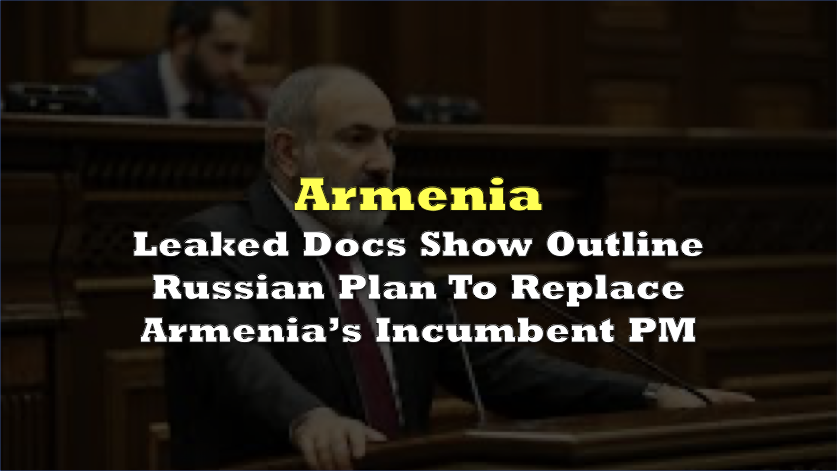

Armenia’s election risk is shifting from whether Prime Minister Nikol Pashinyan has opponents to whether those opponents can be engineered into a single bloc before voters go to the polls on June 7.
That is the central mechanism inside the alleged Russian intelligence documents now circulating through Armenian and regional media. The materials do not merely describe anti-Pashinyan sentiment but they outline a way to turn fragmented grievance into a unified electoral list, with Russian-Armenian billionaire Samvel Karapetyan positioned as the political container.
The documents, whose authenticity remains unverified, divide Armenian voters into three color-coded fields. One is tied to the old parliamentary opposition around former presidents Robert Kocharyan and Serzh Sargsyan. Another is tied to Pashinyan and pro-Western forces. The largest, described as a roughly 70% “red” field, is presented as voters who want Pashinyan removed but do not want the former regime restored.
 Sponsored · Selkirk Copper Mines
That 70% figure is the leak’s most consequential assumption and its least proven one.
Public polling reviewed does not show Karapetyan controlling anything close to that space. OC Media reported that the latest International Republican Institute survey put Pashinyan’s Civil Contract at 32%, Karapetyan’s Strong Armenia at 6%, undecided voters at 23%, and respondents refusing to answer at 21%.
That is where Karapetyan becomes useful in the document’s logic. He is framed as a billionaire coalition-builder who could play the role Bidzina Ivanishvili played in Georgia in 2012, when a united opposition defeated Mikheil Saakashvili’s ruling party.
The alleged documents explicitly push that comparison, describing Karapetyan as having the chance to become an “Armenian Ivanishvili” and calling for a 2026 contest fought as a head-to-head bloc battle rather than a splintered opposition field.
 Sponsored · Altamira Gold Corp.
The election pits Pashinyan’s Civil Contract, which has sought closer Western ties, against mainly pro-Russian opposition parties. The same Reuters report said that while Civil Contract is expected to remain the largest party, it may fall short of the two-thirds majority needed for constitutional changes tied to Armenia’s next political phase.
Radar Armenia reported that the broader plan proposes a large alliance around Karapetyan’s party, Mother Armenia, Gagik Tsarukyan’s Prosperous Armenia, and a civil platform connected to church and political-prisoner issues. The outlet said the materials were published by “Chronicle of the Caucasus,” which claimed they came from a hacked Russian intelligence officer’s phone.
That structure would solve one opposition problem while creating another. A single list could reduce wasted anti-government votes, but it would also make Pashinyan’s counterargument simpler: that the opposition is not an organic protest vote, but an oligarch-backed vehicle for restoring Russian leverage.
Russia is also using economic pressure points in public. The Kremlin warned Armenia could lose preferential Russian gas pricing if it moves away from Moscow’s integration structures and closer to the EU, Reuters reported.
The Insider separately reported allegations that Russian intelligence services were operating to influence Armenia’s election and identified alleged FSB, GRU, and SVR-linked figures. Moscow has denied allegations of interference, while Karapetyan has accused Pashinyan of being behind reports targeting him, according to regional coverage.
The church layer sharpens that vulnerability. The screenshots refer to detained Archbishop Mikael Ajapahyan as part of the symbolic architecture of the proposed alliance, suggesting a secular blessing from Karapetyan and a spiritual one from the clerical side. Reuters reported in October 2025 that Ajapahyan was sentenced to two years in prison after being found guilty of calls to usurp power, while the Armenian Apostolic Church condemned the case as politically motivated.
The election is already under pressure from criminal, legal, and foreign-interference claims. Reuters reported in April that Armenian anti-corruption authorities detained 14 people linked to a pro-Russian opposition party on suspicion of electoral bribery, while two other Strong Armenia members were arrested and accused of violating campaign-period restrictions on charity work.
The EU has responded on the interference front. The Guardian reported that Brussels is sending experts to Armenia to help counter Russian propaganda, cyber threats, interference, and illicit financial flows ahead of the vote.
The alleged leak therefore lands in the precise seam of Armenia’s election: Pashinyan is not just defending a polling lead, and Karapetyan is not just trying to raise his vote share. The fight is over whether Armenia’s opposition can be vertically integrated in time, with money, party machinery, religious symbolism, and anti-government anger routed through one list.
Information for this story was found via the sources and companies mentioned. The author has no securities or affiliations related to the organizations discussed. Not a recommendation to buy or sell. Always do additional research and consult a professional before purchasing a security. The author holds no licenses.