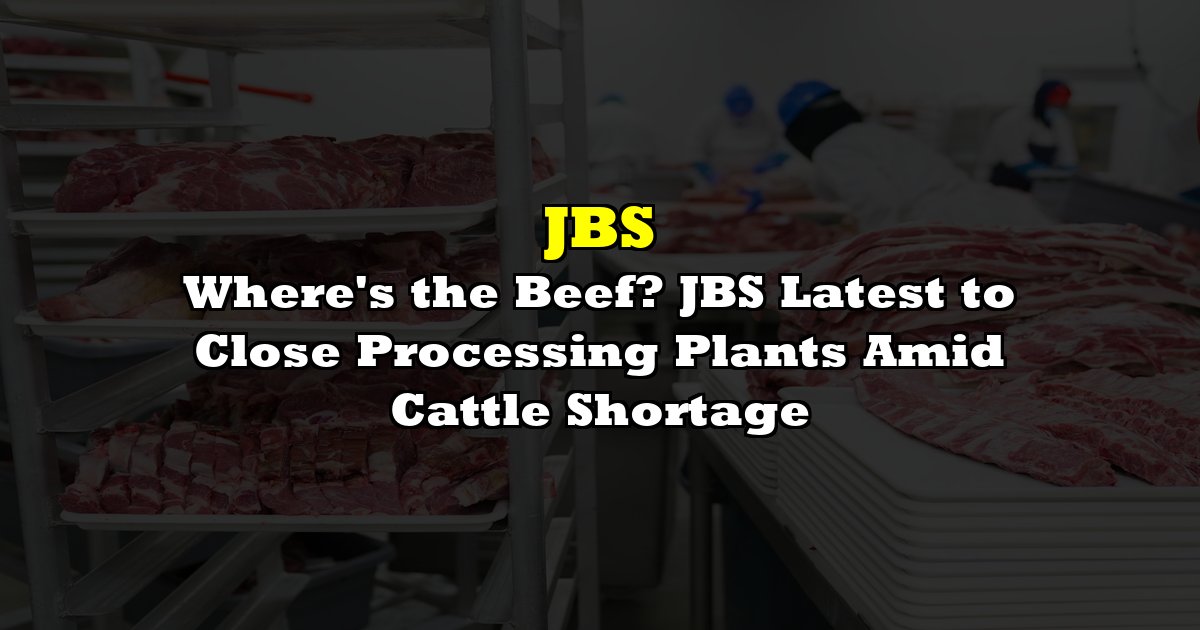

JBS USA is closing a beef production facility in Souderton, Pennsylvania, and a value-added processing plant in Memphis, Tennessee, as a shrinking U.S. cattle herd continues to pressure the economics of large-scale beef processing.
The Pennsylvania plant is the more significant of the two closures. It employs roughly 1,700 workers and can process around 2,000 cattle per day, accounting for less than 2% of total U.S. beef slaughter capacity. JBS says production from both facilities will be redistributed across its existing network, and that affected employees will have the opportunity to apply for positions at other company sites.
The root driver is supply. Years of drought and elevated input costs have steadily eroded the U.S. cattle herd, leaving processors competing for fewer animals. The economics are unforgiving. Packing plants buy cattle by the head and sell by the pound, so constrained supply drives up acquisition costs while compressing margins.
JBS frames the closures differently. CEO Wesley Batista Filho described them as part of a broader push to modernize operations and sharpen the company’s competitive position, pointing to recent investments in Texas, Georgia and Iowa aimed at expanding value-added and prepared foods production. The company also recently merged its beef and case-ready business units into a single integrated platform.
 Sponsored · Power Metallic Inc.
“JBS USA is investing heavily in the United States and in the future of food production,” Batista Filho said in a statement. “At the same time, we must ensure our operations are efficient, modern, and positioned to compete.”
The closures arrive during a turbulent stretch for the U.S. meatpacking industry. Last fall, Tyson Foods permanently shut its beef processing plant in Lexington, Nebraska, cutting approximately 3,200 jobs and removing nearly 5% of national cattle slaughter capacity.
But the issues are also on the labour side. Recently, around 1,700 workers at Cargill’s Fort Morgan, Colorado, facility were locked out after contract talks broke down, with that plant alone representing close to 5% of U.S. beef production. JBS itself dealt with a strike earlier this year at its Greeley, Colorado, plant before workers ratified a new contract.
Analysts expect the JBS closures to have a more limited impact on national processing capacity than the Tyson shutdown, given the smaller scale of the sites and the planned redistribution of output. The northeastern U.S. market, however, could feel a more localized effect, as the region is relatively isolated from other major processing hubs.
The broader pattern is hard to ignore. JBS, Tyson, Cargill and National Beef together control an estimated 80% to 85% of U.S. beef processing capacity. Each closure narrows that infrastructure further, and with the cattle herd still near historic lows, the industry’s ability to scale back up when supply eventually recovers may be more constrained than the headline numbers suggest.
Information for this story was found via the sources and companies mentioned. The author has no securities or affiliations related to the organizations discussed. Not a recommendation to buy or sell. Always do additional research and consult a professional before purchasing a security. The author holds no licenses.