
The first assays from a phase two drill program conducted by Astra Exploration (TSXV: ASTR) were released this morning. The results come from the company’s La Manchuria Gold and Silver Project, found in the Santa Cruz province of Argentina.
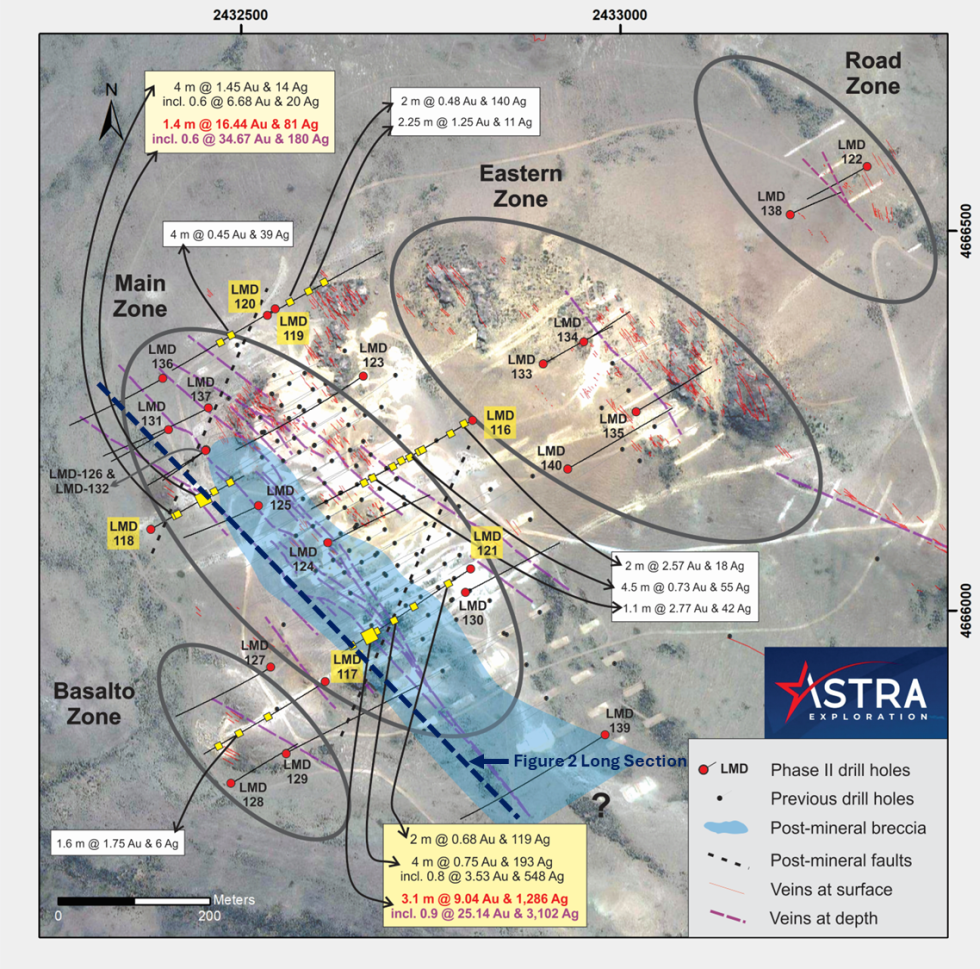
Assays from a total of six holes were released this morning, which follow a 5,119 metre, 25 hole drill program conducted in late 2025. Highlights from the results include:
- LMD-118: 16.4 g/t gold and 81 g/t silver over 1.4 metres from a depth of 114.0 metres
- Including 34.7 g/t gold and 180 g/t silver over 0.6 metres
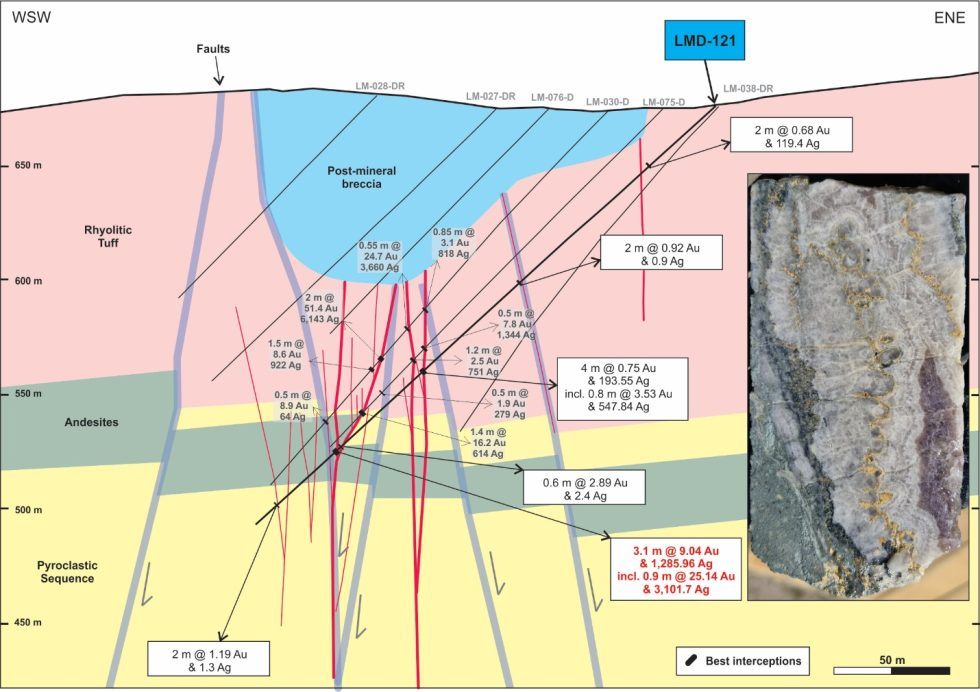
- LMD-121: 9.0 g/t gold and 1,286 g/t silver over 3.1 metres from a depth of 224.4 metres
- Including 25.1 g/t gold and 3,102 g/t silver over 0.9 metres
Drilling under the initial six holes released was focused on the Main Zone area, with all holes intersecting gold and silver mineralization. Both of the highlight holes are said to have intersected a high grade vein within the West Feeder portion of the Main Zone, which contains some of the highest known mineralization at La Manchuria. Drilling has expanded the high grade vein both at depth and along strike to the northwest.
LMD-121 notably intersected the first known occurrence at La Manchuria of high grade gold and silver hosted within andesitic rocks. Mineralization was encountered in two veins within andesitic sill, which presents the potential for new high grade veins to be intersected at depth at the project.
“New sources of high-grade veins continue to emerge at La Manchuria. Drilling has revealed the system is open along strike in both directions, at depth below previous drilling, laterally in new parallel structures, and now we can definitively add additional host rock units to that list. We’ve proven that high-grade gold and silver exist beyond nearly every previously interpreted constraint, which bolsters our original thesis that La Manchuria has the potential to host a multi-million-ounce high-grade deposit,” commented Brian Miller, CEO of Astra Exploration.
Three holes that saw assays released this morning meanwhile focused on the East Feeder of the Main Zone, with those drill holes hitting low sulphidation epithermal veins and veinlets. The results are said to support the shallow bulk disseminated mineralization model currently being used for the Main Zone.
“It is important to keep in mind that these results are from a small portion of the property, which itself now has unconstrained potential – and there are numerous regional targets which show potential for expansion, all centralized within a large project area of spectacular fertility. We are eager to commence with the fully-funded second half of Phase II to further expand the system,” continued Miller.
Drilling at La Manchuria is expected to resume in March with a further 5,000 metres expected to be drilled under the phase two program.
La Manchuria is found within the Deseado Massif district of Argentina, within 50 kilometres of four mines, with the district including Newmont’s Cerro Negro and AngloGold Ashanti’s Cerro Vanguardia mines. The region is said to be the largest gold and silver producing area of the country, with an estimated one million ounces of gold equivalent pulled from the region every year.
Astra Exploration last traded at $0.55 on the TSX Venture.
Information for this story was found via the sources and companies mentioned. The author has no securities or affiliations related to the organizations discussed. Not a recommendation to buy or sell. Always do additional research and consult a professional before purchasing a security. The author holds no licenses.