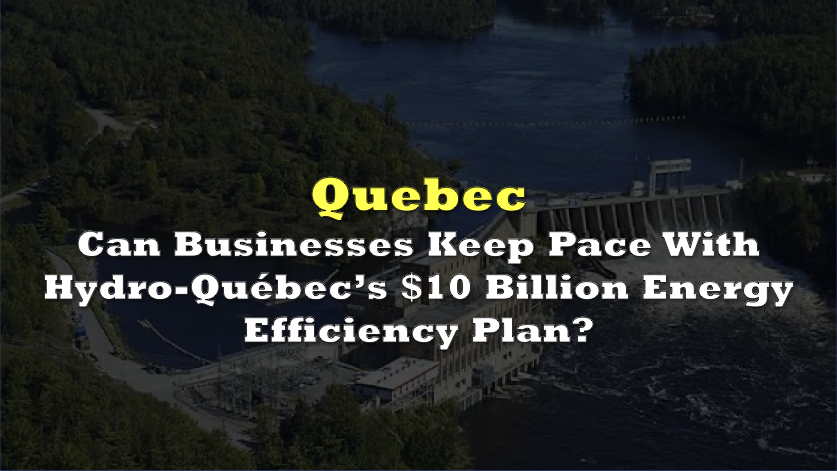

Hydro-Québec is relying on a $10 billion energy efficiency strategy to help accommodate the province’s growing electricity needs, but a survey released Wednesday found that 73.5% of Quebec businesses lack access to specialized energy-management expertise.
The findings from Québec Net Positif, based on a Léger survey of 802 business leaders conducted between July 27 and August 19, come as the provincial utility increasingly relies on reducing electricity consumption alongside expanding generation capacity to meet future demand.
Hydro-Québec disclosed earlier this month that provincial electricity requirements are projected to increase by approximately 60 to 240 TWh by 2041, driven primarily by industrial demand and transportation electrification.
 Sponsored · Cambria Gold Mines
The utility intends to achieve energy savings of 21 TWh and reduce power demand by 3,500 megawatts by 2035. As of November 3, it had achieved 20% of its energy savings target.
For businesses, reducing electricity consumption has become increasingly relevant to operating costs. Hydro-Québec raised electricity rates for commercial and industrial customers by 3.8% on April 1, compared with a 3% increase for residential and agricultural customers.
Hydro-Québec has already expanded financial incentives for businesses to reduce electricity consumption. Its Efficient Solutions Program recorded 10,228 completed projects in 2025, up 49.5% from 6,842 in 2024. The utility attributed approximately 1.1 TWh in electricity savings to the program last year, compared with 1.8 TWh across its broader grant-based energy efficiency and demand response initiatives.
Businesses can also obtain up to $50,000 in financial assistance for eligible energy assessments, increasing to $60,000 when assessments incorporate measures to manage electricity demand during peak periods.
 Sponsored · Selkirk Copper Mines
The reported project totals, however, do not establish how many individual businesses received assistance or how participation was distributed among companies of different sizes. QNP’s survey found that large businesses scored 52.9 out of 100 on its climate transition index in 2026, compared with 35.8 for SMEs. The difference widened to 17.1 points from 13.8 points last year.
The two business groups had recorded nearly identical scores in 2023.
Financial constraints also remain a consideration. Among surveyed business leaders, 31% identified better access to financing as a means of accelerating climate initiatives, while 29% identified stronger evidence of financial benefits.
The business environment has presented additional obstacles. Economic uncertainty was cited by 31% of respondents as a barrier to climate action, while 30% pointed to costs and profitability concerns.
Among exporters, 43% identified trade tensions with the US as an impediment.
QNP measured access to specialized energy-management expertise for the first time this year.