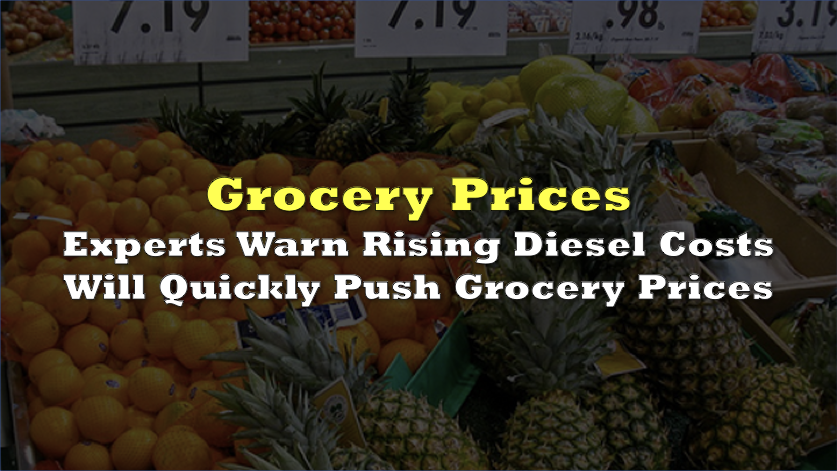

Canadians should prepare for another round of grocery inflation as surging diesel prices raise costs across harvesting, shipping, trucking, and retail, with experts warning that at least some food categories could move higher relatively quickly.
The pressure starts as diesel prices had already risen by $0.48 per litre since the start of March, with Roger McKnight, chief petroleum analyst at En-Pro, saying early indicators pointed to a further $0.12-per-litre increase by Friday. He described diesel prices as “absolutely astronomical” and said he saw no end in sight.
That move has already raised the average cost of filling an 18-wheeler by about $185 since the beginning of the month.
Mike von Massow, a food economist at the University of Guelph, said transportation accounts for about 3.5% of the retail price of food overall and can reach as high as 10% for fresh fruits and vegetables.
Gary Sands, senior vice-president of the Canadian Federation of Independent Grocers, said suppliers will pass higher fuel costs to grocers, and grocers will in turn have little choice but to pass them to consumers. The Retail Council of Canada reinforced that point, saying shipments already moving through the system are being transported using fuel bought at current prices and noting that many contracts include fuel-adjustment clauses.
The Retail Council further argued that food retail margins are typically about 2% to 3%, below the 3.5% average transport share cited by von Massow.
This new fuel shock lands after a long stretch of already elevated food inflation. According to the Statistics Canada figure, grocery prices in Canada have risen by more than 30% since the beginning of 2021, outpacing inflation as a whole.
Furthermore, the burden will not be evenly felt. Neil Hetherington, CEO of Daily Bread Food Bank, said more than one in 10 Torontonians relied on the food bank last year. He said visits that used to happen once a month before the pandemic are now closer to three or four times a month, evidence that households are already using emergency food support more frequently even before.
For higher-income households, substitution can soften the blow. Von Massow noted consumers can change purchase habits and buffer themselves from some increases. But food is non-discretionary, and lower-income households have fewer substitutions left after years of price escalation.
Information for this story was found via Toronto Star and the sources and companies mentioned. The author has no securities or affiliations related to the organizations discussed. Not a recommendation to buy or sell. Always do additional research and consult a professional before purchasing a security. The author holds no licenses.