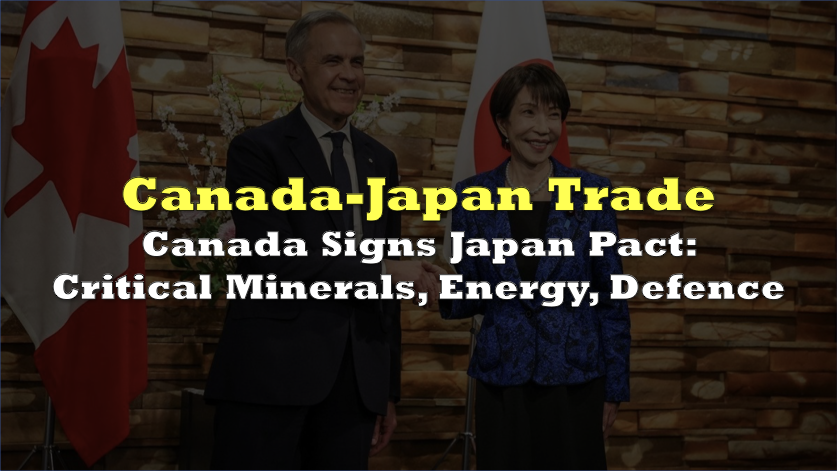

Canada and Japan signed a new Comprehensive Strategic Partnership on Friday that puts critical minerals, energy security, defence cooperation, and technology supply chains at the center of bilateral ties, while leaving unresolved the North American trade risk hanging over Japanese manufacturing investment in Canada.
The agreement, signed in Tokyo by Prime Minister Mark Carney and Prime Minister Takaichi Sanae, commits both countries to deepen cooperation on critical minerals through efforts to secure reliable supply, expand value-added processing, and support diversified manufacturing ecosystems.
The main pillars
The framework also links that work to the G7 Critical Minerals Production Alliance and broadens cooperation into semiconductors, batteries, artificial intelligence, hydrogen fuel cells, quantum technology, fusion energy, and other strategic sectors.
On energy, Canada and Japan said they will expand bilateral trade and cooperation on LNG and LPG, while also increasing work on nuclear technologies, hydrogen, carbon capture, utilization and storage, energy-efficient industrial processes, clean storage, grid modernization, and clean-energy integration.
Carney said Canada can double LNG exports by the end of this decade and double them again by the end of the following decade. Takaichi, according to the English translation of her remarks, said Canada’s LNG expansion has “great significance” for Japan.
Japan’s import dependence gives that part of the deal commercial weight. Ottawa said Japan imports 87% of its energy and 62% of its food. On agriculture, Canada has overtaken the US as Japan’s top supplier of wheat and pork and now supplies 10% of Japan’s caloric intake.
On defence, the two countries announced three bilateral Memorandums of Cooperation covering international emergency response, joint Coast Guard exercises, and action against illegal, unreported, and unregulated fishing in the North Pacific. They also committed to additional strategic planning, bilateral exercises, and joint operations, including joint sails between the Royal Canadian Navy and the Japanese Navy and the potential participation of Japan in Canada’s Operation NANOOK in the Arctic.
The new Canada-Japan Cyber Policy Dialogue will focus on information exchange, resilience building, and cyber threats. Ottawa also said Canadian and Japanese companies will pursue greater collaboration in defence-related frontier technologies including AI, autonomous systems, and space security.
The CUSMA connection
Ottawa framed the agreement around a large existing commercial base. Japan is an over $5.5 trillion economy, the world’s fourth largest, Canada’s fourth-largest source of foreign direct investment, and a bilateral trade partner with nearly $40 billion in two-way trade. On the other hand, Ottawa said 70% of the cars manufactured in Canada are made by Japanese companies.
However, the North American trade corridor looms on the expanse of the trade. Japan’s ambassador to Canada, Kanji Yamanouchi, said continued access to the US market under the CUSMA is the “critical condition” for current and future Japanese auto investment in Canada. He pointed to the scale mismatch directly, citing Canada’s roughly $2.5 trillion GDP against a $30 trillion US market. With vehicles produced in Canada sold domestically and exported to the US, the Tokyo agreement does not remove the dependence of Japanese manufacturers on the outcome of the CUSMA review.
In addition, the two governments will modernize the Canada-Japan Joint Economic Committee, which marks its 50th year, and target sectors including semiconductors, batteries, AI, clean energy, critical minerals, and supply-chain resilience.
Ottawa also announced a Team Canada Trade Mission to Japan in 2026 and an upcoming visit to Canada by the Japan Business Federation.
The Tokyo stop closed Carney’s 10-day Indo-Pacific tour after India and Australia. Ottawa said Canada secured more than $5 billion in commercial agreements in India and up to $10 billion in investment commitments in Australia but no comparable headline investment total was announced in Japan.
Information for this story was found via CTV News, BOE Report, and the sources and companies mentioned. The author has no securities or affiliations related to the organizations discussed. Not a recommendation to buy or sell. Always do additional research and consult a professional before purchasing a security. The author holds no licenses.