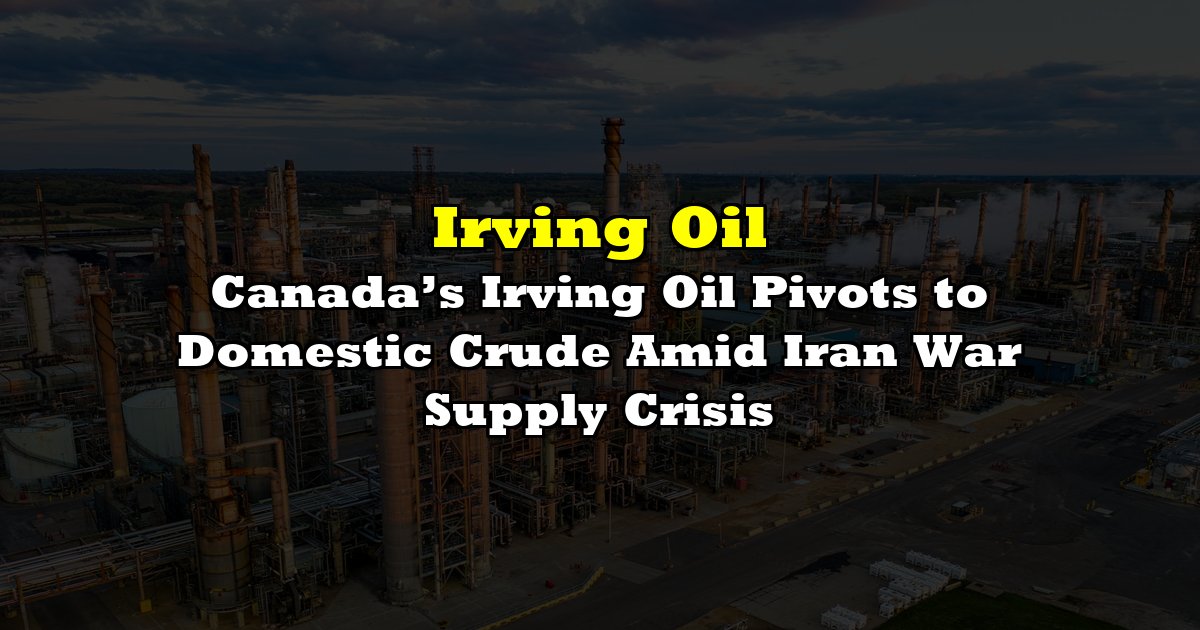

Irving Oil Ltd., operator of Canada’s largest refinery, has secured approval to source 650,000 to 680,000 barrels of crude from Newfoundland and Labrador for the first time since July 2020, as the ongoing US-Israel war on Iran disrupts Middle Eastern oil supplies through the Strait of Hormuz.
The crude will be transported from the Whiffen Head terminal to the 320,000-barrel-a-day Saint John refinery in New Brunswick between April 25 and May 25 using foreign tankers, following a waiver from the Canadian Transportation Agency.
The Saint John refinery, a critical supplier to the US Northeast, has historically relied on Persian Gulf crude, with Saudi Arab Light ranking as its second-most-used grade since 2020, behind West Texas Intermediate. Iraq’s Basrah Light also featured prominently among its imports, alongside Saudi Arab Heavy and Arab Extra Light. However, the Iran conflict has throttled these supply lines, prompting Irving to label the situation as the most severe crude oil disruption in recent history, with profound impacts on global production, shipping, refining, and energy security.
Canada's largest refinery is sourcing Newfoundland crude for the first time since 2020, pivoting away from Middle Eastern supplies disrupted by Iran-related tensions.
— The Dive Feed (@TheDeepDiveFeed) April 3, 2026
In response, Irving is in discussions to acquire Hebron crude, produced by Exxon Mobil Corp. off Newfoundland’s Atlantic coast, for immediate delivery. This marks a sharp pivot for the refinery, which last received a cargo of Hibernia crude—about 633,000 barrels—in July 2020 via the tanker Clio. Earlier imports of Newfoundland crude occurred in 2016 and 2017, though reliance on domestic sources has been rare until now.
The shift comes as Canada grapples with limited domestic oil tanker capacity. Under the Coasting Trade Act, akin to the US Jones Act, goods must typically be shipped between Canadian points on Canadian-registered and crewed vessels. The government’s decision to grant Irving a waiver for foreign tankers underscores the urgency of securing alternative crude amid geopolitical turmoil. Meanwhile, in the US, the Trump administration has temporarily lifted Jones Act restrictions for 60 days, allowing foreign-flagged vessels to transport gasoline, diesel, and jet fuel between domestic ports.
Before the crisis escalated, Irving had a million-barrel cargo of Arab Light scheduled to arrive on March 28, having departed Ras Tanura in Saudi Arabia on February 14. Earlier shipments this year included additional cargoes from Saudi Arabia and Iraq, reflecting the refinery’s heavy dependence on the region until the current conflict forced a strategic rethink.
Information for this story was found via the sources and companies mentioned. The author has no securities or affiliations related to the organizations discussed. Not a recommendation to buy or sell. Always do additional research and consult a professional before purchasing a security. The author holds no licenses.