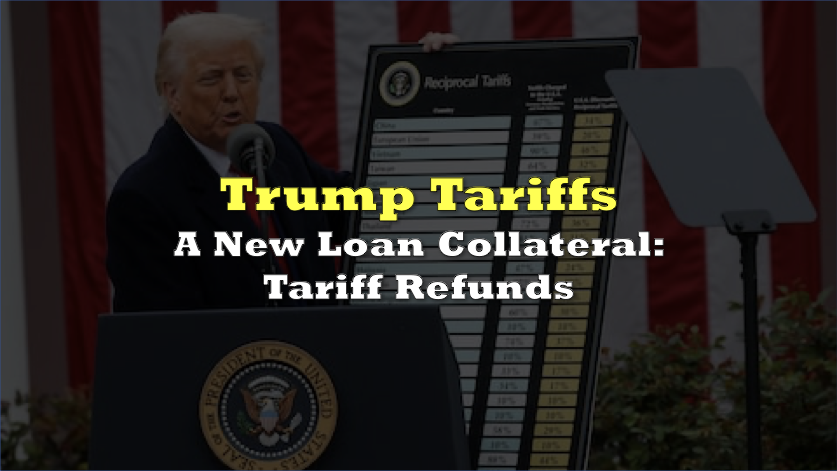
A New Loan Collateral: Tariff Refunds

  • Tariff refund claims are evolving from legal recoveries into financeable assets, with companies weighing the cost of borrowing against the steep discounts demanded by buyers of those claims.

Tariff refund claims tied to President Donald Trump’s now-overturned “Liberation Day” tariffs are emerging as a new pocket of structured finance, as importers explore using those claims as collateral for loans instead of selling them outright at a discount.

The US Supreme Court declared the tariffs illegal in February, but more than 330,000 importers that paid the levies are still seeking about $166 billion back from the government. That lag has opened space for lenders, claim buyers, brokers, and legal advisers to structure transactions around future refund proceeds.

Several financial firms had already begun buying refund claims from importers that doubted they would see cash anytime soon. The newer variation is lending against the claims, which gives companies immediate liquidity while allowing them to retain ownership of the refund right.

Borrowing, not selling

The loans are being structured as term loans with payment-in-kind interest, meaning the interest accrues and is intended to be repaid from the eventual refund.

That discount remains material even after prices improved following the Supreme Court ruling. According to Neil Seiden, managing director of Asset Enhancement Solutions, a $500,000 tariff claim can generally be sold outright at roughly 55 to 75 cents on the dollar. For larger financings, the funds he works with require a minimum $10.0 million loan size backed by a tariff claim of at least $20.0 million.

Seiden said that at a hypothetical 15% interest rate, the break-even point between borrowing and selling a claim at 80 cents on the dollar is a little more than two years. If a company expects the refund inside that window, borrowing may preserve more value. If it expects a longer delay, accrued interest can erode the benefit.

Trade experts cited in the report believe refunds could take at least two years to resolve, with delays driven by possible appeals, eligibility reviews, administrative bottlenecks, and what was described as the Trump administration’s adversarial stance toward refunds. The US customs agency said Tuesday that it was making progress on a refund process, but also indicated some payments may be delayed.

Risk on both sides

The structure is not free money with a bow on top. Borrowers face high interest costs and may still owe the loan if the government does not issue the expected refund. Seiden said lenders underwrite heavily to ensure the borrower can repay, and if the refund falls short of covering the interest, the company must pay the difference out of pocket.

There’s also the danger of collateral erosion where the claim values fall and the collateral backing the loan weakens materially, raising the prospect of losses or borrower default.

That risk explains why some capital providers still prefer outright purchases. Outpost Capital Partners managing partner Brian Coppola said he plans to deploy billions into refund claims and has already acquired several from large US retailers.

Buyers in that market are also looking for protection. Tony Gulotta, principal at tax consultancy Ryan, said he has discussed contingency insurance with at least one buyer to protect against seller insolvency or a breakdown in seller cooperation during the refund process.

One additional risk flagged for larger retailers is litigation exposure. Gulotta said retailers could face class-action suits if tariffs were passed through to customers, creating another complication around the ultimate value of claims.

So far, the market remains early. Asset Enhancement Solutions has already brokered $20.0 million in tariff claim purchases but has not yet closed a loan backed by a tariff refund.


Information for this story was found via Reuters and the sources and companies mentioned. The author has no securities or affiliations related to the organizations discussed. Not a recommendation to buy or sell. Always do additional research and consult a professional before purchasing a security. The author holds no licenses.


Leave a Reply

Video Articles

This Gold Story Starts With Cash Flow | Gordon Robb – ESGold

Silverco Cusi Mine PEA: Bigger Isn’t Always Better

Fixing Heart Disease Tied to Sudden Death in Young People | David Elsley – Cardiol Therapeutics

Recommended

Cambria Gold To Spin Out Mt. Margaret Copper-Gold Project Into US-Focused Entity

Two Vessels Attacked Near Strait of Hormuz Within Hours as IRGC Escalates Maritime Campaign

Related News

Pentagon Targets Domestic Gallium Recovery After China Export Curbs

The Pentagon plans to award contracts to North American companies by year-end to recover gallium,...

Friday, March 7, 2025, 10:39:00 AM

Ontario Targets Auto, Steel Sectors with $1B Emergency Loan Program

Ontario announced Wednesday that emergency funding will soon flow to businesses hammered by US trade...

Thursday, August 14, 2025, 12:59:00 PM

Griffin: US Should Focus on Strengths, Not Manufacturing Revival

Citadel CEO Ken Griffin rejected President Trump’s tariff strategy as ineffective in bringing back manufacturing...

Sunday, May 4, 2025, 07:44:00 AM

Is Saudi Arabia Poised to Profit from a US Imposing Tariffs on Canada Oil?

In a week marked by renewed attention on U.S. energy policy, a debate has emerged...

Thursday, January 23, 2025, 02:04:00 PM

Auto Sector Faces Uncertain Future as US-Canada Trade Tensions Escalate

Canada’s automotive sector stands at a critical juncture as recently implemented US tariffs threaten its...

Monday, May 12, 2025, 12:10:00 PM