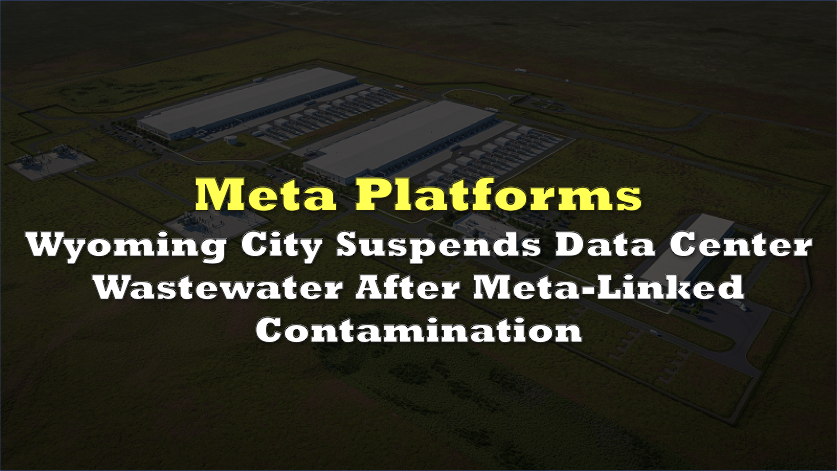

Cheyenne, Wyoming has stopped accepting certain industrial wastewater from data center operations after a Meta Platforms contractor was cited for significant noncompliance over a bacterial discharge that reached the city’s wastewater treatment process.
The City of Cheyenne Board of Public Utilities said it is suspending acceptance of industrial discharges tied to data center fill-and-flush and closed-loop system operations until further notice.
The board identified Goat Systems LLC as the regulated industrial wastewater discharger in significant noncompliance with Cheyenne City Code. It said Goat Systems contributed Cupriavidus gilardii, a bacterium, in a way that interfered with and caused pass-through at Cheyenne’s water reclamation facilities.
 Sponsored · Altamira Gold Corp.
The discharge was tied to fill-and-flush work at “Meta Cheyenne Datacenter CHY 1-2,” according to the notice. BOPU said Goat Systems was notified of the pollutant and immediately stopped discharging wastewater from that operation.
The agency revoked Goat Systems’ industrial discharge privileges for fill-and-flush operations effective March 24, 2026.
The public policy problem is timing. BOPU issued a broader warning on June 26 reminding residential, commercial and industrial users that hazardous substances are prohibited in the sanitary sewer system, but that notice did not name Goat Systems or Meta. The named noncompliance notice came days later, after months of questions about the source of the contamination.
That gap is now driving the political pressure. Conservative commentator Daniel Horowitz accused local officials of withholding information while Cheyenne considered data center issues.
Goat Systems has been tied to Meta’s Cheyenne expansion before. Data Center Dynamics reported in 2024 that the company behind the then-unnamed Project Cosmo was Goat Systems, and that the project covered about 945 acres with plans for roughly 800,000 square feet of data center development.
 Sponsored · Selkirk Copper Mines
Meta later publicly announced Cheyenne as its newest data center location, describing the campus as a 715,000-square-foot project with more than $800 million in planned investment, about 100 permanent jobs and more than 1,000 construction workers at peak construction. This is part of the larger $8.3 billion campus projected to host roughly 251,000 H100-equivalent AI chips and will be supported by 220 MW of power.
Cowboy State Daily reported that Meta said it is supporting its general contractor, Fortis, in resolving the issue with BOPU. Meta’s statement said Fortis stopped discharging industrial wastewater and began hauling it offsite after BOPU identified a substance in the city’s wastewater, not public drinking water.
Meta also said that Fortis began independent testing with an environmental specialist and found no trace of the substance.
Cheyenne City Councilman Pete Laybourn called the disclosure “a very, very unpleasant surprise,” and Mayor Patrick Collins described it as a disappointment while crediting BOPU for catching and addressing the contamination.
BOPU’s June 26 notice said Cupriavidus gilardii is not a regulated contaminant, but the later significant noncompliance notice said the discharge still interfered with Cheyenne’s wastewater treatment processes.
That means the enforcement issue is not simply whether a pollutant appears on a standard contaminant list. The issue is whether the discharge disrupted the system.
Cheyenne is not alone in facing a sharper data center backlash. Across the US, local fights increasingly center on water, power, noise, tax incentives and transparency. Recent reporting has shown cities debating new limits, zoning restrictions, and even bans as AI demand pushes developers into more communities.
For Cheyenne, the city already has a data center footprint, and industry boosters have promoted Wyoming’s tax structure, energy access, climate and land availability as selling points for expansion. 1547 Critical Systems Realty, a data center operator, described Cheyenne as an emerging market helped by fiber routes, lower costs and major investments by Microsoft and Meta.
The wastewater notice complicates that pitch. For a city courting hyperscale investment, the lesson is blunt: data centers may live in the cloud, but their risk profile still lands in pipes, treatment plants and council chambers.