
Three Canadian National Railway trains carrying combustible and flammable materials were immobilized in northwestern Ontario as advancing wildfires forced evacuations, closed transportation routes, and temporarily severed rail operations through a remote section of the province.
CN evacuated employees and suspended operations in the area as a precaution, according to reporting by Superior North News. Ontario Provincial Police said emergency responders and railway officials were assessing the stopped trains and that there was no immediate threat to the public when the police advisory was issued.
The operational consequences extend beyond the dramatic footage of flames surrounding a locomotive. The incident left three freight trains, including cars carrying hazardous cargo, staged on an isolated rail subdivision while communities on both sides of the corridor were under mandatory evacuation orders.
OPP said the trains were stopped between mile markers 20 and 23 of CN’s Allanwater Subdivision near Collins, Ontario, because of wildfire activity.
 Sponsored · Selkirk Copper Mines
Police did not identify the specific products aboard the trains, the number of tank cars involved, or whether any rail cars or cargo systems were damaged. No leak, derailment, fire involving the cargo, or immediate threat to nearby communities was reported in the official advisory.
CN temporarily suspended operations through the affected area. The company’s network forms a major east-west freight connection across northern Ontario, meaning an extended closure could force trains to wait at terminals, be staged elsewhere on the system, or face longer transit times.
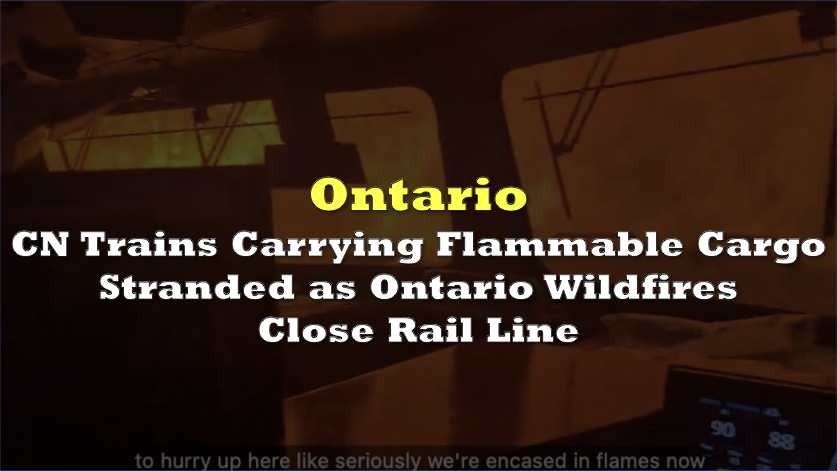
Video circulated by Ontario NDP legislator Sol Mamakwa shows flames burning along both sides of a railway track while crew members communicate urgently from inside a locomotive.
“This could potentially overtake us here,” a crew member says in the recording. “We’re encased in flames.”
The rail shutdown occurred during a broader evacuation across northwestern Ontario. OPP issued mandatory evacuation orders affecting Armstrong, Collins First Nation, Whitesand First Nation, Lac La Croix First Nation, and Lac des Mille Lacs First Nation. Road closures and fire conditions complicated movement across an area where communities are separated by long distances and limited transportation links.
Ontario also imposed a Restricted Fire Zone across the Northwest Region and parts of the Northeast Region beginning at 12:01 a.m. on July 15. The restriction included the Municipality of Greenstone, which contains Armstrong, and prohibited most outdoor fires as authorities attempted to prevent additional ignitions.
The stranded trains underline the vulnerability of northern rail operations to fires occurring far from major terminals or emergency-response centres.
In southern urban corridors, equipment can often be held in large yards, crews can be replaced quickly, and emergency responders have multiple road approaches. The Allanwater corridor runs through sparsely populated territory where access can depend on the railway itself.
Once wildfire conditions close both roads and tracks, crews may have limited escape options and responders may be unable to approach trains carrying hazardous materials until fire conditions improve.