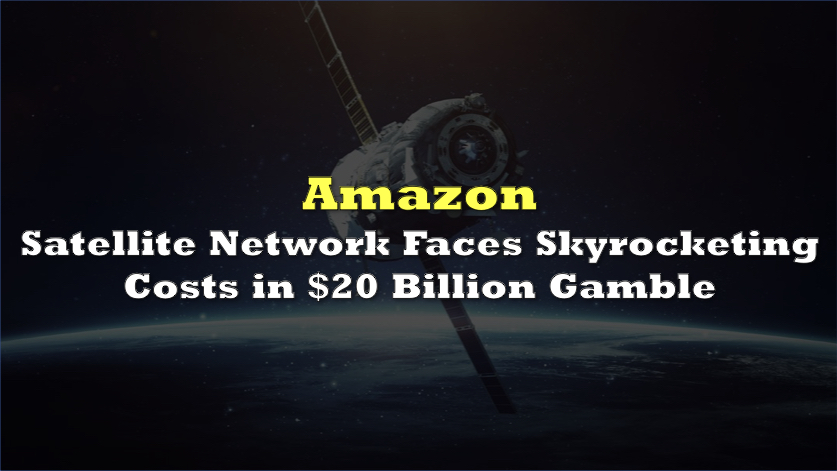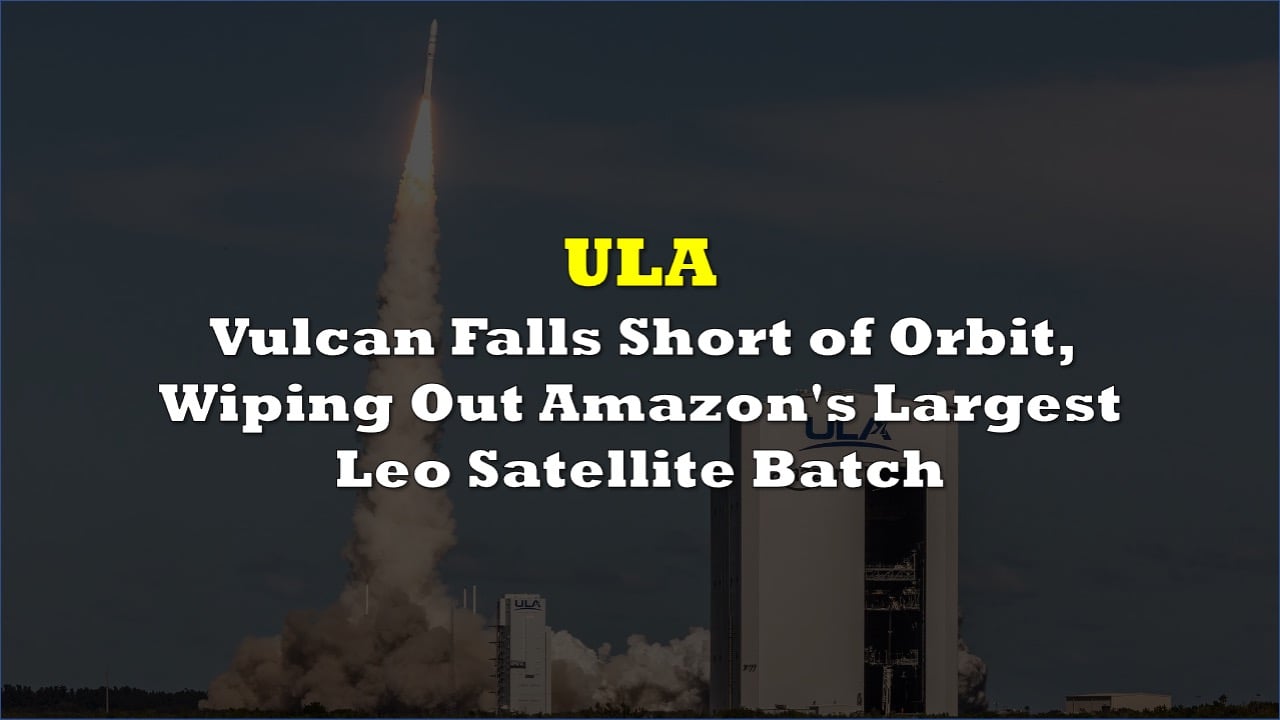

A United Launch Alliance Vulcan rocket failed about 10 minutes into flight Sunday and lost 40 Amazon (Nasdaq: AMZN) Leo internet satellites, the first outright mission failure since ULA formed in 2006.
The rocket lifted off at 12:40 p.m. EST from Space Launch Complex 41 at Cape Canaveral Space Force Station in Florida. ULA, a joint venture of Boeing (NYSE: BA) and Lockheed Martin (NYSE: LMT), said about 50 minutes later that the vehicle suffered an anomaly and failed to deliver the mission to orbit.
The failure came while the Centaur upper stage was due to be firing, and ULA has not identified a cause. Public flight telemetry also appeared to show the first stage’s two BE-4 engines burning longer than planned and the Centaur separating later than expected, though no official account has tied either detail to the failure. The six strap-on solid boosters appeared to perform normally.
ULA said it will investigate with Amazon and other partners and aims to resume flying quickly. A person familiar with the matter said Blue Origin, which builds Vulcan’s BE-4 first-stage engines, is helping with the investigation. NASA Administrator Jared Isaacman offered the agency’s assistance with the probe and the fixes.
 Sponsored · Cambria Gold Mines
Amazon said that launches carry risk, especially on inaugural missions, and called ULA a trusted partner that it believes will learn from the failure.
The launch had slipped from Friday, when a nitrogen gas plant shared by several launch providers failed. Network problems between the rocket and ground systems forced another delay Saturday. Controllers also called a hold 20 seconds before liftoff Sunday for an unexplained technical issue, and ULA cleared it. It remains unclear whether that hold played a role.
The rocket carried the largest payload Amazon has flown on a single launch, and the flight was the first of 38 Vulcan missions the company bought. The company planned to put more than 1,500 first-generation Leo satellites on Vulcan, the largest share of any rocket it has booked.
Amazon had 396 satellites in orbit before Sunday and said it still planned to begin commercial service later this year. The lost satellites would have lifted the total to 436.
The FCC waived the halfway deployment milestone of 1,616 satellites in June but kept the July 2029 deadline for the full 3,232-satellite constellation. Satellites launched after July 30 will temporarily lose spectrum priority under the waiver.
Amazon’s other heavy rockets offer limited relief as Blue Origin’s New Glenn remains out of service after an explosion at its launch pad in May. Arianespace plans to fly its next Ariane 6 with Leo satellites no earlier than November 23. Amazon cannot fly Vulcan again until ULA finishes its investigation.
Vulcan had flown four times before Sunday and sat idle for the nine months before it. Booster nozzle problems struck the second flight in October 2024 and the fourth in February, though the rocket reached orbit both times. Sunday’s flight was the first to carry six strap-on boosters.
The Space Force said in late February that it would not launch national security missions on Vulcan until the booster anomaly was resolved. ULA chief executive Mark Peller said before Sunday’s launch that engineers had pinpointed three likely causes of the nozzle problem and moved to fix each one. ULA has not said how long the new investigation will take.