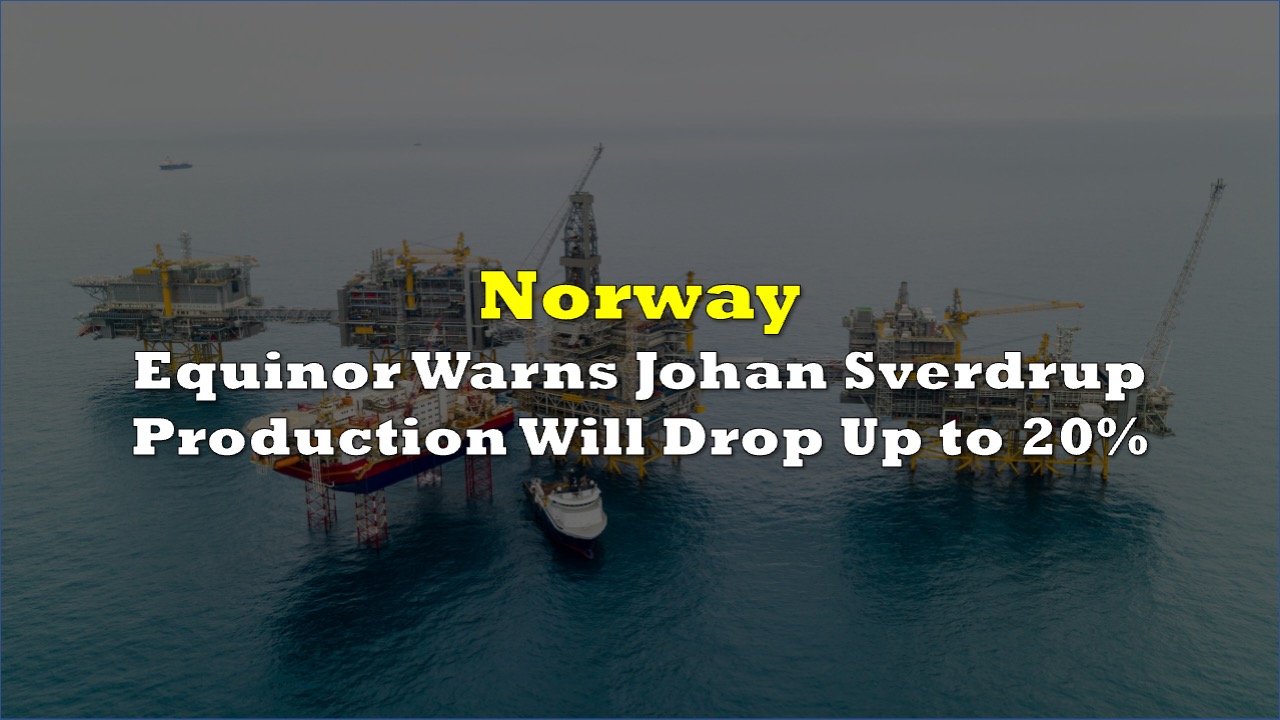

Production will decline between 10% and 20% this year at Norway’s Johan Sverdrup oil field, marking a shift for the North Sea asset that has driven European supply expansion since 2019, Equinor announced Wednesday.
Chief Executive Officer Anders Opedal revealed the forecast during a media briefing alongside fourth-quarter results. The field pumped an average 712,000 barrels per day last year, according to loading programs compiled by Bloomberg.
Norway’s Equinor expects oil output from its Johan Sverdrup oil field, the largest source of European supply growth in the last decade, to fall by 10-20% this year.
— Heather Exner-Pirot (@ExnerPirot) February 4, 2026
Dwindling output in the key North Sea field is the latest reminder that global oil markets may struggle to keep…
“We’ve been able to postpone the decline for a long time,” Opedal said. “This year we anticipate a decline of more than 10%, but well below 20%.”
Johan Sverdrup supplies about 33% of Norway’s crude production and ranks as the third-largest field on the Norwegian continental shelf. Equinor shares dipped as much as 1.2% in Oslo following the announcement.
The output decline underscores concerns about global supply shortfalls after a period of oversupply. Meeting declining production from mature fields requires annual investment of $540 billion, according to International Energy Agency estimates.
The field sits 160 kilometers west of Stavanger and contains an estimated 2.7 billion barrels of extractable reserves. Production began in October 2019, with maximum capacity at 755,000 barrels per day.
Equinor and partners are investing 13 billion Norwegian kroner ($1.3 billion) in a third development phase targeting 40 million to 50 million additional barrels through two new subsea templates.
The field produced a record 260 million barrels last year, exceeding any previous annual total from a Norwegian asset. Equinor’s overall equity production reached 2.14 million barrels of oil equivalent per day in 2025, up 3.4% from 2024.
Johan Sverdrup operates with carbon emissions of 0.67 kilograms of CO2 per barrel, well below the 15-kilogram global average. Shore-based hydroelectric power reduces emissions by 80% to 90% compared with traditional offshore operations.
Information for this story was found via Bloomberg, and the sources and companies mentioned. The author has no securities or affiliations related to the organizations discussed. Not a recommendation to buy or sell. Always do additional research and consult a professional before purchasing a security. The author holds no licenses.