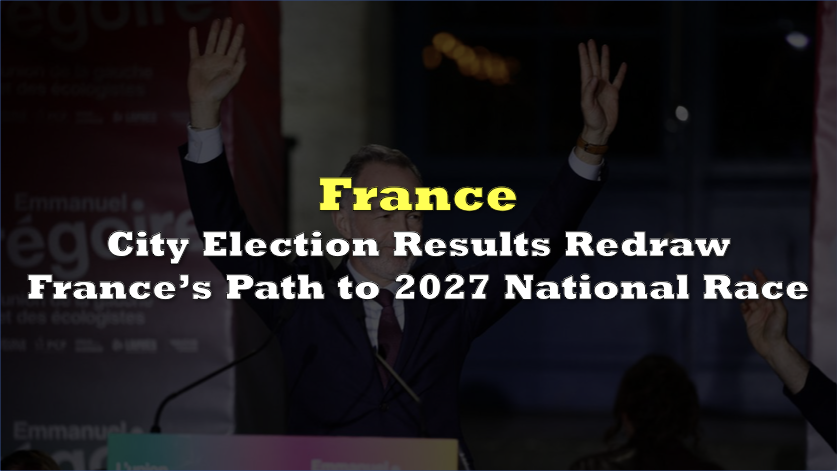

France’s municipal runoff gave mainstream parties their clearest morale boost in months and suggested that the presidential election next year may be more competitive than national polling alone implies. The Socialists and their allies held France’s largest urban bastions, the centre took symbolic ground, the mainstream right remained locally relevant, and the far right again showed strength outside the biggest metropolitan strongholds.
The most important result was the left’s hold over the country’s biggest city halls. The Socialists and allies kept Paris, Marseille, and Lille, while Lyon stayed in the broader left column. Holding these cities matters because those four cities are among the country’s most visible political platforms and the best tests of turnout machinery.
Paris was especially valuable. Socialist Emmanuel Grégoire defeated conservative Rachida Dati, extending roughly 25 years of left-led control of the capital after Anne Hidalgo did not seek another term.
In Marseille, Socialists retained as incumbent Benoît Payan held off far-right hopes of capturing France’s second-largest city. Lille also remained in Socialist hands.
In Lyon, Green mayor Grégory Doucet survived a difficult contest despite a late merger with France Unbowed, or LFI.
The 2027 race
Across several cities, including Toulouse, Strasbourg, Poitiers, Limoges and Tulle, alliances between mainstream left parties and LFI underperformed or failed. In older Socialist strongholds such as Clermont-Ferrand and Brest, voters moved toward the centre and right rather than rewarding union with the far left.
The implication for the national race is blunt. A united left is not automatically an electorally stronger left. In large cities where Socialist incumbents kept their distance from LFI, including Paris, Marseille and Lille, left-wing administrations were comfortably returned. That gives the Socialist Party an argument that ideological moderation and distance from LFI’s controversies may be more effective than bloc politics in a presidential runoff environment.
LFI still found evidence of momentum. It pointed to a first-round win in Saint-Denis and a runoff victory in Roubaix, reinforcing its appeal in suburban and peripheral zones with large immigrant working-class populations and younger activist voters.
But the broader map in these notes supports a harsher national reading. LFI can mobilize pockets. It did not prove it can anchor a winning mainstream coalition.
The far right’s results were real but mixed. National Rally and its allies secured a major symbolic victory in Nice, where Éric Ciotti defeated incumbent Christian Estrosi and gave the nationalist camp control of France’s fifth-largest city. The party also showed strength in smaller provincial municipalities and kept or won towns such as Perpignan, Montargis, Carcassonne, and La Seyne-sur-Mer.
However, reports suggest the party did not take Marseille, Toulon, or Nîmes reinforcing a national pattern already familiar in French politics. While National Rally is strong in polls, strong in parts of provincial France, and increasingly normalized in alliances with figures from the traditional right, it still faces resistance in the country’s biggest urban battlegrounds when opponents consolidate against it.
For President Emmanuel Macron’s camp, the results were neither collapse nor comeback. Renaissance scored a symbolic win in Bordeaux, where Thomas Cazenave defeated the outgoing Green mayor with backing from the centre and right.
Former prime minister Édouard Philippe also won in Le Havre, strengthening his standing as a possible centrist candidate in 2027 and clearing a condition he had attached to a presidential run. But the broader presidential alliance also showed fragility, with François Bayrou losing in Pau.
Interior Ministry figures put mainland participation at 48.1%, above the Covid-hit 2020 election but still below pre-pandemic norms.
Information for this story was found via BBC, Euro News, and the sources and companies mentioned. The author has no securities or affiliations related to the organizations discussed. Not a recommendation to buy or sell. Always do additional research and consult a professional before purchasing a security. The author holds no licenses.