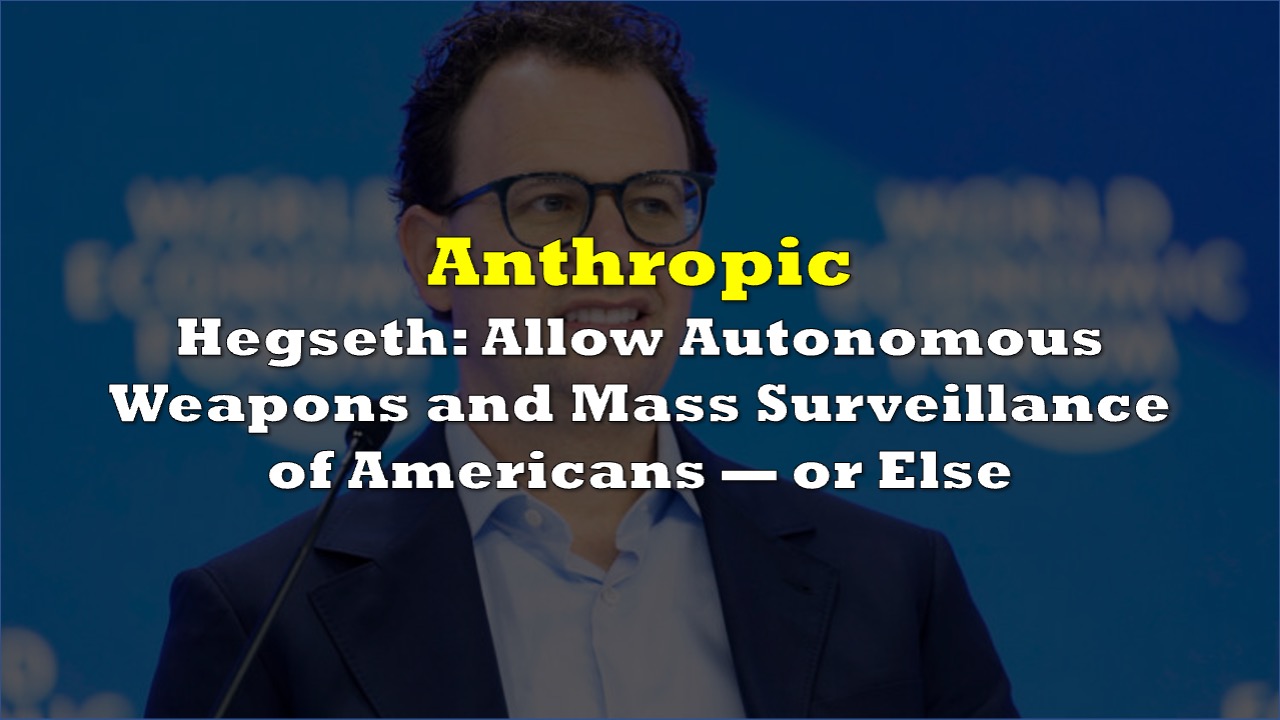

Defense Secretary Pete Hegseth met with Anthropic CEO Dario Amodei at the Pentagon on Tuesday and delivered a hard deadline: agree by 5 p.m. Friday to give the military unfettered access to Claude, or face consequences that could include a government blacklist — or forced compliance under a Cold War-era national security law.
Read: Pentagon Threatens to Banish Anthropic as Hegseth Issues Ultimatum
The Pentagon put three options on the table if Anthropic does not comply, according to an exclusive report from Axios. The first is the termination of Anthropic’s $200 million contract with the Defense Department. The second is a “supply chain risk” designation — effectively a government blacklist that would require any company with Pentagon contracts to certify it does not use Claude in its workflows. The third, and most sweeping, is the invocation of the Defense Production Act.
A Pentagon official put it plainly: the company has until “5:01pm on Friday to get on board or not,” adding that Hegseth would ensure “the Defense Production Act is invoked on Anthropic, compelling them to be used by the Pentagon regardless of if they want to or not.”
The Defense Production Act, a law from the 1950s typically invoked during national emergencies, gives the government authority to compel private companies to share resources deemed critical to national security. The Trump administration previously used it during the pandemic. Applying it to an AI company would be unprecedented.
wow. "the US government forces anthropic to misalign Claude" was not even in my list of possible paths to Doom. guess it should have been https://t.co/9cMC5AaqX2
— Tenobrus (@tenobrus) February 24, 2026
Despite the pressure, Amodei held his ground. Multiple sources described the tone of the meeting as cordial — Hegseth praised Claude and said the Pentagon wants to keep working with Anthropic — but Amodei did not move on either of the company’s two red lines: Claude will not be used for fully autonomous weapons operating without human involvement, and it will not support the mass surveillance of Americans.
He also disputed the Pentagon’s claim that Anthropic raised concerns about Claude’s use during the January raid that captured Venezuelan President Nicolás Maduro, telling Hegseth that Anthropic never objected to or interfered with any legitimate military operation.
Anthropic’s post-meeting statement held the same line: “We continued good-faith conversations about our usage policy to ensure Anthropic can continue to support the government’s national security mission in line with what our models can reliably and responsibly do.”
The Pentagon’s response was pointed. “You can’t lead tactical ops by exception,” a senior official told CNN. “Legality is the Pentagon’s responsibility as the end user.”
During the meeting, Hegseth compared the situation to a defense contractor telling the military it could not use one of its planes for a particular mission — arguing that once the Pentagon purchases a product, the company has no say in how it is used.
Amodei’s counterargument was that AI models are fundamentally different from hardware. Claude’s behavior is not fixed at delivery; it reflects design choices Anthropic makes about reliability and safety margins.
The company’s position is that AI systems are not yet reliable enough for lethal autonomous decisions, and that the technology significantly expands what mass domestic surveillance can accomplish — raising risks that did not exist with conventional defense products.
The DPA threat is shakier than it sounds. To start, Hegseth cannot invoke it himself — the authority belongs to the president, meaning any actual action would require Trump to sign an executive order. But Trump does love his executive orders.
More fundamentally, the DPA was designed for physical goods: weapons systems, raw materials, ventilators, and semiconductors. The statute defines national defense in terms of military production, critical infrastructure, and supply chains for tangible goods, and the Pentagon routinely uses it to prioritize delivery of hardware contracts without any emergency declaration.
Applying it to compel a private company to alter the behavioral parameters of a software model is a different matter entirely. Franklin Turner, a government contracts lawyer at McCarter & English, told Reuters the scenario is “unprecedented and will almost certainly trigger a raft of downstream litigation if the administration takes adverse action against Anthropic here.”
The Mercatus Center’s legal analysis of Biden’s attempt to invoke the DPA on AI reporting requirements reached a similar conclusion: stretching the statute to cover AI model behavior “lacks a connection to the DPA’s traditional goals of boosting production, stockpiling, or prioritizing the acquisition of tangible goods.”
Trump could potentially claim cover under the national energy emergency he declared in January 2025 — the same hook he used for the minerals executive order last March — but that would still face immediate legal challenge on the question of whether AI guardrails constitute an “industrial resource” under the statute.
Whether Hegseth follows through by Friday remains the central question. The Pentagon has acknowledged that losing Claude would cause significant disruption — it remains the only AI model operating in classified military systems, and CBS News reported that one source described Claude as ahead of rivals in applications including offensive cyber capabilities.
Grok recently cleared classified network access, but is not considered a full substitute. Google‘s Gemini is seen as a potential longer-term replacement, though a classified-systems deal is not yet finalized. Anthropic, for its part, shows no sign of capitulating. Sources familiar with the company’s position told multiple outlets it has no plans to drop either red line before the deadline.
Information for this story was found via the sources and companies mentioned. The author has no securities or affiliations related to the organizations discussed. Not a recommendation to buy or sell. Always do additional research and consult a professional before purchasing a security. The author holds no licenses.