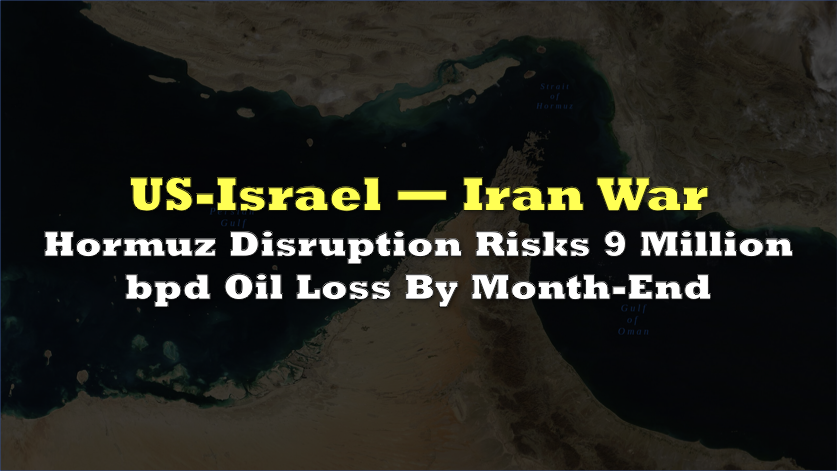

The Strait of Hormuz traffic freeze is now translating into what analysts describe as the “largest daily oil production disruption on record,” with regional output at risk of falling by more than 4 million barrels per day by Friday and around 9 million bpd by the end of the month, equivalent to nearly 10% of global demand.
Within hours of the war’s escalation, oil producer DNO’s chairman ordered the company’s Iraq wells shut while in transit from New York to Oslo on Feb. 28. As reports spread of an Iranian naval warning to ships not to enter Hormuz, tanker traffic slowed to a near standstill, Iraqi producers began running out of storage, and the country cut output by more than two-thirds.
Kuwait’s tanks then began filling, and Abu Dhabi National Oil Co. signaled on Saturday that it too was slowing production to prevent storage overflow.
US crude futures surged 36% last week, their biggest weekly jump since the contract began trading in 1983. Prices then rose again after President Donald Trump called on Friday for Iran’s unconditional surrender, marking the biggest single-day advance since the rebound from the 2020 pandemic crash, before adding another 20% when markets reopened Sunday evening.
US oil also moved above $100 a barrel on Sunday for the first time since the fallout from Russia’s invasion of Ukraine.
The strait is neither formally closed nor fully blocked, and some vessels carrying Iranian crude have still crossed. But on Sunday more than 1,000 ships were waiting to transit, with owners and crews deterred after attacks on at least nine vessels and the death of one crew member.
“We are looking at what is by far the biggest disruption in world history in terms of daily oil production,” said energy historian Daniel Yergin. The comparison point in market psychology is the 1973 embargo, when oil prices quadrupled within three months, but the current shock is being measured first in daily barrels at risk, not just price trajectory.
JPMorgan’s Natasha Kaneva called closure of the strait “an unthinkable scenario,” noting that in the entire written history of Hormuz it had never been closed.
Hormuz handles about a fifth of global oil and LNG supply, and the interruption is already spreading beyond crude. Middle Eastern aluminum smelters declared force majeure, pushing aluminum prices to multiyear highs while Norsk Hydro said its curtailment in Qatar could take 6 to 12 months to fully reverse.
Qatar has also halted natural gas output after Iranian drones targeted its Ras Laffan gas complex, removing roughly one-fifth of global LNG supply at a stroke. European gas prices jumped at the end of a winter that had already drained inventories, and Asian prices rose even more sharply in Qatar’s core export markets.
Traders rerouted cargoes mid-voyage toward higher-priced Asian buyers, including the LNG tanker Clean Mistral, which turned from a Spain-bound route toward Asia. Even if Hormuz reopens, liquefaction trains are not plug-and-play assets and could take weeks to restart.
China has stockpiles equal to roughly 200 days of imports and can switch to more coal if prices spike toward the $150-a-barrel level some on Wall Street are forecasting.
But elsewhere the buffers are thinner. Asia imports around 80% of the petroleum that sails through the Gulf. Myanmar has already rationed fuel for cars, Thailand has suspended some fuel exports, and the Philippines has ordered government offices to switch off computers at lunch and keep air conditioning no lower than 75 degrees Fahrenheit.
In India, fertilizer producers may have to cut output, raising risks for crop yields, while Pakistan faces the prospect of sharply higher energy bills under IMF-linked constraints.
The US is more insulated than in past oil shocks because oil now accounts for a smaller share of GDP and the country is a major energy exporter. However, higher gasoline, diesel and jet fuel prices are already feeding through to consumers and airlines, while rising energy costs have also pushed up mortgage rates and US government borrowing costs.
The administration has responded by easing sanctions on Russian crude to give India an alternative to Gulf barrels, a move that directly cuts across Washington’s recent effort to squeeze Moscow’s oil sector.
Information for this story was found via The Wall Street Journal and the sources and companies mentioned. The author has no securities or affiliations related to the organizations discussed. Not a recommendation to buy or sell. Always do additional research and consult a professional before purchasing a security. The author holds no licenses.