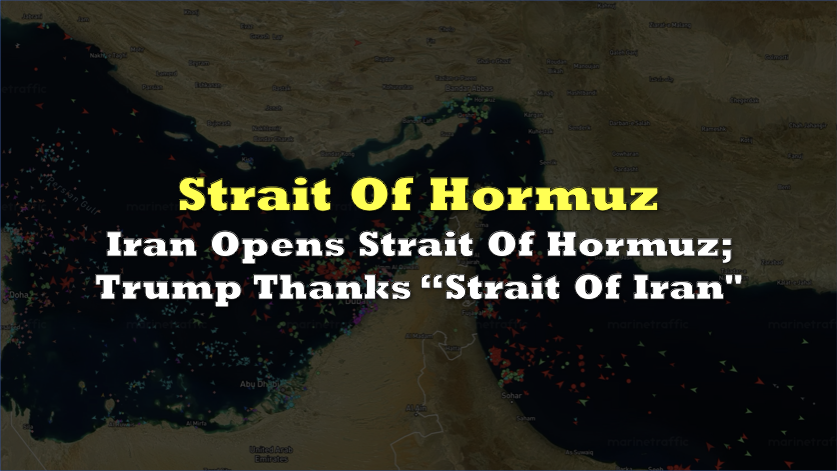

Iran’s decision to reopen the Strait of Hormuz for commercial shipping triggered an immediate repricing across oil, equities, and diplomacy, but the fine print showed that freedom of passage remains conditional and the US squeeze on Iran is still active.
Iranian Foreign Minister Abbas Araghchi said Friday that passage for all commercial vessels through the strait is “declared completely open” for the remaining period of the ceasefire, while specifying that ships must use “the coordinated route” already set by Iran’s Ports and Maritime Organisation.
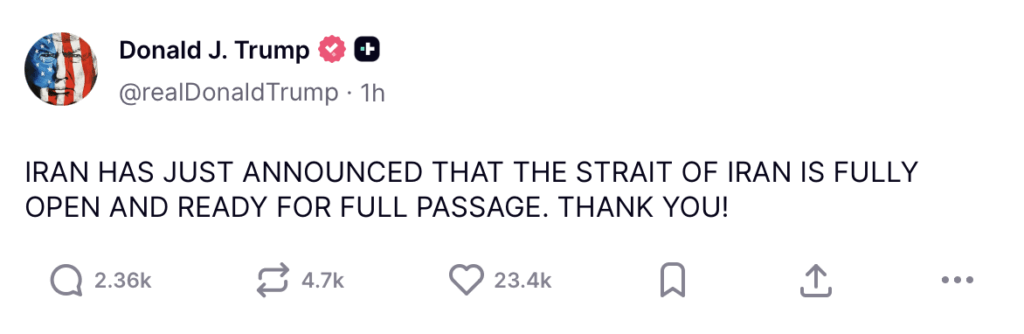
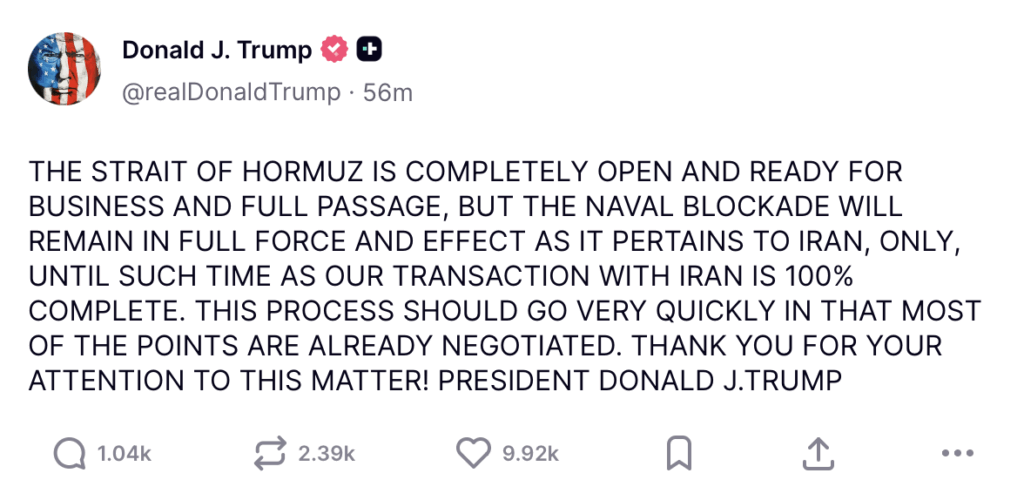
Trump welcomed the move in a Truth Social post, briefly referring to the waterway as the ‘Strait of Iran’ before later using the correct name, the Strait of Hormuz, while reiterating that the U.S. naval blockade on Iranian ships and ports would remain until a broader deal is complete.”
Brent crude fell about 9% to roughly $90 a barrel in Reuters reporting, while US crude dropped 10% to $81.5. The Dow Jones Industrial Average rose 678 points, or 1.4%, while the S&P 500 gained 0.8% and the Nasdaq added 1%. S&P futures were also reportedly up 0.9%, Europe’s STOXX 600 up 1.4%, and the US 10-year Treasury yield down 7 basis points to 4.23%.
 Sponsored · Cambria Gold Mines
The scale of the move reflects how central Hormuz remains to global energy pricing. Before the war, about one-fifth of the world’s oil and liquefied natural gas transit moved through the strait. Reuters said Brent had approached $120 a barrel in late March before Friday’s reversal. AP reported stocks have rallied more than 11% from their late-March low on hopes the US and Iran can still avoid the most damaging global economic scenario.
The reopening also arrived under deadline pressure as the truce in Lebanon is 10 days long and appears to be holding, while regional officials said the US and Iran had an “in-principle agreement” to extend the ceasefire to allow more diplomacy.
Trump separately said talks could resume as soon as this weekend and that he would extend the ceasefire if the sides were close to a deal. Pakistan remains central to that channel, with its army chief meeting Iran’s parliament speaker on Thursday as mediators pushed on three sticking points: Iran’s nuclear program, the Strait of Hormuz, and compensation for wartime damage.
The economic urgency behind reopening the passage had become acute. IEA Executive Director Fatih Birol warned Europe had “maybe six weeks or so” of jet fuel left if the strait stayed closed, while broader economic damage would intensify the longer the disruption lasted.
Prior to this, Trump prematurely claimed he is “permanently opening” the Strait of Hormuz and adding that “China is very happy” with the move that President Xi Jinping will give him “a big, fat hug.”
Information for this story was found via the sources and companies mentioned. The author has no securities or affiliations related to the organizations discussed. Not a recommendation to buy or sell. Always do additional research and consult a professional before purchasing a security. The author holds no licenses.