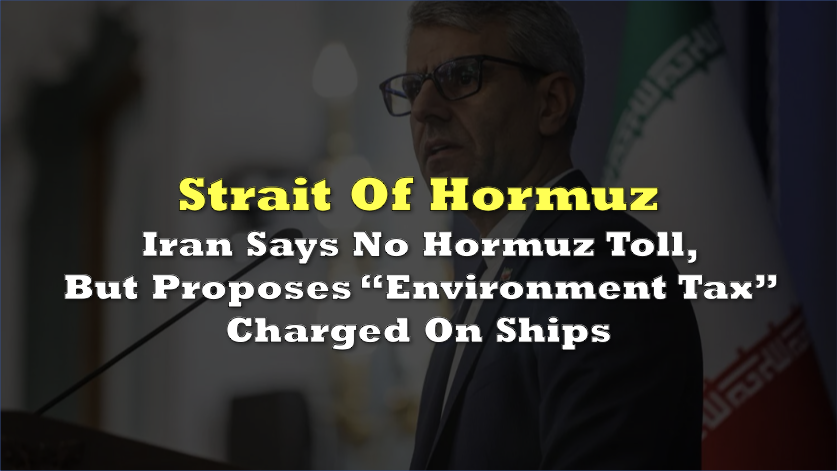

Iran’s proposed “environmental tax” on ships using the Strait of Hormuz creates a practical problem before it creates a pricing problem: no major shipper, insurer, bank, or charterer can assess the charge without knowing who collects it, what service is being sold, and whether the money reaches a sanctioned Iranian entity.
That is the unresolved issue behind Tehran’s latest language shift. According to an Iran Observer post citing Iran’s Foreign Ministry, Iran says there is “no toll” and that the proposed charge should instead be described as an environmental tax tied to maritime services for the Strait of Hormuz, the Persian Gulf, and the Sea of Oman. Iran and Oman are reportedly drafting a new protocol and hope to reach a final agreement soon.
The claim changes the label, not the compliance test. OFAC warned on May 1 that US and non-US persons face sanctions exposure if they pay or facilitate Iranian demands for safe passage through Hormuz. The alert specifically covered multiple payment routes, including fiat currency, digital assets, offsets, informal swaps, and in-kind arrangements.
 Sponsored · Selkirk Copper Mines
That makes the missing details material. A vessel operator would need to know whether the charge is mandatory, whether Oman has formally agreed, whether an independent maritime body collects the money, whether the proceeds are ring-fenced for environmental services, and whether any Iranian state, port, military, or sanctioned-linked entity touches the payment chain.
Without those details, the proposed tax sits in the most difficult category for the maritime industry: a payment described as regulatory by one government but potentially treated as coercive or sanctions-linked by another.
Reuters reported that Secretary of State Marco Rubio said a Hormuz tolling system would make a diplomatic agreement with Iran unfeasible. He described such a system as unacceptable, illegal, and a global threat, according to the report.
US and Chinese officials had also agreed that no country should charge tolls in international waterways, according to the State Department as reported by Reuters. Iran’s environmental framing appears designed to move the proposal into a different legal lane.
The Oman piece is especially important. Hormuz traffic passes through waters bordered by Iran and Oman, and Tehran’s claim of a joint protocol would carry different weight if Muscat publicly confirms the structure, terms, and enforcement role.
Without that confirmation, the proposal remains Iran’s description of a system that shipping companies may still be unable to use.
The timing adds pressure. Reuters reported Monday that several oil and LNG tankers had exited Hormuz after months of disrupted traffic, including vessels carrying LNG to Pakistan and China and a supertanker with Iraqi crude bound for China. Shipping activity, however, remains far below pre-war levels, with hundreds of ships and thousands of seafarers still affected by the Gulf disruption, according to the same report.
Information for this story was found via the sources and companies mentioned. The author has no securities or affiliations related to the organizations discussed. Not a recommendation to buy or sell. Always do additional research and consult a professional before purchasing a security. The author holds no licenses.