


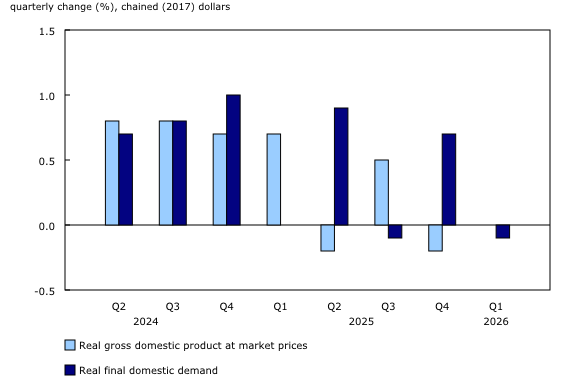
Canada’s economy flatlined in the first quarter, delivering a result so far below expectations that it tipped the country into a technical recession, Statistics Canada reported May 29. Annualized real GDP fell 0.1%, a miss of 1.6 percentage points against economists’ consensus forecast of 1.5% growth.
Two consecutive quarters of negative real GDP growth meet the common definition of a technical recession. The Q4 2025 contraction, itself revised lower to 1.0% annualized on the same day, made the pair complete. Three of the last four quarters have now posted negative readings.
The pattern underneath the headline number is one of persistent investment weakness. Business capital investment fell 0.7% in Q1, its fifth straight quarterly decline. Engineering structures led the damage, dropping 4.6%. Business investment in residential structures slid 2.0%, extending a 2.4% decline from Q4 2025.
 Sponsored · Altamira Gold Corp.
Resale housing activity took a harder hit still. Ownership transfer costs collapsed 9.9% in Q1, after falling 3.4% across all of 2025. New residential construction edged down 0.1%, though work on row homes and apartments increased.
Not everything moved against the trend. Machinery and equipment spending rose 2.5%. Non-residential buildings investment gained 2.1%. Software spending climbed 1.9%. Mineral exploration and evaluation surged 27.9%.
On the trade side, exports edged down 0.1% after rising 1.6% in Q4 2025. U.S. tariffs hammered shipments of passenger cars and light trucks, the steepest drag on the export line. Crude oil, crude bitumen, and natural gas exports moved higher, partially absorbing the auto-sector losses.
Imports rose 2.9%, but roughly half of that gain was tied to gold purchases, intermediate metal products and waste and scrap metal flowing into domestic inventories. Strip those out and imports were up a more modest 1.2%, led by passenger cars, light trucks, and industrial machinery. The gold-driven import surge built up business inventories, with the manufacturing sector adding to stockpiles after significant drawdowns in Q4 2025.
Household spending held up better than the investment side. Consumption rose 0.4%, building on a 0.7% gain the prior quarter, with financial services and food driving growth. Fewer new-vehicle purchases and a pullback in Canadians travelling abroad held the pace in check. Household disposable income rose 0.6% on the quarter. The saving rate held at 3.5%.
Statistics Canada’s early estimate for April points to 0.4% monthly GDP growth, driven by a return to activity in mining, quarrying, and oil and gas sectors. Those figures are expected to be revised.
Information for this story was found via the sources and companies mentioned. The author has no securities or affiliations related to the organizations discussed. Not a recommendation to buy or sell. Always do additional research and consult a professional before purchasing a security. The author holds no licenses.





The West Needs To Level The Playing Field To Compete With China
Access to the raw materials of the new green economy is increasingly a high-stakes chess...