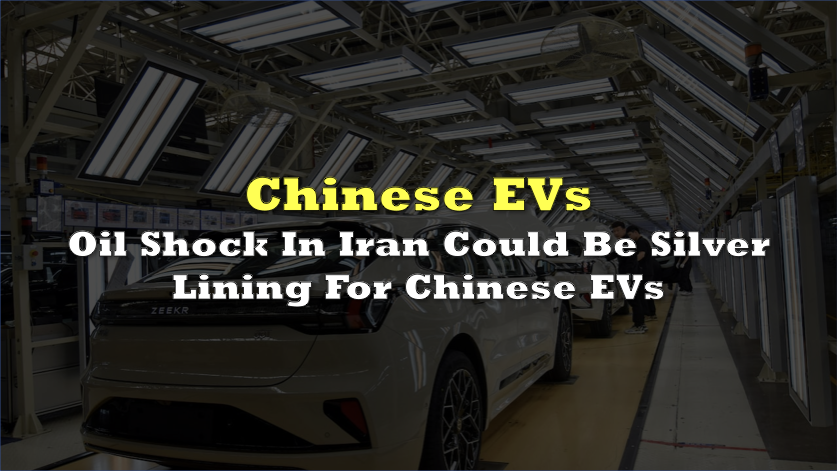

The Iran-linked oil shock could become a demand catalyst for electric vehicles, with the biggest near-term winners likely to be Chinese carmakers already expanding aggressively across cost-sensitive overseas markets.
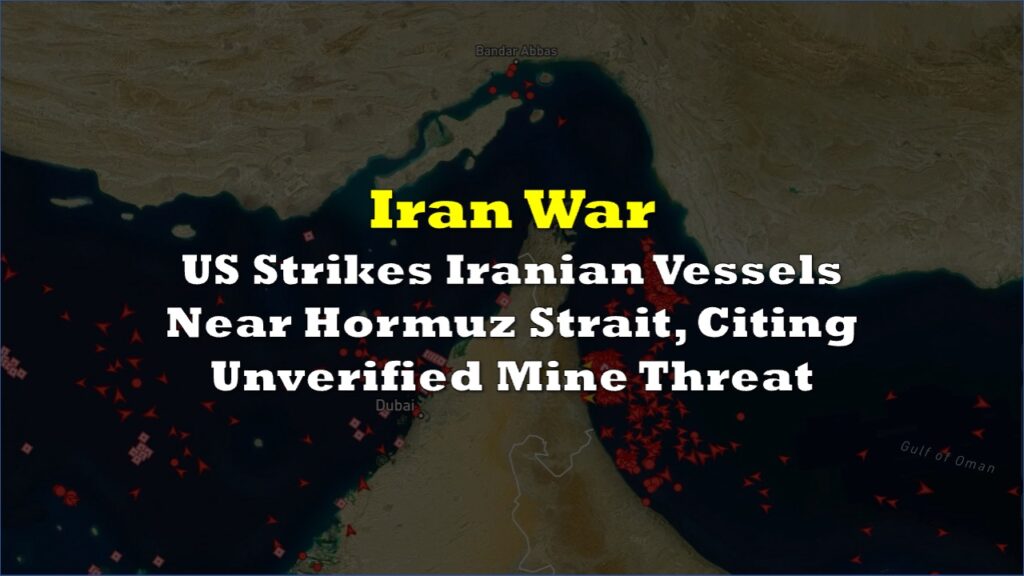
Brent crude traded above US$100 per barrel on Monday, while Wood Mackenzie’s David Brown said global oil prices had already surged an “eye-watering” 50% so far this month. He said the possible closure of the Strait of Hormuz could be a “game-changer for EVs.”
Brown added the effect would be especially strong in countries with access to low-cost Chinese EVs, where the price advantage over internal combustion models would arrive sooner. He pointed to Brazil as already the largest overseas market for BYD, underlining how emerging markets are becoming central to China’s EV export strategy.
HSBC’s Justin Feng made the same argument from a macro angle. In a Friday report, he said higher and more volatile oil prices could make EVs a clearer “cost-savings proposition” if the conflict persists, particularly across Asia.
The adoption data is already showing the shift. British think tank Ember said 39 countries now have EVs accounting for more than 10% of total auto sales, up from just four in 2019. A prolonged oil shock would reinforce that trajectory rather than create it from scratch.
Chinese automakers became the world’s largest sellers of vehicles in 2025, overtaking Japan. China shipped 8.32 million vehicles overseas last year, up 30%, while EV exports reached 2.32 million units, up 38%. Europe remained the largest export market, followed by Southeast Asia, Latin America, and the Middle East.
There is, however, a near-term operational constraint. EV manufacturing is energy intensive, so higher fuel and power costs can raise production costs and pressure margins. The reports identify Thailand as particularly exposed because it relies heavily on energy imports from the Gulf.
China appears better insulated on that front. The reports argue its EV sector is supported by more integrated supply chains and greater flexibility in energy sourcing, giving Chinese manufacturers more room to absorb shocks than peers in more energy-exposed markets.
Information for this story was found via South China Morning Post, Zero Hedge, and the sources and companies mentioned. The author has no securities or affiliations related to the organizations discussed. Not a recommendation to buy or sell. Always do additional research and consult a professional before purchasing a security. The author holds no licenses.