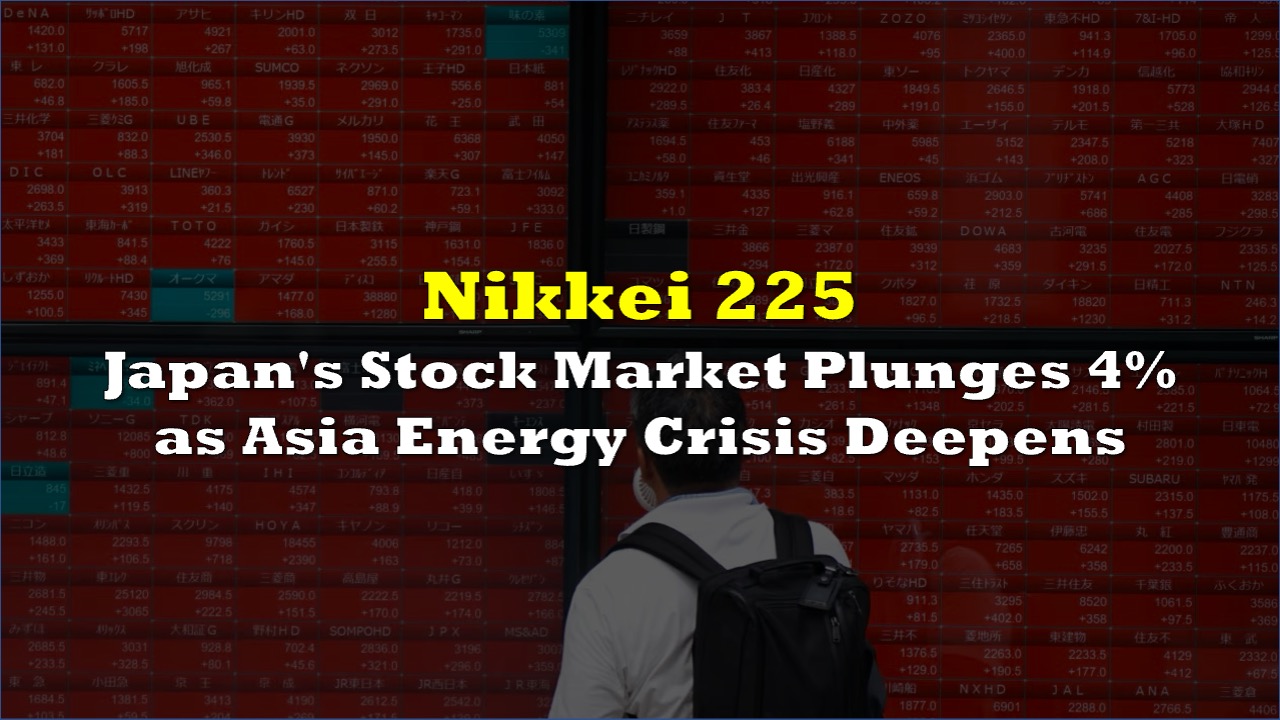

Japan’s stock market shed more than 4% Monday morning as surging oil prices and a deepening energy crisis tied to the five-week-old US-Iran war hammered Asian markets from Tokyo to Seoul.
The Nikkei 225 fell 4.33% to 51,061.90 as of mid-morning trade in Tokyo, shedding 2,311 points from Friday’s close of 53,373.07. The broader Topix dropped 3.9%. South Korea’s KOSPI declined roughly 4% to 5,240, while Hong Kong’s Hang Seng fell 1.52% and Taiwan’s Weighted Index lost 1.86%.
BREAKING: Japan's stock market falls nearly -5% as Asia's energy crisis intensifies. pic.twitter.com/ocHHn0O1F5
— The Kobeissi Letter (@KobeissiLetter) March 30, 2026
The sell-off follows a sharp rise in Brent crude to $115.61 per barrel — a price not seen since the summer of 2022 — as Iran-backed Houthi militants launched a volley of ballistic missiles at Israeli military sites over the weekend and President Donald Trump told the Financial Times he favored “taking” Iran’s oil, deepening fears of further escalation. US West Texas Intermediate futures climbed 1.62% to $101.25 per barrel.
The conflict, which began February 28 when the US and Israel launched joint air strikes on Iranian nuclear and military facilities, has effectively closed the Strait of Hormuz — the narrow waterway that carries roughly 20% of global oil supply. The closure has forced Gulf producers to slash combined output by at least 10 million barrels per day, according to the International Energy Agency’s March Oil Market Report, which called the disruption the largest in the history of the global oil market.
Bank of Japan policymakers flagged growing unease at their March meeting over the risk that sustained oil-driven inflation could force an earlier and steeper rate-tightening path than the central bank had anticipated. At least one member cautioned that global energy disruptions were raising the odds of broader domestic price pressures taking hold — a scenario that could compel the BOJ to act ahead of schedule.
Japan’s exposure to the crisis runs deep. According to the Ministry of Economy, Trade and Industry, 95.1% of the country’s crude oil imports originated from the Middle East as of January 2026, with 73.7% transiting the Strait of Hormuz directly. Tokyo has moved to cushion the blow: on March 16, Prime Minister Sanae Takaichi ordered the largest drawdown in the nation’s reserve history — 80 million barrels from the national and private stockpiles, representing roughly 45 days of domestic consumption.
Read: Japan Moves to Tap Oil Reserves as Iran War Shuts the Strait of Hormuz
Analysts warn that buffer buys limited time if the Strait closure extends beyond three months. In the meantime, rising input costs continue to squeeze automakers, semiconductor manufacturers, and logistics firms — sectors that dominate the Nikkei’s composition.
Asian markets entered the week under broad selling pressure, with analysts warning the worst may be ahead. In a research note circulated this week, Marko Papic of geopolitical strategy firm BCA Research put current war-related supply losses at 4.5 to 5 million barrels per day — about 5% of global output — and cautioned that the shortfall could reach twice that level by mid-April, which would surpass any crude supply disruption in recorded history.
Trump moved to deploy additional US troops to the region and floated the possibility of seizing Iran’s Kharg Island oil export hub, a move analysts at Quantum Strategy warned could trigger full-scale escalation.
JUST IN: 🇺🇸🇮🇷 President Trump confirms he is considering seizing Iran's Kharg Island, FT reports.
— BRICS News (@BRICSinfo) March 30, 2026
"My preference would be to take the oil…I don't think they have any defense. We could take it very easily." pic.twitter.com/W7Ze4jj4Zi
The administration has separately sought to buy time by temporarily lifting sanctions on select Russian petroleum tankers and coordinating with the IEA on a record 400-million-barrel emergency release from member states’ strategic reserves — a stockpile draw the agency cautioned would replace only a fraction of what the Strait closure removes each month.
Information for this story was found via the sources and companies mentioned. The author has no securities or affiliations related to the organizations discussed. Not a recommendation to buy or sell. Always do additional research and consult a professional before purchasing a security. The author holds no licenses.