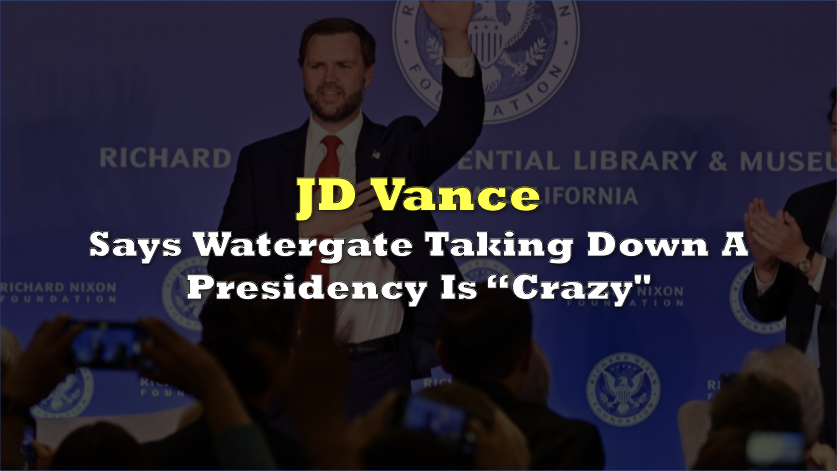

Speaking Thursday at the Richard Nixon Presidential Library in Yorba Linda, California, the Vice President JD Vance argued that Nixon’s reputation is “enjoying a bit of a renaissance” and said the Watergate scandal would be treated very differently now.
“If Watergate happened tomorrow, it would be like a 12-hour news story,” Vance said, reported by AP News. “The idea that it would have taken down a presidency is crazy.”
The statement compresses a two-year constitutional crisis into a claim about attention and also reframes one of the clearest modern examples of presidential accountability as a question of whether scandal can still survive long enough to matter.
 Sponsored · Altamira Gold Corp.
That makes Vance’s line more than a historical aside. It is a political test case.
Watergate is usually remembered through the outcome: Richard Nixon became the only US president to resign. In 1974, the House Judiciary Committee approved three articles of impeachment against Nixon. The charges involved obstruction of justice, abuse of power, and contempt of Congress. Nixon resigned on August 9, 1974, before the full House could vote, after court-ordered tapes damaged his remaining support.
In Vance’s telling, Watergate belongs less to the category of constitutional rupture and more to the category of political combat. He linked Nixon’s downfall to what he described as “deep state” pressure, then compared it to forces he said tried to weaken Donald Trump’s first administration.
The distinction matters because Watergate has long served as a shared reference point for executive limits. Vance is now testing whether that reference point still holds inside a Republican coalition shaped by Trump’s impeachments, criminal investigations, media distrust, and suspicion of permanent Washington.
But Watergate was not just a news story. It was a chain of legal, congressional, judicial, and political events. Its consequence came from accumulation, not attention alone.
That is the gap in Vance’s framing. He is not only saying the media cycle has changed. He is implying that the political system’s capacity to punish presidential misconduct has changed with it.
The venue sharpened the message. Vance made the remarks at the Richard Nixon Presidential Library in California during an event tied to his book “Communion.” He also praised Nixon’s broader legacy, including the former president’s foreign policy record, while suggesting that Nixon is receiving a deserved reassessment.
For Vance, Nixon offers more than a historical figure to defend. He offers a template for grievance politics: a leader remembered by critics for abuse of power, but by sympathetic conservatives as a strategic mind damaged by hostile institutions.