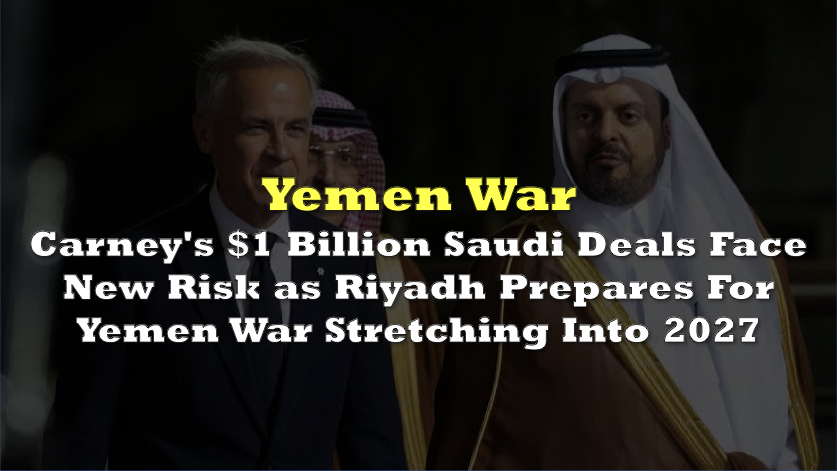

Canada’s effort to expand commercial ties with Saudi Arabia is encountering a longer regional conflict than Ottawa anticipated when Prime Minister Mark Carney announced more than $1 billion in bilateral agreements in July, with new reporting indicating Riyadh is preparing for military operations in Yemen to continue into 2027.
The potential overlap comes as Canada seeks to finalize an investment-protection agreement with the kingdom by early 2027, while Canadian pension funds have been courted as potential investors in Saudi infrastructure, energy, and technology.
According to Reuters, two Western officials briefed by Saudi authorities said the kingdom anticipates up to six additional months of fighting against Yemen’s Houthi movement. A third source familiar with the planning corroborated the account.
 Sponsored · Selkirk Copper Mines
Saudi officials reportedly want their Yemeni allies to secure additional territory before entering negotiations.
READ: Saudi-Backed Yemeni Forces Open Push to Seize All Houthi-Held Areas
During Carney’s July 9 visit to Jeddah, Canadian and Saudi entities signed 13 commercial agreements and memorandums of understanding valued collectively at more than $1 billion. The arrangements covered mining, infrastructure, health technology, and defence, with Canadian companies positioned to participate in projects supporting Saudi Arabia’s Vision 2030 economic diversification program.
Carney also announced plans for Finance Minister François-Philippe Champagne to lead a delegation of Canadian pension funds to explore investment opportunities.
 Sponsored · Cambria Gold Mines
The government described the commercial arrangements as part of its strategy to diversify trade beyond the US.
The bilateral investment-protection agreement, meanwhile, remained a negotiation target in the governments’ July announcement rather than a completed treaty.
The investment environment has deteriorated during the wider regional conflict. Allianz Research reported that portfolio equity flows into Saudi Arabia declined 48% between March and August 2026 compared with the corresponding period last year.
The insurer’s research also projected that Gulf foreign direct investment would fall below its pre-war trajectory, reflecting the conflict’s broader effects on economic activity and investor confidence.
Operational disruptions are already evident. Reuters reported that attacks have affected Riyadh’s airport and Aramco’s headquarters, while major international events have been postponed.
On Wednesday, Associated Press reported that Saudi air defences intercepted two Houthi cruise missiles targeting Riyadh.
The US has so far withheld direct offensive military assistance requested by Saudi Arabia, according to earlier Reuters reporting. One source told Reuters that American intervention could accelerate Saudi-backed forces’ territorial gains.
During their July meeting, Carney and Crown Prince Mohammed bin Salman jointly endorsed a political solution to Yemen’s conflict.
While the newly reported Saudi military timetable does not establish that Canada’s commercial agreements are in jeopardy, it does place Ottawa’s investment expansion alongside a documented decline in regional capital flows and an unresolved conflict extending toward the same 2027 deadline targeted for bilateral investment protections.