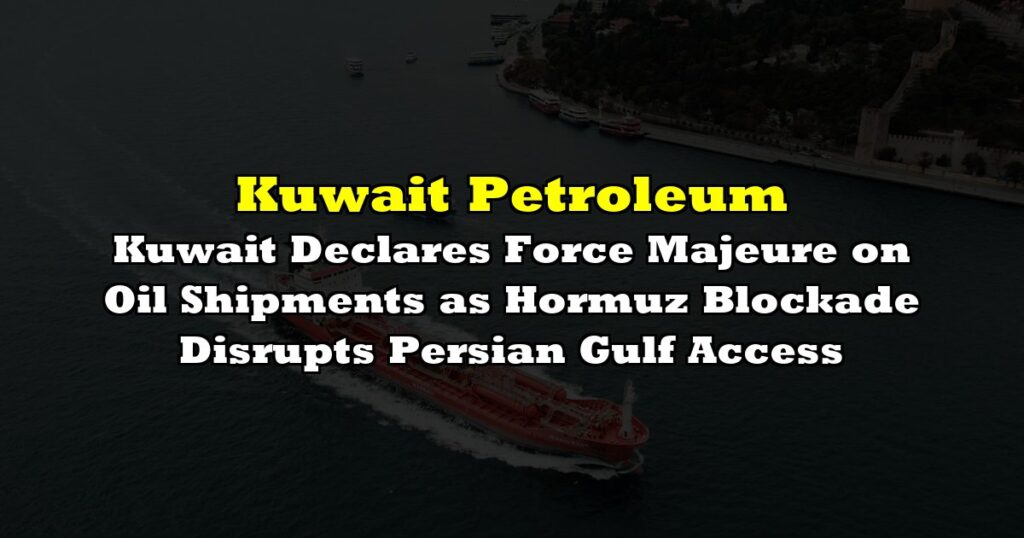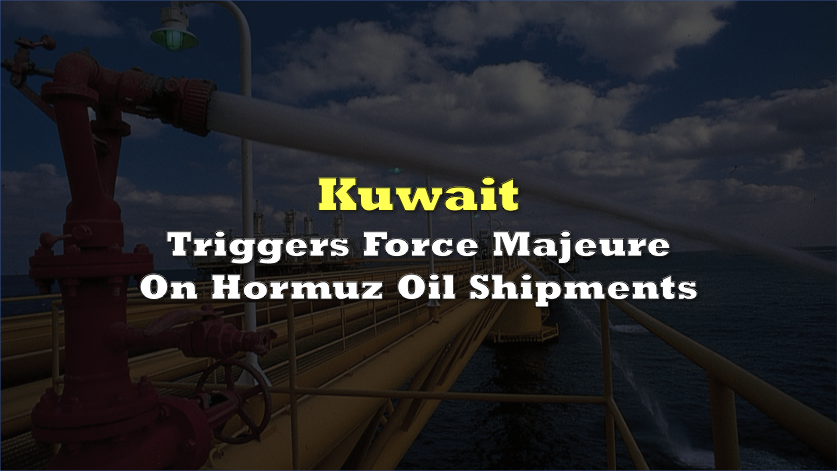

Kuwait has formally shifted the Strait of Hormuz disruption from market anxiety to contractual reality, declaring force majeure on crude oil and refined product shipments.
State-run Kuwait Petroleum Corp. notified customers on Friday, according to a document obtained by Bloomberg News, though the notice does not mean all supplies stop immediately.
A force majeure declaration gives a supplier legal cover to miss or delay deliveries when events outside its control block performance. In this case, Kuwait is signaling that tanker access, not just upstream production, has become the binding constraint. Bloomberg reported that some supply may still continue, but only where logistics remain workable.
 Sponsored · Selkirk Copper Mines
That notice lands into a market already dealing with a much broader physical bottleneck. Reuters reported that roughly 13 million barrels of oil remain trapped and about 260 tankers stuck in or around the Gulf would be first in line to move once traffic normalizes. Restoring pre-war energy flows will be far slower than any headline about a reopening suggests, because storage, vessel sequencing, field restart timing, and damaged infrastructure all stand between policy statements and actual cargo movement.
The Strait of Hormuz normally carries about one-fifth of the world’s oil and LNG supplies and serves as the only sea exit for fuels exported by Kuwait, Saudi Arabia, Iraq, Iran, and much of the UAE’s Gulf production.
For Kuwait, the shipping problem sits on top of an already constrained production backdrop. The Middle East state begun precautionary output and refining cuts in March as the regional conflict disrupted exports, with crude production in February running around 2.6 million barrels per day.
Brent crude rose 4.8% to $94.75 a barrel on Monday, while WTI gained 5.7% to $88.61, as fears grew that the U.S.-Iran ceasefire could unravel and Hormuz traffic remained disrupted. Reuters also reported that oil production remains down by 10 million to 11 million barrels per day, while physical markets continue to face high freight costs and sharply reduced vessel movements through the strait.
Information for this story was found via the sources and companies mentioned. The author has no securities or affiliations related to the organizations discussed. Not a recommendation to buy or sell. Always do additional research and consult a professional before purchasing a security. The author holds no licenses.