

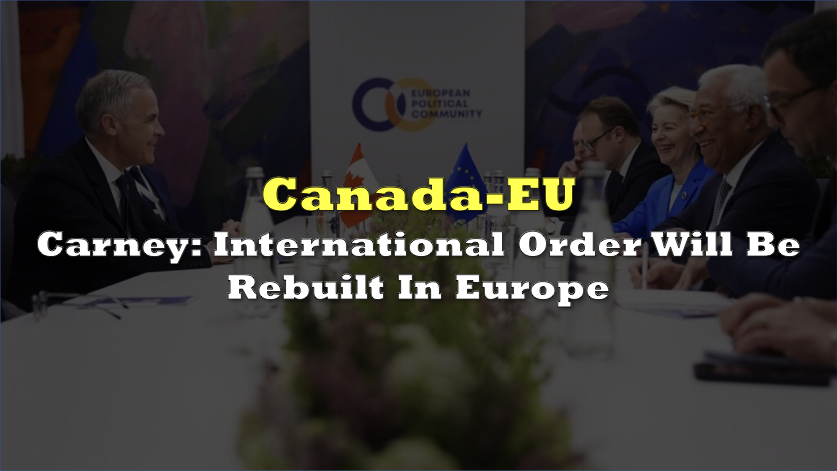

Prime Minister Mark Carney used Canada’s first appearance at the European Political Community Summit in Armenia to argue that the next international order will be rebuilt from Europe, tying the claim to a broader Canadian push into defence, critical minerals, energy, digital infrastructure, space, semiconductors, payment systems, vaccines, and clean technology.
“I’ll close with this: it’s my strong personal view that as the international order will be rebuilt. But it will be rebuilt out of Europe,” Carney said.
The remark triggered backlash online from critics who framed it as evidence that Ottawa intends to shift Canada away from the US and toward Europe in core economic sectors.
Carney was the first non-European leader to attend an EPC summit, even making remarks that “it is fitting that Canada is the first non-European country to join this forum as we are the most European of non-European countries.”
 Sponsored · PTX Metals Inc.
The EPC, launched in 2022, brings together EU and non-EU European states for strategic dialogue, with this summit focused heavily on security, energy, and supply chains.
Carney’s office said the visit was aimed at strengthening trade and security partnerships with European nations in a “more dangerous and divided world.” During the summit, Carney held bilateral meetings with leaders from Armenia, France, Italy, Poland, Spain, Ukraine, the European Council, the European Commission, and the European Parliament.
Carney’s speech positioned strategic autonomy as a modern industrial doctrine. He listed food, energy, and defence as traditional security pillars, but argued that sovereignty now also extends to space-based communications, semiconductors, digital sovereignty, critical minerals, independent payment systems, clean energy, and vaccines.
That framing aligns with the Canada-EU “Strategic Partnership of the Future,” announced in June 2025 by Carney, European Council President António Costa, and European Commission President Ursula von der Leyen.
The Prime Minister’s Office said Canada and the EU have moved “with speed and ambition” over the past year to deepen that partnership.
Carney said Canada had struck $18 billion worth of critical minerals deals across 20 of the world’s leading critical minerals over the past year. He framed those assets as being “warehoused” for government-to-government deals with close partners, first through the G7 and then more broadly with European allies.
Canada has also become the first non-European country to join the EU’s Security Action for Europe initiative. The Prime Minister’s Office said in April that Canada’s participation in SAFE would unlock “billions of dollars” in opportunities and market access for Canadian defence industries, businesses, and workers.
AP reported that SAFE is a €150 billion, or roughly $170 billion, EU-backed defence loan initiative, and that Canada joined as it sought to diversify military procurement away from the United States, which accounts for more than 70% of Canadian defence capital spending.
Carney also announced approximately $270 million in new Canadian support for Ukraine through the NATO Prioritised Ukraine Requirements List. Ottawa said the contribution would fund critical military capabilities while reinforcing collective security and transatlantic defence readiness.
Information for this briefing was found via the sources and the companies mentioned. The author has no securities or affiliations related to this organization. Not a recommendation to buy or sell. Always do additional research and consult a professional before purchasing a security. The author holds no licenses.


One Response
Carney is gas lighting piece of shit. Europe is a bigger mess than the US, they mostly socialist and their vision of world order is nothing I want to be a part. Too bad we have too many low information, low intelligence voters that vote for the wretchedly corrupt Liberal party