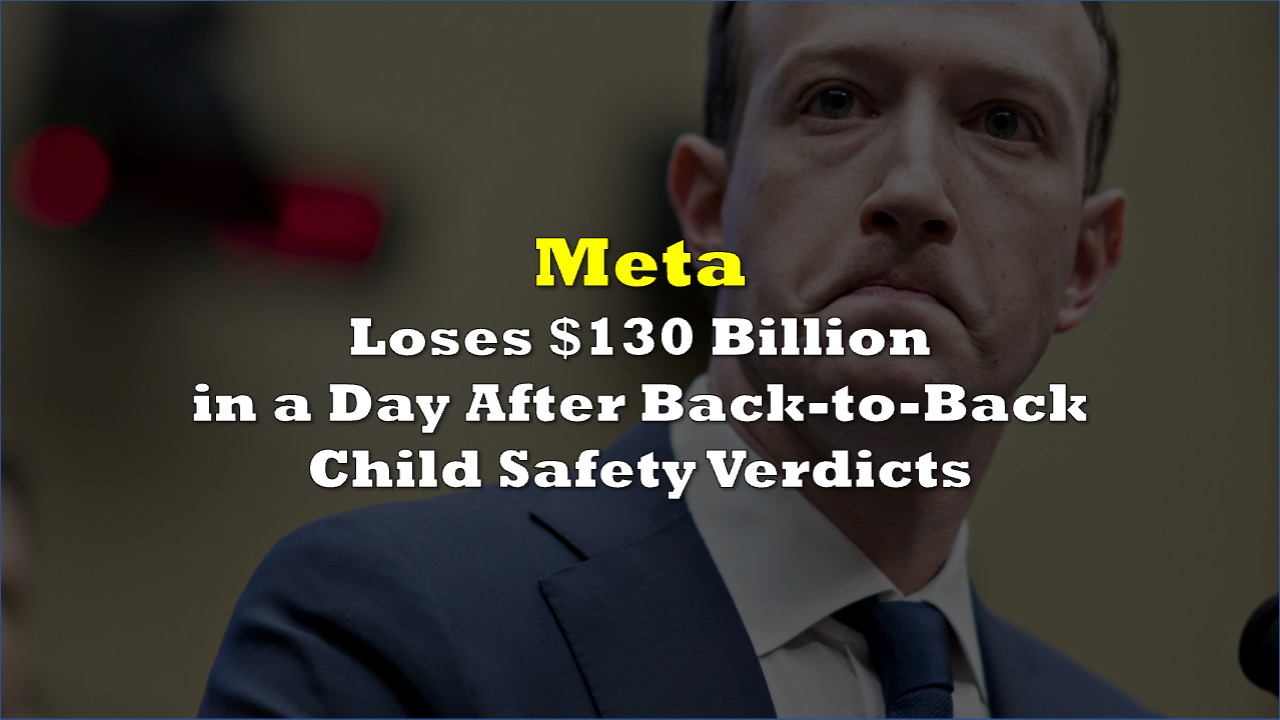

Meta Platforms (Nasdaq: META) lost approximately $130 billion in market capitalization on Thursday after back-to-back jury verdicts found the company legally responsible for harming young users — rulings that investors fear could expose the social media giant to hundreds of billions of dollars in future liability.
Meta’s stock closed down nearly 8% Thursday, its steepest single-day decline in over two years. The sell-off came after two separate juries this week handed down decisions that legal experts are calling a turning point for Big Tech’s long-standing immunity from product liability claims.
Meta just lost $130 billion in market cap. pic.twitter.com/GDnTYPEoRq
— Brew Markets (@brewmarkets) March 26, 2026
The first verdict came Tuesday in Santa Fe, New Mexico. A jury determined that Meta hid from users the extent of child sexual exploitation occurring on its platforms and deceived them about the safety of Facebook, Instagram, and WhatsApp, ordering the company to pay $375 million in civil penalties — short of the $2 billion the state’s attorney general had sought but the largest award of its kind against a major technology company on child safety grounds.
The second came on Wednesday in Los Angeles. A California jury that deliberated for more than nine days found Meta and Alphabet’s YouTube negligent in the design of their platforms, awarding $3 million in combined compensatory and punitive damages to a 20-year-old plaintiff who said Instagram and YouTube addiction worsened her mental health. Meta bore 70% of the liability. Both companies said they plan to appeal.
Read: California Jury Finds Meta, YouTube Liable for Social Media Addiction in Landmark Verdict
The damages in both cases are marginal for a company with a $1.5 trillion market cap and more than $60 billion in annual net income. What rattled investors was the legal theory that drove both verdicts.
Both juries ruled against Meta, not on the content posted by users — the territory Section 230 of the Communications Decency Act has protected for three decades — but on the deliberate design of the platforms themselves: features like infinite scroll and variable reward algorithms engineered to maximize engagement. That punches straight through Section 230’s shield and creates precedent for the thousands of similar cases now working through US courts.
“You add it all up and it could be hundreds of billions of dollars,” social psychologist Jonathan Haidt told CNN. “That, I think, would get Meta’s attention, and I think that would possibly cause them to change their behavior.”
Timothy Edgar, a lecturer at Harvard Law School, described the twin outcomes as “a major watershed event” that represents “a big shift in how Americans are viewing Big Tech.” Analysts at JPMorgan and Goldman Sachs began revising their 2026 price targets for Meta, citing what one note called “unquantifiable tail risk” from the pending caseload.
The verdicts compounded pressure that had already been building on Meta’s stock, which entered Thursday down 17% for the year. The company has guided for $115 billion to $135 billion in capital expenditure in 2026, focused on AI infrastructure, even as its models lag behind rivals such as Google, OpenAI, and Anthropic.
Reality Labs, Meta’s augmented and virtual reality division, has accumulated more than $80 billion in operating losses since 2021.
Meta CEO Mark Zuckerberg testified during the Los Angeles trial. The company argued that mental health challenges are complex and cannot be attributed to any single platform. A Meta spokesperson called the LA jury’s award “less than 0.5% of what the lawyers were requesting.” The next federal bellwether trial in the social media addiction litigation is scheduled for June 15, 2026.
US Senator Dick Durbin, the ranking member of the Senate Judiciary Committee, said the verdicts bolster his push to sunset Section 230.
These back-to-back decisions in New Mexico and California show that Big Tech has become Big Tobacco. Now, it’s time for Congress to sunset Section 230 once and for all. https://t.co/44sjxJcCBk
— Senator Dick Durbin (@SenatorDurbin) March 25, 2026
Information for this story was found via the sources and companies mentioned. The author has no securities or affiliations related to the organizations discussed. Not a recommendation to buy or sell. Always do additional research and consult a professional before purchasing a security. The author holds no licenses.